Lactase is a digestive enzyme that breaks down lactose (milk sugar) into glucose and galactose, helping to manage lactose intolerance symptoms like bloating, gas, and diarrhea. While the body naturally produces it in the small intestine, supplements containing lactase (sometimes called acid lactase) are used to aid digestion.
Everything You Need to Know
Can lactose intolerance cause sibo?
Conclusion: Lactose intolerance is a common condition in patients with IBS in northwest Italy (59%), very frequently associated with SIBO (72%). This association turned out to be a major cause of symptom persistence in patients on lactose-free diet until successful eradication of SIBO was achieved.
What cheese is good for lactose intolerance?
There are several types of cheeses that those with lactose intolerance are able to enjoy in moderation. Natural cheeses such as Cheddar, Colby, Monterey Jack, Mozzarella and Swiss contain minimal amounts of lactose. Shred them onto veggies, pastas and salads. In 1.5 oz.
What are the top 10 worst foods for lactose intolerance?
Common Foods to Avoid if Lactose Intolerant
Milk and milk-based beverages.
Cheese, particularly soft varieties like cottage cheese and ricotta.
Ice cream and frozen yogurt.
Butter and margarine.
Cream cheese and sour cream.
Certain baked goods which utilize milk or butter.
Creamy sauces and dressings.
What does a lactose intolerant poop feel like?
People with lactose intolerance often have diarrhea, gas and bloating after eating or drinking foods containing lactose. The condition is usually harmless, but its symptoms can cause discomfort. Too little of an enzyme made in the small intestine, called lactase, is usually responsible for lactose intolerance.
Main Details:
Function: Lactase breaks down lactose, a disaccharide sugar found in milk, allowing it to be absorbed.
Deficiency: People with low levels of this enzyme suffer from lactose intolerance, leading to malabsorption.
"Acid" Lactase vs. Neutral:
Neutral Lactase: Used in the food industry to make lactose-free milk.
Acid Lactase: Primarily used in supplements because it can withstand the acidic environment of the stomach to help digest dairy products.
Sources: Acid lactase is derived from fungi such as Aspergillus oryzae and Aspergillus niger.
Supplements: Common brands include Lactaid, Lac-Dose, and Lactrase, taken as capsules or tablets to alleviate symptoms.


Applications
As a Pre-Digester - Used in dairy products to aid individuals with milk intolerance.
Cheese and Yogurt Production - Improves fermentation and consistency by pre-hydrolyzing lactose in milk.
Sweetener and Syrup Production - Applied in processing whey and lactose for producing sweeteners and hydrolyzed whey syrup.
ANALYTICAL RESULTS
| Test Item | Method / Ref. | Specification | Result | Conclusion |
|---|---|---|---|---|
| Identification | In-house ID / label claim | Acid Lactase (β-galactosidase) | Conforms | Pass |
| Appearance | Visual | Off-white to light yellow powder | Conforms | Pass |
| Enzyme Activity | In-house or AOAC assay | NLT 5,000 ACU/g | 5,350 ACU/g | Pass |
| pH (1% solution) | pH meter | 3.0 – 5.5 | 4.3 | Pass |
| Moisture | Gravimetric / USP 731 | ≤ 5.0% | 3.6% | Pass |
| Ash | Gravimetric / USP 281 | ≤ 5.0% | 4.1% | Pass |
| Protein Content | Kjeldahl Method | ≥ 50% | 52.3% | Pass |
| Total Plate Count | Plate Count | ≤ 10,000 CFU/g | 1,800 CFU/g | Pass |
| Yeast & Mold | Plate Count | ≤ 100 CFU/g | <10 CFU/g | Pass |
| Coliforms | Plate Count | ≤ 30 CFU/g | <10 CFU/g | Pass |
| E. coli | Absence Test | Negative / 25g | Not Detected | Pass |
| Salmonella | Absence Test | Negative / 25g | Not Detected | Pass |
| Lead (Pb) | ICP-MS / ICP-OES | ≤ 5 mg/kg | 0.22 mg/kg | Pass |
| Arsenic (As) | ICP-MS / ICP-OES | ≤ 3 mg/kg | 0.12 mg/kg | Pass |
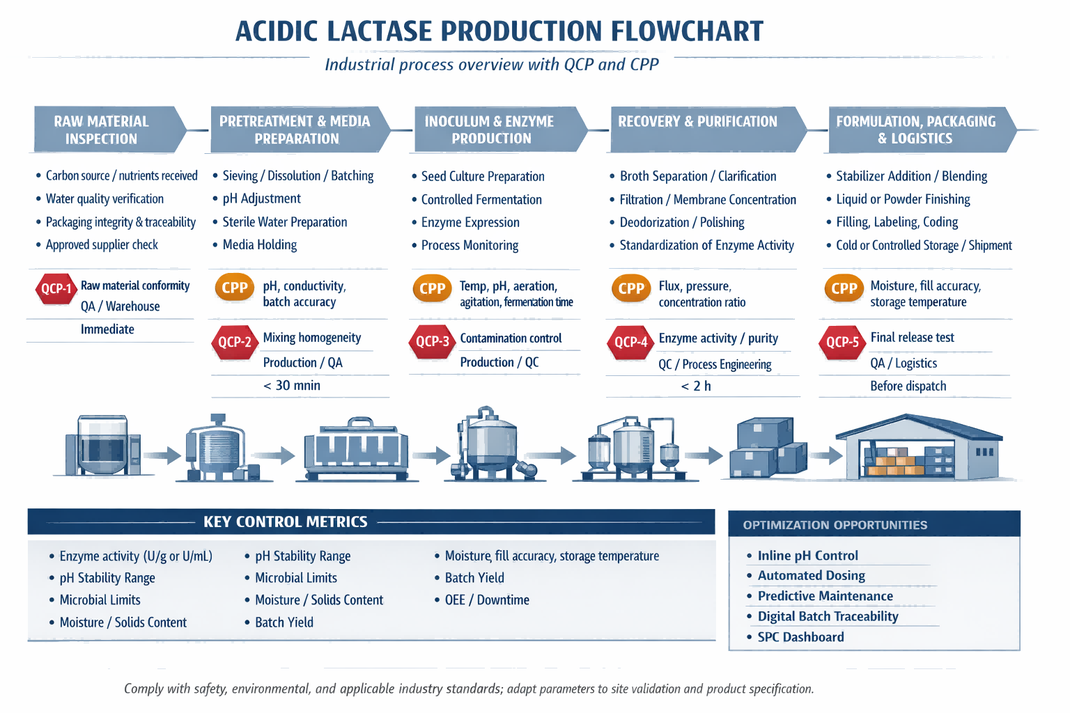
Production Process