


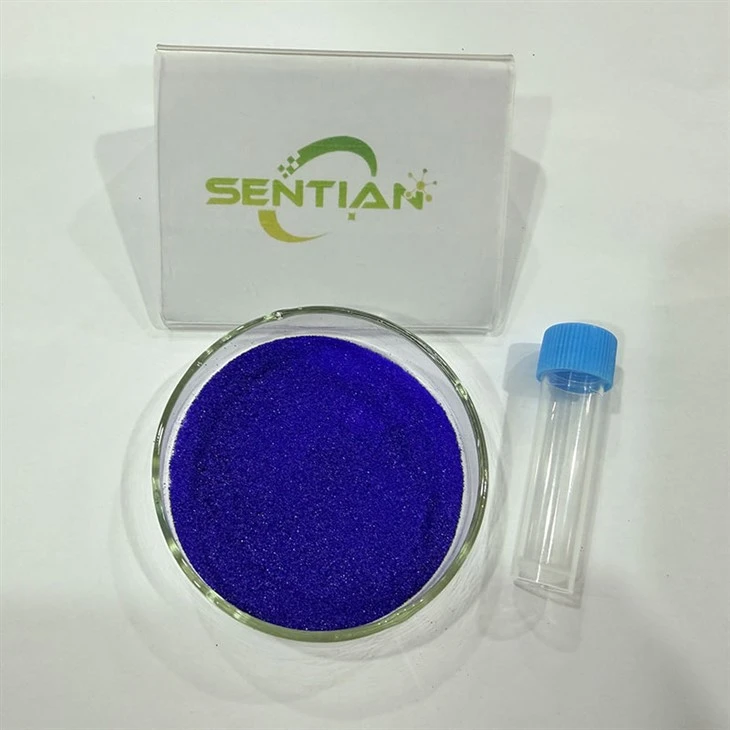
What is GHK-Cu Powder?
GHK-Cu Powder is a copper peptide complex, consisting of the naturally-occurring tripeptide glycyl-L-histidyl-L-lysine (GHK) and copper ions, which is known to be a high-value cosmetic raw material in premium personal care and cosmetic formulations. It is available as a fine powder, typically blue to blue-violet in colour, and is used widely in the cosmetic ingredients industry because of its high purity, good water solubility, and compatibility with modern formulation systems. It is standard to be used in cosmetic manufacturing in products such as cosmetics, skin care products, private label cosmetics, cosmetic formulation laboratories, as well as raw material distributors for formulations like facial care products, serums, lotions, eye care products, and scalp care products. In the realm of cosmetic formulations, it has emerged as a pivotal ingredient, especially in the production of high-quality beauty products and the development of innovative formulas. The professional manufacturers produce it under a strict quality control environment to ensure that the peptide content, appearance, moisture, and microbial compliance are consistent. We usually supply technical docs like COA, MSDS, and TDS, and certifications like GMP, ISO, for international sourcing and export. As the world looks for high-quality cosmetic ingredients and peptide science technologies that are backed by research, it remains a hot item among the international personal care and skin care manufacturing industry.

COA
.
| Item | Specification | Result | Method |
| Appearance | Blue fine powder | Blue fine powder | Visual |
| Purity (GHK-Cu) | ≥98.0% / ≥99.0% | 99.20% | HPLC |
| Identification | Positive | Positive | HPLC/UV |
| Molecular Weight | 742.29 Da | 742.29 Da | Theoretical |
| Solubility | Soluble in water | Fully soluble | Test |
| Moisture | ≤5.0% | 2.30% | Karl Fischer |
| Heavy Metals (as Pb) | ≤10 ppm | 4.8 ppm | ICP-MS |
| Arsenic (As) | ≤2 ppm | 0.6 ppm | ICP-MS |
| Lead (Pb) | ≤3 ppm | 1.2 ppm | ICP-MS |
| Mercury (Hg) | ≤1 ppm | 0.2 ppm | ICP-MS |
| Microbial Count | ≤1000 CFU/g | 120 CFU/g | Microbial Test |
| Yeast & Mold | ≤100 CFU/g | 18 CFU/g | Microbial Test |
| E. Coli | Negative | Negative | Microbial Test |
| Salmonella | Negative | Negative | Microbial Test |
| pH (1% solution) | 5.0 – 7.0 | 620.00% | pH Meter |
Sentian Bio provides free samples, OEM/ODM customized products, and professional technical support. Contact us anytime at sales3@sentianbio.com or LEAVE A MESSAGE!
Market Trends
The global Copper Peptide Powder market is witnessing steady growth, as people are increasingly seeking to use high-quality cosmetic peptides, clean-label cosmetics, and scientifically tested skin care ingredients. The use of naturally inspired ingredient concepts, combined with advanced biotechnology, is gaining traction among consumers and is driving cosmetic brands and manufacturers to grow their portfolio of peptide-based raw materials in high-end skin care and personal care items. The beauty industry has demonstrated a definite trend towards minimal ingredients, transparency in ingredient sourcing, and multi-functional cosmetic ingredients in the last few years, further propelling the growth. Meanwhile, global consumers have been focused on product quality, traceability of ingredients, sustainability, and the sophistication of product formulation, and are increasingly looking for assurance from trusted suppliers regarding the stability of production and quality management systems. Additionally, the escalating demand for it in commercial applications has been driven by the mass popularity of the premium skincare products, scalp care products, and professional cosmetic formulations in North America, Europe, Southeast Asia, and the Middle East. Furthermore, the innovative technologies in cosmetic biotechnology, peptide synthesis, and formulation are enabling more sophisticated and user-friendly peptide products for contemporary beauty companies to be created.
Features
Its unique blue to blue-violet color, along with its water solubility and versatility across a variety of cosmetic formulation systems, makes it an extremely versatile peptide ingredient for today's cosmetic and personal care formulas. It is formulated as a copper peptide complex of glycyl-L-histidyl-L-lysine and copper ions, which has good formulation stability under pH and temperature conditions that are well controlled, which is essential for ensuring consistency during production and storage of cosmetic products. It is normally delivered in a fine hygroscopic powder in high-purity specifications, providing formulators with a range of benefits and advantages, including dosing precision and uniform dispersion in water-based serums, emulsions, gels, lotions, masks, and scalp care products. The peptide structure also ensures compatibility with other commonly used cosmetic ingredients such as hyaluronic acid, amino acids, botanical extracts, peptides, moisturizers, and fermentation-derived actives for formulation flexibility in the development of multifunctional products. Formulators tend to prefer GHK Copper Peptide Powder for its low usage levels, minimal residue in final formulations, and its ability to fit high-end cosmetic systems that focus on advanced ingredient technology. Optimum stability is usually achieved by storing at cool, dry, and light-protected conditions; and avoiding excessive heat, strong oxidizing agents, and highly alkaline conditions during processing, etc.

Benefits
1. High formulation versatility
Formulators can use Copper Tripeptide-1 Powder in a variety of cosmetic systems such as aqueous solutions, emulsions, gels, and hybrid peptide complexes, allowing for versatility in product development across a number of categories.
2. Strong compatibility with modern active systems
It can be used in combination with standard cosmetic ingredients, including hyaluronic acid, botanical extracts, amino acids, and other peptides, with very few compatibility restrictions.
3. Premium ingredient positioning for brands
As it is a peptide, it can be used in skincare products, and with scientific sourcing, cosmetic companies can feature their finished products in the high-end and technology-driven skin care market, aiding product differentiation.
4. Low dosage efficiency in formulations
It is generally active at fairly low inclusion levels, giving formulators a cost-efficient solution, whilst retaining formulation elegance and texture stability.
5. Good sensory neutrality in finished products
If used correctly, it has the ability to provide a pleasing texture and appearance without impacting color, fragrance, or sensory qualities, and can be used in minimalist and clean-label cosmetic product concepts.
6. Support for product innovation and portfolio expansion
It can be used in a variety of ways, enabling manufacturers to create multiple product lines, including serums, masks, hair and scalp care products, and specialty cosmetics, which increases product line diversity.
7. Reliable supply chain adaptability
It is offered in bulk sizes, comes with customised specifications, and is suitable for large-scale production planning, OEM/ODM projects, and long-term procurement strategies for global cosmetic companies.
Factory

Certificate

Exhibition
