


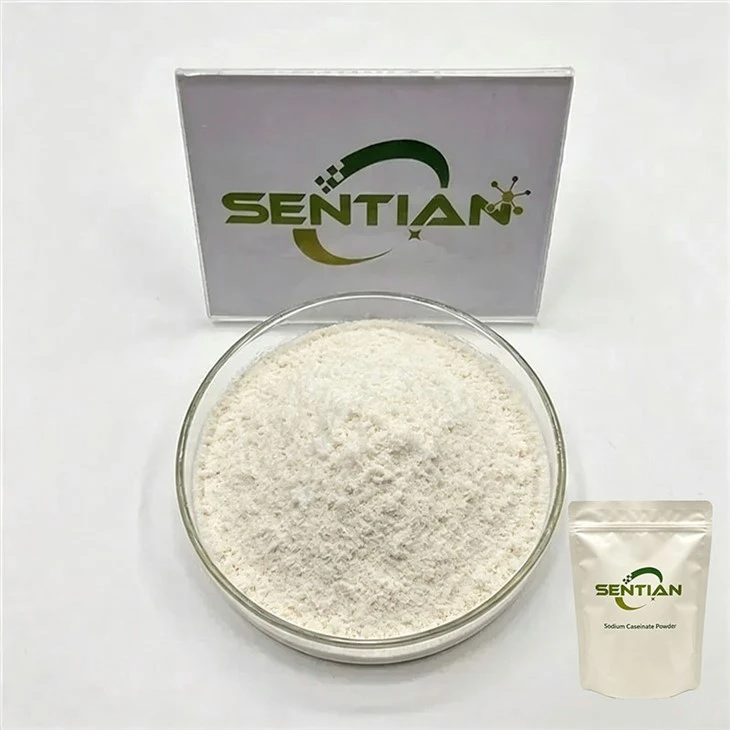
Xi'an Sentian Biotechnology Co., Ltd. is one of the leading manufacturers and suppliers of sodium caseinate powder in China. We are committed to providing high quality customized service and OEM&ODM private label service for global clients. Please feel free to buy bulk sodium caseinate powder in stock here from our factory. Also, free sample is available.
What is Sodium Caseinate Powder?
Sodium Caseinate Powder is a water-soluble functional milk protein extracted by a gentle neutralisation and spray-drying process. It is a high-quality product used in a variety of applications in global food, beverage, and industrial manufacturing as an emulsifier and stabiliser and as a nutritional ingredient. Manufactured to high commercial standards, the fine offwhite/pale yellow powder is highly soluble, heat-stable, and water-binding and is a core processing ingredient in complicated formulations. It is an essential ingredient in the modern food industry for optimizing product texture and structural integrity in a wide range of food products such as processed meats, dairy analogs, sports nutrition powder, bakery applications, and creamer powder. The ability of sodium caseinate to form stable interfacial films around the oil droplets is very effective in preventing phase separation and fat syneresis and regulates shelf life and mouthfeel of systems containing oil droplets. In addition to its functional processing properties, it provides an outstanding nutritional profile, with its nutrient composition providing a rich source of essential amino acids and high-quality dietary protein, making it available to formulation specialists to enrich the nutritional value of a range of food products, both conventional and specialized. Its even bulk density, flowability, and dispersibility ensure that it is compatible with large-scale, automated processing lines, without blocking or non-uniform blending problems.

COA
| Item | Specification | Result | Test Method |
| Appearance | White to cream-colored, free-flowing powder | Complies | Visual |
| Odor & Taste | Bland, characteristic of milk protein; free from foreign odor | Complies | Sensory |
| Dispersibility | Dispersible in water | Complies | In-house Method |
| Milk Protein (N × 6.38), Dry Basis | ≥ 90.0% | 92.40% | AOAC 991.20 |
| Moisture | ≤ 6.0% | 4.82% | AOAC 925.45 |
| Milk Fat | ≤ 2.0% | 1.21% | AOAC 989.05 |
| Lactose | ≤ 1.0% | 0.32% | AOAC 984.15 |
| Total Ash | ≤ 5.0% | 3.72% | AOAC 942.05 |
| pH (5% Solution) | 6.2–7.5 | 6.76 | USDA / In-house Method |
| Scorched Particles | ≤ Disc B | Disc A | ISO 5739 |
| Insolubility | ≤ 1.0 mL | 0.32 mL | In-house Method |
| Sodium (Na) | ≤ 1.5% | 1.18% | ICP-OES |
| Total Plate Count | ≤ 10,000 CFU/g | 1,800 CFU/g | AOAC |
| Yeast & Mold | ≤ 100 CFU/g | <10 CFU/g | AOAC |
| Coliforms | ≤ 10 CFU/g | <10 CFU/g | AOAC |
| Escherichia coli | Absent | Absent | AOAC |
| Staphylococcus aureus | Absent | Absent | AOAC |
| Salmonella | Absent in 25 g | Absent | AOAC |
| Antibiotics / Inhibitors | Negative | Negative | In-house Method |
| Lead (Pb) | ≤ 2.0 mg/kg | <0.10 mg/kg | ICP-MS |
| Arsenic (As) | ≤ 1.0 mg/kg | <0.05 mg/kg | ICP-MS |
| Cadmium (Cd) | ≤ 1.0 mg/kg | <0.02 mg/kg | ICP-MS |
| Mercury (Hg) | ≤ 0.1 mg/kg | <0.01 mg/kg | ICP-MS |
| Total Heavy Metals | ≤ 10 mg/kg | <1.0 mg/kg | ICP-MS |
Sentian Bio provides free samples, OEM/ODM customized products, and professional technical support. Contact us anytime at sales3@sentianbio.com or LEAVE A MESSAGE!
Market Trends
The processed food industry's macro-level growth, the growing demand for convenience foods containing nutritious and functional dairy ingredients, and the shift towards clean-label foods are driving steady growth. With the growing consumer demand for high-quality, natural ingredients, Sodium Caseinate is a protein that is easily recognised and derived from milk, which makes a difference in terms of structure and clean label. The need for strong functional ingredients that can provide product stability over long "food chains" has grown because of macro-economic changes, including the rapid urbanisation in emerging economies and the global trend towards "ready to drink" (RTD) beverages and convenient packaged foods. At the same time, consumers' growing awareness of the benefits of natural, nutrient-rich ingredients has encouraged formulation experts to switch from synthetic emulsifiers and stabilizers to proteins from milk. It is a sought-after ingredient in sports nutrition, functional food, and clinical nutrition applications, where industrial buyers are increasingly looking to it to achieve their formulation aims for clean labels and high protein content without degrading organoleptic quality or processing efficiency. Thus, ingredient suppliers and commercial manufacturers are developing their production capacities and physical properties to easily integrate into this modern and automated world of food processing.
Features
The unique physicochemical properties allow it to be an ideal material for commercial food and industrial formulations requiring outstanding structural properties. Its excellent surface-active and emulsifying properties are due to its amphiphilic molecular structure, which has clearly defined hydrophobic and hydrophilic regions; it has a high degree of purity, is off-white in colour, and has a neutral taste profile. When dissolved, it is highly soluble over a wide temperature range and provides smooth and homogeneous solutions with no gritty residue. It has excellent thermal stability that ensures that formulations retain their structure and do not cause protein denaturation during the most demanding of processing conditions, including UHT, pasteurisation and retort sterilisation. From a biochemical point of view, sodium caseinate has outstanding water-binding and fat-encapsulating properties and is able to limit the migration of water and the occurrence of oil syneresis in high-fat or multiphase emulsions. Its unique rheological control also offers the advantage to formulators, with the ability to impart desirable viscosity to the product, enhance the overrun of whipped systems, and provide foam architecture stability without compromising the desirable natural flavor profile. Moreover, Sodium Caseinate Powder has a uniform bulk density, low hygroscopicity, and excellent powder flowability, which are advantageous for dry blending, dusting to a minimum, and automated dosing in high-throughput manufacturing processes.

Benefits
1. Superior Emulsification and Interface Stability:
Sodium Caseinate is a very good surface-active agent, decreases interfacial tension, makes oil-in-water emulsions stable, and prevents the separation of phases during shelf life.
2. Excellent Thermal Processing Tolerance:
Maintains its structure and functions even under extreme temperature stress, such as pasteurization, UHT, and retort processes, without thermal coagulation.
3. Enhanced Water-Binding Capacity:
Effectively retains free water inside food matrices, reduces syneresis, maintains internal moisture balance, and enhances freshness of the products in refrigerated and frozen products.
4. Optimized Texture and Rheology Control:
It imparts desirable body and smooth mouthfeel to liquid and semi-solid formulations, as well as superior overrun and stability in whipped formulations, and gives controlled viscosity.
5. High Protein Density and Nutritional Value:
Provides the full range of essential amino acids, with high digestibility, so that manufacturers can increase protein levels in food matrices and beverages without having to sacrifice taste.
6. Superior Powder Flow and Blending Properties:
Has low hygroscopicity, small particle size, and a large bulk density, which facilitates efficient dry blending, limited dusting, and easy automatic processing.
7. Clean-Label and Neutral Sensory Profile:
Provides a soft, neutral taste and colour that can be easily added to light formulations without overpowering or masking other notes, as well as requiring too many masking ingredients.
FAQ
What is the primary function of Sodium Caseinate Powder in food manufacturing?
Sodium caseinate is a multi-purpose processing aid which is predominantly used in the processing of creamer powders, processed meats, emulsions and dairy analogs as a high-performance emulsifier, stabilizer and texture improver.
How does Sodium Caseinate perform under thermal processing like UHT or pasteurization?
It is extremely heat-stable and thermally resistant, and with high-temperature treatment, it withstands any co-coagulation or precipitation in the structure and still maintains the emulsifying property.
Is Sodium Caseinate compatible with dry-blending and automated dosing systems?
Yes. Uniform bulk density, good powder flowability and low hygroscopicity, low dusting, smooth conveying and uniform blending in high-speed production lines.
What is the solubility profile of Sodium Caseinate Powder?
It is completely soluble over an extended temperature range, and disperses quickly to produce smooth, homogeneous solutions, free of gritty deposits or phase separation.
Can Sodium Caseinate be used to boost the protein content of clean-label formulations?
Yes. It is a complete amino acid profile, highly purified, neutral-tasting ingredient derived from milk, providing a completely clean, neutral taste profile with the ability to formulate to higher protein content without affecting the objective flavour and sensory profile.
Production Process

Certificate

Exhibition
