


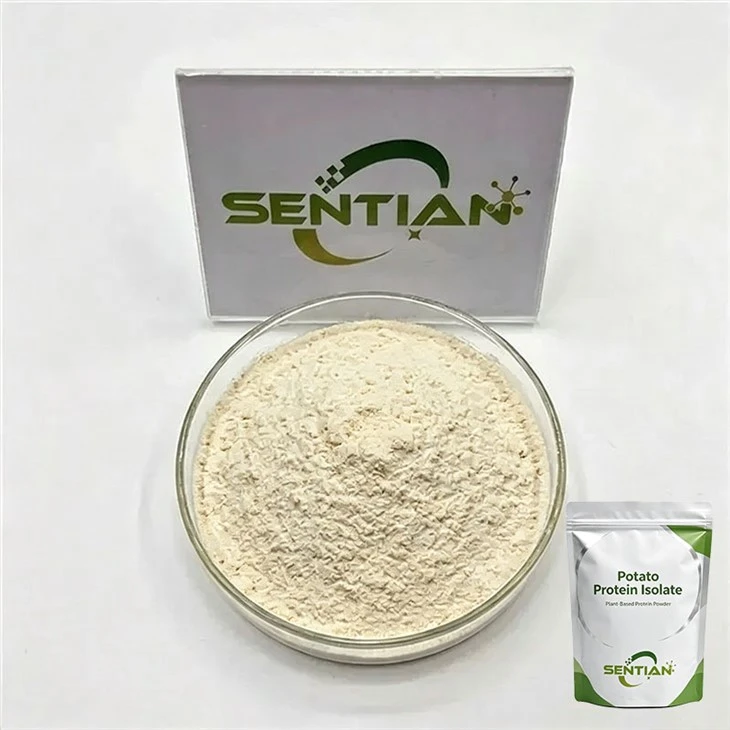
What is Potato Protein Isolate Powder?
Potato Protein Isolate Powder is a high-level and ultra-purified botanical product prepared by specific fractionation processes and tailored to the needs of enterprise-level procurement and industrial, large-scale manufacturing. This special protein powder is a highly concentrated source of protein, offering unparalleled purity levels of protein – a great starting point for global food, beverage and nutrition product developers looking for raw materials with a high performance. The highly refined protein isolate is also separated from unwanted starch and other non-protein components by very sophisticated separation technology, which are essentially absent from the product, leaving a pure and neutral flavor for complex commercial protein formulations that require very low levels of these extraneous ingredients. Its high techno-functional properties such as excellent heat stability, fast hydration rate, and excellent film-forming properties are appreciated by industrial R&D teams, enabling them to fine-tune viscosity, moisture control, and structure in various processing conditions. Additionally, its natural allergen-free composition, free from the most common allergens in agriculture (soy, dairy, and wheat gluten), allows enterprise clients to easily create high-quality, clean-label products to meet the dietary requirements of consumers across the globe.

COA
| Items | Specification | Result | Test Method |
| Appearance | Light Cream to Pale Yellow Fine Powder | Complies | Visual |
| Odor | Characteristic, Mild | Complies | Organoleptic |
| Taste | Neutral Characteristic Taste | Complies | Organoleptic |
| Protein (Dry Basis) | ≥80.0% | 81.62% | Kjeldahl Method |
| Moisture | ≤7.0% | 4.81% | AOAC |
| Ash | ≤5.0% | 2.74% | AOAC |
| Fat | ≤1.5% | 0.83% | AOAC |
| pH (10% Solution) | 5.5–7.5 | 6.38 | pH Meter |
| Water Solubility | ≥90% | 94.50% | Internal Method |
| Bulk Density | 0.35–0.60 g/mL | 0.47 g/mL | USP |
| Particle Size | 95% Pass 80 Mesh | 98.3% Pass | Sieve Analysis |
| Microbiological Analysis | |||
| Total Plate Count | ≤5,000 CFU/g | 680 CFU/g | ISO 4833 |
| Yeast | ≤100 CFU/g | <10 CFU/g | ISO 21527 |
| Mold | ≤100 CFU/g | <10 CFU/g | ISO 21527 |
| Enterobacteriaceae | ≤10 CFU/g | <10 CFU/g | ISO 21528 |
| Escherichia coli | Negative/10 g | Negative | ISO 16649 |
| Salmonella | Negative/25 g | Negative | ISO 6579 |
| Staphylococcus aureus | Negative/25 g | Negative | ISO 6888 |
| Heavy Metal Analysis | |||
| Lead (Pb) | ≤0.50 mg/kg | 0.11 mg/kg | ICP-MS |
| Arsenic (As) | ≤0.50 mg/kg | 0.08 mg/kg | ICP-MS |
| Cadmium (Cd) | ≤0.30 mg/kg | 0.04 mg/kg | ICP-MS |
| Mercury (Hg) | ≤0.10 mg/kg | 0.01 mg/kg | ICP-MS |
| Additional Quality Parameters | |||
| Gluten | Not Detected | Not Detected | ELISA |
| GMO Status | Non-GMO | Non-GMO | PCR Method |
| Allergens | Free from Major Declared Allergens | Complies | Internal Standard |
Sentian Bio provides free samples, OEM/ODM customized products, and professional technical support. Contact us anytime at sales3@sentianbio.com or LEAVE A MESSAGE!
Features
The advanced physicochemical properties of Potato Protein Powder confer a unique set of formulation tools for scientists with a high degree of control over complex industrial matrices. Its molecular structure consists of a large number of globular proteins with well-balanced hydrophilic and hydrophobic domains, responsible for its unique surface-active properties and very fast rate of adsorption to interfaces. This molecular structure provides the isolate with exceptional foaming properties and foam stability, allowing for fine and even aeration in whipped culinary bases and specialty baked products without structure collapse, allowing formulators to achieve their desired aeration. Moreover, the product has a unique property of thermal gelation threshold in the moderate range of processing temperatures so that it can provide a firm gel network in high-moisture meat analogs and processed food systems with moisture holding, thereby improving the structural reinforcement of processed food systems. This high-purity isolate is used in solutions with desirable pseudoplastic flow behavior that remain low in viscosity in the high shear mixing and pumping steps in the process and regain structure immediately after processing. Its wide pH range and buffering capacity also help formulators to keep beverages and sauces at a stable pH in various scenarios. Technical teams can confidently overcome the challenges of formulation of traditional plant proteins, thanks to these measurable, physicochemical characteristics, with optimized texture and moisture binding, and batch-to-batch consistency in large-scale commercial manufacturing.
How to Store Properly?
1. Climate-Controlled Ambient Environment:
The sealed packaging should be stored in a cool, dry warehouse, with relative humidity below 65% and temperature below 25℃, to avoid moisture leakage between the Bulk Potato Protein Powder and the caking phenomenon.
2. Palletized Elevation and Air Circulation:
Place all bulk drums or multi-wall bags on standard industrial pallets instead of placing them on concrete floors, with appropriate lateral spacing between pallet racks for even air circulation and no thermal condensation.
3. Light and Odor Protection:
Packaging needs to be protected from direct prolonged UV exposure and from volatile chemical agents, strong solvents, or strong raw material odors; the neutral sensory profile of the refined protein can easily absorb the odors.
4. Strict Seal Management and Resealing Protocols:
After opening any industrial container or inner polyethylene liner for use in production batching, make sure that it is sealed as soon as possible upon extraction from the container by using proper tie-off or clamping to prevent ambient air exposure and hygroscopic moisture absorption.
5. FIFO Inventory Rotation System:
Adopt a First-In, First-Out (FIFO) stock management system to achieve maximum use efficiency and systematically assign production lot numbers, thereby ensuring production consistency, functional performance, and stability throughout the production process.

Recommended Usage
1. Hard Gelatin and Veggie Capsules:
The Potato Protein Isolate's uniform particle size distribution and low bulk density can be used to precisely dose the particles by volume and minimize bridging during high-speed automated encapsulation runs with free-flowing excipients.
2. Direct Compression and Wet Granulation Tablets:
Technical teams need to use suitable binding agents and lubricants to control the native elasticity of the protein to ensure that the tablets are sufficiently hard at the high pressures the punches will apply, while avoiding the chance of lamination, capping, and fracturing the structure of the tablet during the compression process.
3. Ready-to-Drink (RTD) Beverages and Functional Liquids:
Technical operators should pre-hydrate the isolate using controlled high shear agitation in moderately warmed water, then subject it to precise thermal processing and pH buffering to avoid sedimentation, prevent high viscosity, and ensure complete solubility during the entire pasteurization and bottling processes with aqueous delivery systems.
4. Viscous Syrups and Concentrated Drops:
For high solids liquid matrices, it is recommended that the protein powder be introduced in stages to a slowly increasing level of solids content, with the protein being added continuously to a stirred liquid matrix to ensure complete hydration and to produce a stable and uniform dispersion without changing the final product's attributes and characteristics of mouthfeel and stability.
5. Dry-Blend Nutritional Powders and Instantized Mixes:
For multi-ingredient dry powder sachets or combinations of powders in canisters, production teams should adhere to tiered particle-sizing protocols and the use of anti-caking agents to ensure uniform dispersion when reconstituted in the user's liquid product to avoid clumping and provide a smooth sensory experience.
Production Process

Certificate

Exhibition
