


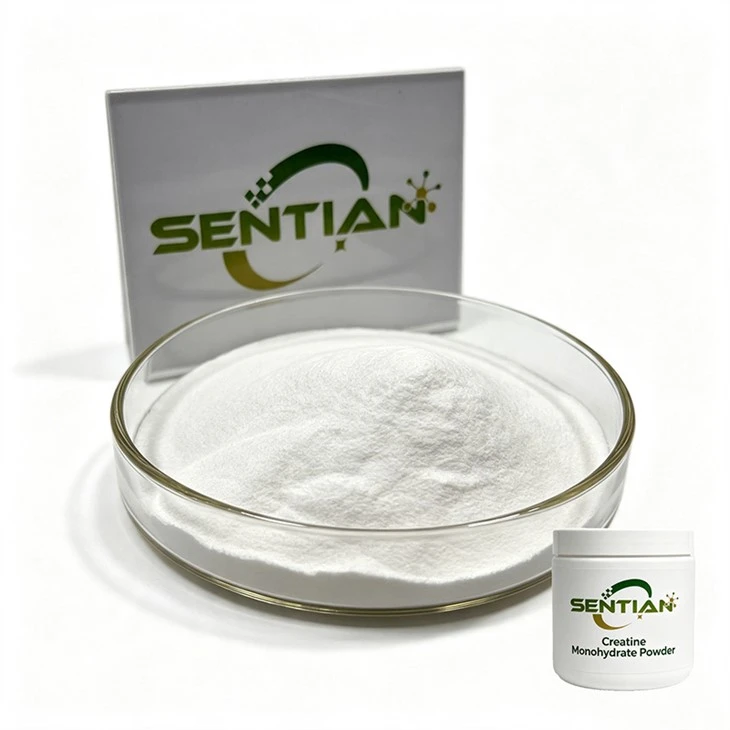
Xi'an Sentian Biotechnology Co., Ltd. is one of the leading manufacturers and suppliers of bulk creatine monohydrate powder in China. We are committed to providing high quality customized service and OEM&ODM private label service for global clients. Please feel free to buy bulk bulk creatine monohydrate powder in stock here from our factory. Also, free sample is available.
What is Bulk Creatine Monohydrate Powder?
Bulk Creatine Monohydrate Powder is a leading, scientifically proven functional ingredient, specially designed for high-performance sports nutrition products, functional beverages, and daily performance dietary supplements. It has a high-purity crystalline structure and is a versatile active compound that is ideally formulated to support pathways of cellular energy production and improve metrics of exercise and high-intensity exercise performance in short-duration, repetitive exercise bouts. Its outstanding chemical stability and neutral flavor are ideal for its use in pre-workout powders, post-workout recovery matrices, and physical stamina capsules, making it a favorite among formulators and product developers. Regarding manufacturability and formulation, the ingredient is excellent as a blending component and results in complete mixing with even distribution in the complex matrix of dry-blend formulations, without the formation of cakes and separation into phases. High-assay purity standards, excellent moisture control, and comprehensive testing for heavy metals and other impurities are critical analytical parameters for quality assurance labs and procurement teams to guarantee optimal functionality, safety, and regulatory compliance around the world. As a reliable ergogenic ingredient, brand owners and contract manufacturers can use it to build commercial formulations that provide high efficacy to meet the performance expectations of today's fitness enthusiasts, athletes, and active lifestyle consumers around the world.

COA
.
| ITEM | SPECIFICATION | RESULT |
| Appearance | White to off-white crystalline powder | White crystalline powder |
| Odor | Odorless | Odorless |
| Identification | Positive by IR / HPLC | Positive |
| Creatine Monohydrate Content | 98.0–102.0% | 99.80% |
| Water Content | 11.5–12.5% | 12.10% |
| Creatinine | ≤ 100 ppm | 42 ppm |
| Dicyandiamide | ≤ 20 ppm | 6.8 ppm |
| Dihydrotriazine | ≤ 5 ppm | 1.2 ppm |
| Sulfate | ≤ 0.03% | 0.01% |
| Chloride | ≤ 0.01% | 0.00% |
| Residue on Ignition | ≤ 0.10% | 0.06% |
| pH Value (5% Solution) | 6.5–7.5 | 6.9 |
| Particle Size | ≥ 95% through 80 mesh | 98.20% |
| Bulk Density | 0.50–0.70 g/mL | 0.61 g/mL |
| Arsenic (As) | ≤ 1.0 ppm | 0.18 ppm |
| Lead (Pb) | ≤ 1.0 ppm | 0.21 ppm |
| Cadmium (Cd) | ≤ 0.5 ppm | 0.07 ppm |
| Mercury (Hg) | ≤ 0.1 ppm | 0.018 ppm |
| Total Plate Count | ≤ 1,000 CFU/g | 120 CFU/g |
| Yeast & Mold | ≤ 100 CFU/g | 18 CFU/g |
| E. coli | Absent in 10 g | Absent |
| Salmonella | Absent in 25 g | Absent |
Sentian Bio provides free samples, OEM/ODM customized products, and professional technical support. Contact us anytime at sales3@sentianbio.com or LEAVE A MESSAGE!
How it works?
The primary framework of action in which Creatine Monohydrate Powder operates is in cellular energy metabolism, specifically as a temporal and spatial buffer for adenosine triphosphate (ATP) homeostasis in the context of high-intensity, short-duration, energy-requiring cellular activity. Creatine that is taken in is converted to phosphocreatine by the enzyme creatine kinase, which is stored primarily in the tissues of skeletal muscle. The phosphocreatine system is the quickest intracellular energy store that can be tapped, providing a rapid supply of ATP by donating its high-energy phosphate to adenosine diphosphate (ADP); this happens much more rapidly than by oxidative phosphorylation or glycolysis. This enzymatic reaction, which is mediated by tissue-specific isoenzymes of creatine kinase, is a highly effective means of maintaining high levels of ATP/ADP in cells, and an effective buffer of intracellular hydrogen ions, which decreases metabolic acidosis during heavy metabolic work. In addition to its role in shuttling between sites of ATP production in the mitochondria and sites of utilization in the cytosol via the phosphocreatine pathway, creatine also plays a regulatory role in cellular osmotic function, cellular hydration status, and specific pathways of gene expression linked to protein turnover and anabolic signaling.
Why it popular?
1. Extensive Scientific Validation:
The ingredient is supported by decades of rigorous and scientifically robust peer-reviewed clinical research and academic studies and is one of the most well-researched ingredients in sports science, offering brands and formulators the highest level of credibility in the market based on solid science.
2. Versatile Functional Multi-Utility:
In addition to its basic functionality as an energy supplement, it can be easily used in various product categories such as pre-workout dry powders, ready-to-mix powders, functional drinks, and even capsules for everyday nutrition, providing multi-faceted utility in a variety of commercial formulations.
3. Clean Label and High Purity:
It is a naturally minimalist product without synthetic additives, allergens, or artificial modifiers; it directly responds to the growing worldwide demands of consumers and manufacturers for transparency and clean labelling of raw material inputs.
4. Exceptional Batch-to-Batch Stability:
It has its own inherent chemical stability and is not chemically reactive with its surroundings, and its physical structure allows it to be stable in storage for a long time, resist degradation in industrial processing, and maintain consistent performance within high-volume commercial manufacturing runs.
5. Cost-Effective Scalability:
Highly optimized and proven synthesis routes globally, coupled with the high quality of the Creatine Product and its economic efficiency, make it an attractive and easy-to-use high-value product for large-scale enterprise portfolios.

Applications and Synergies
Pure Creatine Monohydrate Powder is a very versatile active ingredient that can be used in a wide variety of commercial applications such as advanced sports nutrition products, endurance sports beverage systems, and daily performance line products for brand portfolios. Its formulation versatility-single-ingredient capsules, flavoured ready-to-mix (RTM) powders or compressed tablets-makes it easy for product developers to create full nutrition matrices in industrial manufacturing. Formulators often use it synergistically in dry blend systems, for example with other ergogenic substrates such as beta-alanine to optimise the intracellular buffering pathway or with a rapid transport carbohydrate matrix or insulin-secreting amino acids to optimise uptake dynamics during the recovery phases after exercise. In addition, electrolyte integration, like potassium and magnesium, aids in thorough hydration and mineral replenishment mechanisms in advanced sporting drinks. These strategic ingredient combinations and multi-channel applications enable contract manufacturers and brand owners to create innovative, high-performing commercial products that are exactly what is required to match the changing market trends and clean-label manufacturing requirements.
FAQ
What is the typical HPLC assay purity standard for industrial creatine monohydrate powder?
99.5% to 99.9% purity by HPLC. Important for the consistency of batch production in the manufacturing of large amounts of supplements.
Why do formulators choose micronized grades over standard particle sizes?
Ultra-fine 200-mesh particle sizing avoids the possibility of caking, provides the same homogeneous dry-blend distribution, and enhances the dispersion of liquids in ready-to-mix (RTM) products.
Which raw materials provide the most effective formulation synergy?
For all-round sports nutrition dry-mix systems: beta-alanine, transport-enhancing carbohydrates, and electrolytes (magnesium/potassium).
What quality documents are required for procurement?
Lot-specific Certificates of Analysis (COA), non-GMO verification, allergen statements, and cGMP compliance documentation.
Factory

Certificate

Exhibition
