


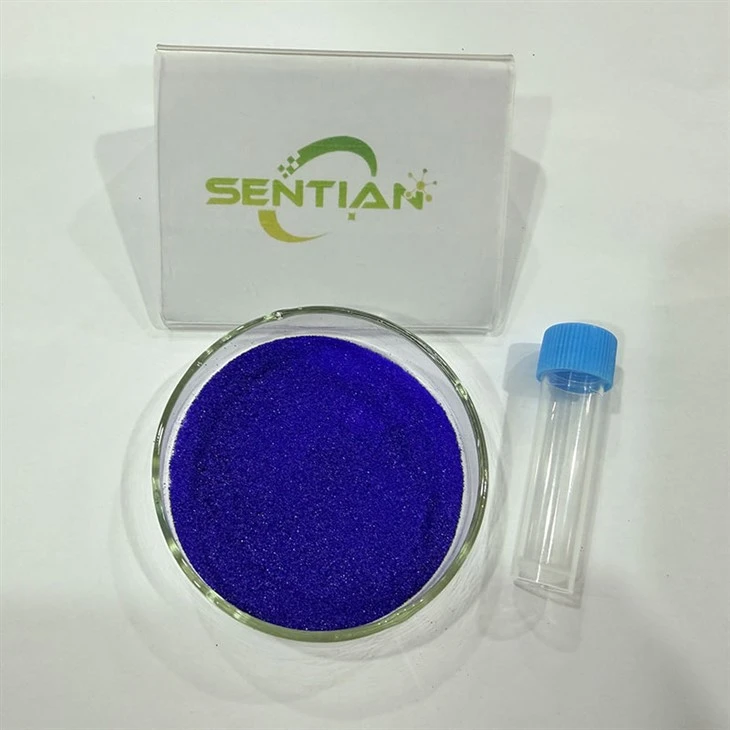
What is GHK-Cu Peptide Powder?
GHK-Cu Peptide Powder is a bio-active, high-purity peptide complex of glycyl-L-histidyl-L-lysine (GHK) chelated to copper ions. It is usually delivered as a fine blue to deep blue powder, which is produced by careful peptide synthesis and subsequent, carefully controlled, copper chelation and purification steps to achieve the molecular uniformity, low impurity content, and batch-to-batch uniformity required. It is generally used as a functional cosmetic raw material and distinguished as a biomimetic peptide in modern personal care R&D due to its advanced formulation system in cosmetic R&D. The material is highly water-soluble and has good compatibility with typical formulation bases, such as aqueous solutions, emulsions, gels, and serum systems, enabling flexibility in the various architectures of industrial products. In a manufacturing and supply chain context, it is often accompanied by robust quality control measures such as analytical characterisation by HPLC or other appropriate methods to establish the identity, stability, and purity profile of peptides, and copper coordination in the presence of specific conditions of storage. The product comes in a range of specification grades, as well as customisable purity grades and versatile packaging formats, with OEM/ODM support to help enterprise customers scale up the development of formulations and incorporate ingredients into unique personal care product portfolios.

COA
| Items | Specification | Result |
| Appearance | Blue to Deep Blue Fine Powder | Complies |
| Identification | Positive | Complies |
| Assay (HPLC) | ≥99.0% | 99.36% |
| Copper Content | 8.0%–10.0% | 9.12% |
| Peptide Purity | ≥98.0% | 98.74% |
| Loss on Drying | ≤5.0% | 2.18% |
| Residue on Ignition | ≤1.0% | 0.21% |
| pH (1% Solution) | 5.0–7.0 | 614.00% |
| Heavy Metals | ≤10 ppm | <10 ppm |
| Lead (Pb) | ≤2 ppm | <2 ppm |
| Arsenic (As) | ≤1 ppm | <1 ppm |
| Cadmium (Cd) | ≤1 ppm | <1 ppm |
| Mercury (Hg) | ≤0.1 ppm | <0.1 ppm |
| Total Plate Count | ≤1000 CFU/g | <100 CFU/g |
| Yeast & Mold | ≤100 CFU/g | <10 CFU/g |
| E. coli | Negative | Negative |
| Salmonella | Negative | Negative |
Sentian Bio provides free samples, OEM/ODM customized products, and professional technical support. Contact us anytime at sales3@sentianbio.com or LEAVE A MESSAGE!
Main Ingredients
The key active ingredient of Copper Peptide Powder is the bioavailable copper complex, GHK-Cu, which is a tripeptide of copper (Cu²+) and the naturally occurring peptide glycyl-L-histidyl-L-lysine (GHK). It is the basic functional structure of this GHK-Cu complex that determines the physicochemical and bioactive properties of the material to be used in formulations. This complex usually dominates the composition of most high-purity commercial grades, and is usually fixed to a specified ratio, so that batches of the same grade have consistent molecular activity. The GHK tripeptide is comprised of three amino acids, glycine, histidine, and lysine, that create a stable coordination site for copper binding, which allows the production of a well-defined blue crystalline or amorphous powder as a function of the processing conditions. Minor components can consist of trace moisture, or of salts or impurities left over from the purification process, or from the processing itself, which are all rigorously monitored and held within specification limits by purification and analytical testing procedures. The main focus in ingredient supply is on maintaining the high chelation stability, low free copper content, and verified peptide integrity, which directly affect the formulation consistency in cosmetic and personal care systems. The copper ion is not present free in the product, but it is structurally bound to the peptide complex, and it is the only critical and essential functional ingredient, whereas the rest of the ingredients are secondary and are well controlled according to quality control parameters.
Manufacturing Pathway
1. Solid-Phase Peptide Synthesis (SPPS) of GHK Backbone
First, a tripeptide glycyl-L-histidyl-L-lysine is stepwise assembled on a solid resin. Protected amino acids are joined together one by one under controlled conditions so as to ensure the correct sequence and to keep impurities to a minimum.
2. Cleavage and Deprotection
Once the chain is assembled, the peptide is cleaved from the resin, and the protecting groups are removed by the action of an acid-based cleavage system. This results in crude GHK peptide, which can be processed.
3. Primary Purification
Removal of truncated sequences and by-products is achieved by purification of the crude peptide by preparative HPLC or any other method of separation, resulting in a more pure product and consistent identity.
4. Copper Chelation Reaction
A controlled Cu²⁺ source is then allowed to react with the purified GHK peptide under a controlled physical condition (pH and temperature). The Cu ion coordinates to the peptide's coordination sites to give the stable GHK-Cu complex.
5. Secondary Purification and Stabilization
The complex is further purified to deplete free copper ions and to remove other impurities, to guarantee a consistent copper to peptide ratio and stable material profile.
6. Drying and Powder Formation
The purified solution is then freeze-dried or vacuum-dried to give a stable solid form, without loss of molecular integrity.
7. Milling and Standardization
The dried product is ground to a uniform fine powder to ensure uniformity of particle size, which is important for consistency of solubility and blending in formulation.
8. Quality Control and Packaging
Final batches of Copper Tripeptide-1 Powder are stringently tested for identity, purity, copper content, and microbial limits prior to packaging under moisture-controlled conditions or under inert conditions for supply.

Safety
Copper Tripeptide Powder is considered a well-known cosmetic raw material with a known molecular structure and handling profile in the industry. Instead, it is its composition, purity, and controlled state of copper chelation that primarily determine its safety profile, not a pharmacological interpretation. In a good commercial production, the copper ion is held in the GHK tripeptide complex, providing greater material stability and consistency of performance in formulation systems, as well as minimizing the amount of free copper in the production. If produced under standard conditions such as GMP-approved facilities, the material is likely to be quality-controlled and quality assured using various quality control methods, such as purity testing, heavy metal limitations, microbial testing, residual solvent testing, etc., which meet the cosmetic ingredient specifications. It is used in practical industrial applications as a low concentration functional ingredient in cosmetic formulations, the compatibility of which with the majority of cosmetic bases (emulsions, gels, aqueous) is supported by the suppliers. Good formulation design, concentration control, and stability testing are of importance to ensure the product consistency during shelf life, as in the case of most peptide-based raw materials.
Production Process

Certificate

Exhibition
