


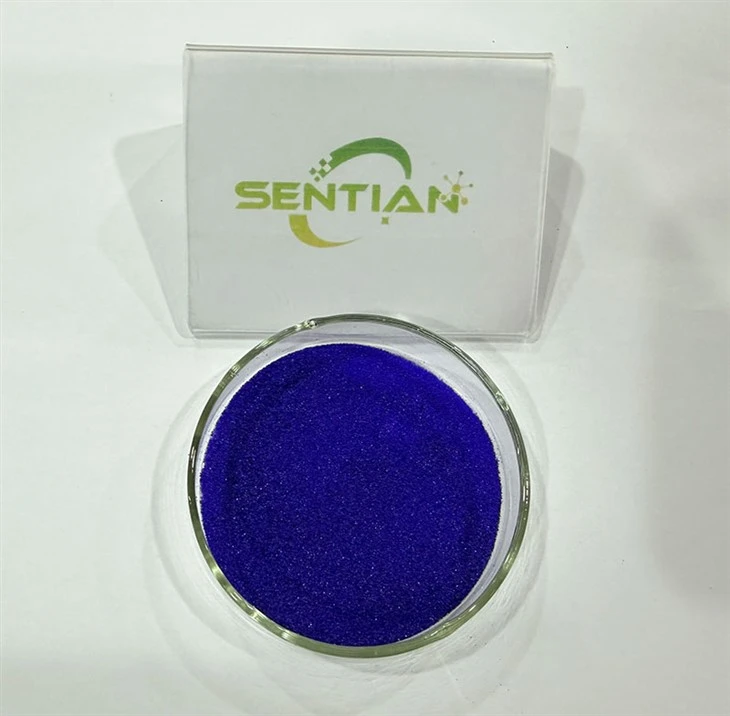
What is Copper Peptide Powder?
Copper Peptide Powder is a copper complex peptide raw material that is widely used in the cosmetic and personal care industry for advanced formulation development. It is generally formed by a combination of short polypeptide chains and copper ions, and is generally a fine blue to deep blue powder, which has good water solubility and stability in cosmetic systems based on water. It is offered to cosmetic companies, contract formulators, and brand owners as a functional ingredient in premium positioning skin care products such as serums, emulsions, gels, masks, scalp care products, etc. Its ability to be used in diverse cosmetic base materials, such as humectants, polymers, botanical extracts, and other peptide or fermentation products, offers great value for the industry, many of which are incompatible with other actives in the formulation. It is normally processed under controlled manufacturing conditions to guarantee its purity, controlled copper content, and stable physicochemical properties that are suitable for large-scale manufacturing. It has various benefits for formulators, like easy dispersion in water systems, predictable formulation performance, and flexibility in adjusting the usage levels according to the formulation design requirements. Moreover, it caters to the cosmetic industry's emerging trends regarding biotechnology-derived ingredients and simple formulation ideas suitable for the high-end skin care product lines and innovative brand portfolios of the industry.

COA
| Item | Specification | Result | Test Method |
| Appearance | Blue to Blue-Violet Powder | Conforms | Visual |
| Identification | Positive | Positive | HPLC |
| Assay (GHK-Cu) | ≥98.0% | 99.21% | HPLC |
| Peptide Content | ≥98.0% | 98.84% | HPLC |
| Copper Content | 7.5%–9.5% | 8.41% | ICP-OES |
| Solubility | Freely Soluble in Water | Conforms | Visual |
| pH (1% Solution) | 6.0–8.0 | 6.82 | USP |
| Loss on Drying | ≤5.0% | 2.18% | USP <731> |
| Residue on Ignition | ≤1.0% | 0.19% | USP <281> |
| Heavy Metals | ≤10 ppm | <10 ppm | ICP-MS |
| Lead (Pb) | ≤1.0 ppm | <0.10 ppm | ICP-MS |
| Arsenic (As) | ≤1.0 ppm | <0.10 ppm | ICP-MS |
| Cadmium (Cd) | ≤0.5 ppm | <0.05 ppm | ICP-MS |
| Mercury (Hg) | ≤0.1 ppm | <0.02 ppm | ICP-MS |
| Total Plate Count | ≤1,000 CFU/g | <100 CFU/g | USP <61> |
| Yeast & Mold | ≤100 CFU/g | <10 CFU/g | USP <61> |
| Escherichia coli | Negative | Negative | USP <62> |
| Salmonella | Negative/25g | Negative | USP <62> |
| Staphylococcus aureus | Negative | Negative | USP <62> |
Sentian Bio provides free samples, OEM/ODM customized products, and professional technical support. Contact us anytime at sales3@sentianbio.com or LEAVE A MESSAGE!
Industry Background
GHK-Cu Powder has been developed based on the continuous development of the Cosmetic peptides and Biotechnology-based raw materials market globally, which is one of the major drivers in the personal care and skin care manufacturing industry. The development of cosmetic formulation science allows brands and manufacturers to place more emphasis on the use of high-purity, well-characterised functional ingredients that can help them to gain differentiated product development and premium positioning. In this context, it has come into focus as a subcategory of peptides, owing to recent advancements in peptide synthesis and purification methods, alongside enhanced analytical quality control and consistency to support scalability in the pharmaceutical and cosmetic industries. Concurrently, the global beauty industry is undergoing an unprecedented transition to establishing 'clean label' positionings, formulating with 'minimalist' designs and being transparent about ingredients, which is prompting consumers to seek materials with both a scientific basis and formulation versatility. This has fueled the increasing need of cosmetic companies, contract manufacturers, and private label users for consistent and repeatable raw materials in a variety of skin care products such as serums, emulsions, masks, etc.
Development History
The development history is also parallel to the development history of peptide chemistry and coordination research of trace elements in modern biotechnology. Initial research investigated the binding of short peptide sequences to copper ions under laboratory conditions and the discovery of stable, copper-binding complexes, like GHK. As peptide synthesis and purification techniques have improved, the synthesis of compounds has begun to move from experimental research to a more scalable and efficient industrial production process that yields higher purity, consistency, and control of the peptide structure. It was brought in as a specialized raw material to formulate cosmetics, and with the continuous improvement of the production processes, the solubility, stability, and batch uniformity have been greatly improved, and it has been gradually introduced in the supply chain within the cosmetic ingredients industry as a raw material. In recent years, its development has been further promoted by the development and spreading of the biotechnology-driven cosmetic trend and the requirement for standardized and documented raw materials; thus, the companies that provide the raw materials enhance their quality systems and offer certifications like COA, MSDS, ISO/GMP, etc. As with other peptide categories, today, GHK Copper Peptide Powder is considered a "mature" cosmetic ingredient class in the peptide market, as the market has evolved towards science-based formulation, standardized sourcing, and global supply chain integration.

Application
1. Cosmetic and Personal Care Industry
Copper Tripeptide-1 Powder is commonly utilized in the formulation of skin care and personal care products as a functional ingredient in skin care serums, emulsions, creams, masks, and scalp care products. It is seamlessly incorporated into product systems centred on contemporary cosmetic innovation, texture improvement, and high-quality product formulation design.
2. Professional Skincare Manufacturing
It is used in the creation of bespoke cosmetic lines for international brands, in contract manufacturing, and OEM/ODM production. Manufacturers leverage their applications in the development of differentiated product portfolios with a higher focus on advanced ingredient technology and formulation flexibility.
3. Beauty and Aesthetic Product Development
It's an ingredient often found in a high-end beauty product, where the sophistication or positioning of the ingredient is a key consideration, such as salon-grade or professional skin care product lines.
4. Biotechnology-Based Cosmetic Ingredient Sector
It is used in the formulation systems with peptides in biotech product development of ingredients. This involves research platforms that work on the development of next-generation functional raw material platforms in Cosmetics.
5. Cosmetic Ingredient Distribution and Trading
It is also one of the major raw materials trade products, distributed by distributors and wholesalers to the cosmetic manufacturers in the region, which helps in the cross-border trading of raw materials in the personal care sector.
Production Process

Certificate

Exhibition
