


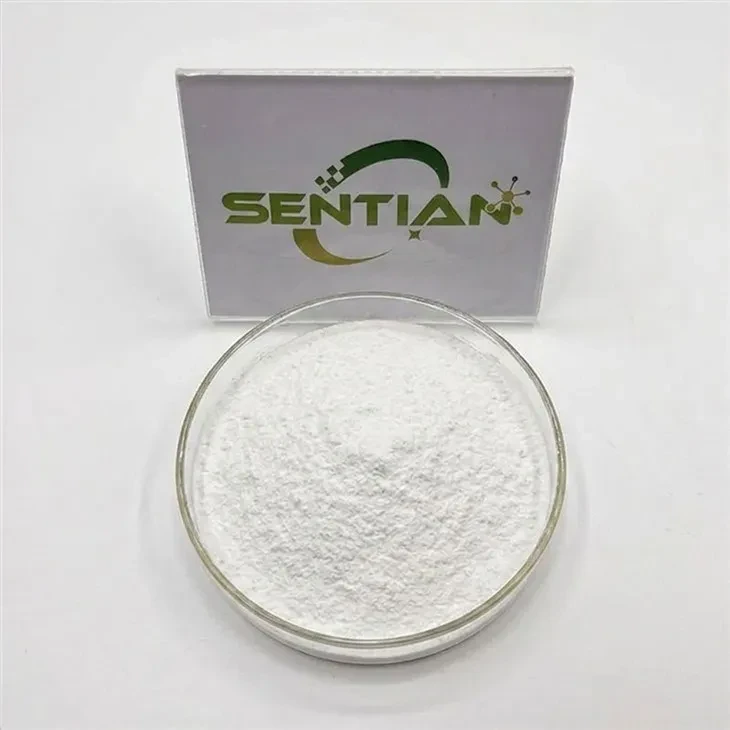
What is 5-Hydroxytryptophan Powder?
5-Hydroxytryptophan Powder is an indole functional raw material, which is naturally derived and standardized, and used in the production of nutraceuticals and dietary supplements. It is located as a plant-based intermediate chemical used mostly as a source for Griffonia simplicifolia seeds and is available in a purified and controlled specification that is appropriate for large-scale formulation and contract manufacturing applications. The material is normally a very fine free-flowing powder that is light off-white to pale yellow in colour and is engineered to be handled in an uniform manner in industry where uniformity and processing efficiency are paramount. The purification and standardization process on it removes any impurities and ensures that the level of 5-HTP is predictable and reproducible in formulation systems as compared to crude botanicals. This is because it is widely used by manufacturers because it can be used in a variety of delivery systems, such as encapsulated systems, compressed tablets, or dry powder blends. It performs well in terms of its physical properties, enabling it to meet the needs of production lines that are being manufactured by OEM/ODM producers, where the need is to provide ingredient performance that is repeatable and scalable. It also shows compatibility with most of the excipients used in the nutraceutical industry, thus providing formulators with the possibility to develop multi-component systems without major processing limitations.

COA
.
| Item | Specification | Result | Test Method |
| Product Name | 5-Hydroxytryptophan Powder | 5-Hydroxytryptophan Powder | Visual |
| Botanical Source | Griffonia simplicifolia Seed Extract | Conforms | TLC |
| Appearance | Off-white to Light Yellow Fine Powder | Conforms | Visual |
| Identification | Positive | Positive | TLC |
| Assay (5-HTP) | ≥98.0% | 98.63% | HPLC |
| Particle Size | 100% Pass 80 Mesh | Conforms | USP <786> |
| Loss on Drying | ≤1.0% | 0.42% | USP <731> |
| Residue on Ignition | ≤0.5% | 0.18% | USP <281> |
| Bulk Density | 0.40–0.70 g/mL | 0.56 g/mL | USP Method |
| Tap Density | 0.50–0.90 g/mL | 0.71 g/mL | USP Method |
| Heavy Metals | ≤10 ppm | <10 ppm | ICP-MS |
| Lead (Pb) | ≤2.0 ppm | 0.08 ppm | ICP-MS |
| Arsenic (As) | ≤1.0 ppm | 0.05 ppm | ICP-MS |
| Cadmium (Cd) | ≤1.0 ppm | 0.03 ppm | ICP-MS |
| Mercury (Hg) | ≤0.1 ppm | 0.01 ppm | ICP-MS |
| Total Plate Count | ≤1,000 CFU/g | <100 CFU/g | USP <2021> |
| Yeast & Mold | ≤100 CFU/g | <10 CFU/g | USP <2021> |
| Escherichia coli | Negative | Negative | USP <2022> |
| Salmonella | Negative/25g | Negative | USP <2022> |
| Staphylococcus aureus | Negative | Negative | USP <2022> |
| Pesticide Residues | Complies with USP/EP Requirements | Conforms | GC-MS/LC-MS |
| Residual Solvents | Complies with USP <467> | Conforms | GC |
| Storage | Store in a Cool, Dry Place Away from Direct Sunlight | Conforms | Internal Standard |
| Shelf Life | 24 Months When Properly Stored | Conforms | Internal Standard |
Sentian Bio provides free samples, OEM/ODM customized products, and professional technical support. Contact us anytime at sales3@sentianbio.com or LEAVE A MESSAGE!
Industry Background
As the global industry of botanical extracts and nutraceutical raw materials continues to grow, the industry background of 5-HTP Powder closely aligns with the steadily rising demand for standardized ingredients from plants in large-scale manufacturing and contract production systems. With the shifting market, buyers like supplement manufacturers (OEM/ODM), ingredient distributors, and brands are increasingly prioritizing consistency, traceability, and consistent processing performance, urging suppliers to improve their extraction process and purification technology, while strengthening quality control systems. It is a functional input to multi-ingredient product systems and, in this context, is not considered to be a product that would be ingested by consumers, but rather an intermediate to be used in a formulation development process. However, industry trends like clean-label positioning, preference for plant-based raw materials, and transparency demands in key nutraceutical markets like North America, Europe, and Asia-Pacific are driving the industry in the direction of more standardized and well-documented raw materials. Meanwhile, the adoption of OEM and ODM production models has driven an increased need for ingredients with consistent assay, physical properties, and blending, encapsulation, and tableting performance; consistency in industrial manufacturing has become even more pronounced.
Development History
Early-stage development was primarily directed toward isolation and identification of the compound from natural products like Griffonia simplicifolia and involved simple solvent extraction; the extraction was not very efficient in terms of purification. Producers could increase the purity of the products and develop the consistency of identification of the active components as analytical chemistry tools improved, particularly those based on chromatography.
The growing market for dietetic supplements and functional food ingredients has caused a change in demand from crude botanicals to standardized and specification-controlled botanicals for commercial formulation. These changes led to an improvement in the multi-step extraction, refining, and concentration processes, yielding more stable assay ranges and increased batch-to-batch consistency in the manufacturing process. Concurrently, globalization of trade led to the use of formal quality systems like GMP and ISO standards that brought some uniformity to the expectations of product production in various suppliers and regions.
OEM/ODM manufacturing trends and clean-label sourcing requirements have influenced the development in recent years, with more focus on traceability and controlled physical properties, as well as formulation compatibility. Detailed analytical testing and stability management are commonly performed in modern production to ensure a consistent product on a large scale in the blending and encapsulation processes. Griffonia Seed Extract 5-HTP has thus become a standardised botanical ingredient, which is incorporated into industrial formulation systems.

Application
1. Dietary supplement manufacturing industry
5-HTP Powder Bulk is used as a functional raw material in capsule, tablet, and powder blend formulations, which are used in multi-ingredient product systems for general nutraceutical positioning and brand development.
2. OEM/ODM contract manufacturing sector
It is commonly used in private label manufacturing as it is a large-scale production where uniform and consistent raw materials are essential for batch uniformity across a range of product lines, efficient production cycles, and consistent formulation performance.
3. Functional food and beverage development
Used in powder-based nutrition products, in stick packs and in instant mix systems, where the compatibility and dispersibility of ingredients are important attributes in the design and manufacturing of the products.
4. Nutritional formulation R&D industry
Used in research and development for new formulations and prototype development of new supplement products to discuss new multi-component blends.
5. Raw material distribution and ingredient trading
Delivered via global ingredient supply chains as a standardised botanical intermediate to wholesalers and distributors that deliver to a number of downstream product manufacturing clients.
6. Pharmaceutical-related research sector
Offers a few applications in the laboratory or formulation research field for chemical analysis, stability testing, and ingredient compatibility studies, but is not marketed as a medicinal product.
Factory

Certificate

Exhibition
