


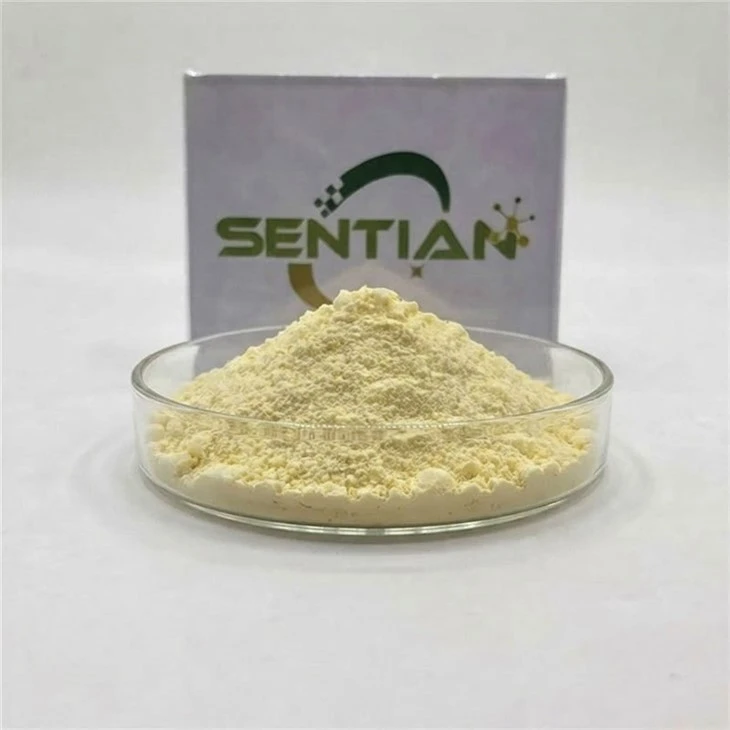
Xi'an Sentian Biotechnology Co., Ltd. is one of the leading manufacturers and suppliers of rutin powder in China. We are committed to providing high quality customized service and OEM&ODM private label service for global clients. Please feel free to buy bulk rutin powder in stock here from our factory. Also, free sample is available.
What is Rutin Powder?
Rutin Powder is a naturally derived, pure form of rutin, which is a flavonoid glycoside, obtained from different sources, mainly Sophora japonica (flower buds) and buckwheat, and typically used in the food, nutraceutical, and cosmetic production sectors. It is generally present in the form of a fine powder that is light yellow to yellow-green in colour, has good stability, and is usually HPLC standardized to varying purity levels, typically 95% or 98%. From a perspective, it is recognized as a functional ingredient for formulation development, especially in formulations containing plant polyphenolic compounds having antioxidant properties and formulation supporting properties. It is somewhat soluble in hot water and is less susceptible to alkaline or hydro-alcoholic systems, which can be used in various industrial processing applications such as beverages, powdered mixes, capsules, tablets, and cosmetic emulsions. It has been employed as a useful additive in manufacturing formulations for antioxidant systems, color protection systems, and stability-enhancing matrices, which enhance product performance and shelf stability. It is often used in cosmetic formulas for skin care and personal care formulations like lotions, creams, and serums containing plant flavonoids for functional formulation support. It is a natural-origin additive that can be used in the food and beverage industry for the production of functional foods, nutritional powders, and fortified foods, depending on regional regulations.

COA
| Analysis Item | Specification | Result |
| Appearance | Yellow to Yellow-Green Fine Powder | Complies |
| Odor | Characteristic | Complies |
| Taste | Characteristic | Complies |
| Assay (Rutin, HPLC) | ≥95.0% | 95.63% |
| Particle Size | 95% Pass 80 Mesh | Complies |
| Loss on Drying | ≤5.0% | 2.41% |
| Ash Content | ≤5.0% | 1.86% |
| Bulk Density | 0.40–0.70 g/ml | 0.56 g/ml |
| Solubility | Partially Soluble in Hot Water | Complies |
| Heavy Metals | ≤10 ppm | Complies |
| Lead (Pb) | ≤2.0 ppm | 0.32 ppm |
| Arsenic (As) | ≤1.0 ppm | 0.08 ppm |
| Cadmium (Cd) | ≤1.0 ppm | 0.05 ppm |
| Mercury (Hg) | ≤0.1 ppm | 0.01 ppm |
| Total Plate Count | ≤1,000 CFU/g | 120 CFU/g |
| Yeast & Mold | ≤100 CFU/g | 18 CFU/g |
| E. coli | Negative | Negative |
| Salmonella | Negative | Negative |
Sentian Bio provides free samples, OEM/ODM customized products, and professional technical support. Contact us anytime at sales3@sentianbio.com or LEAVE A MESSAGE!
Market Trends
These last few years, demand has been growing over the last few years as manufacturers are increasingly looking to botanical flavonoids that can be used in product formulations for "natural origin" positioning without the need to use synthetic additives. This is largely being fueled by consumer awareness of transparency on ingredients, sustainability, and environmental responsibility, which continues to gain momentum in the ingredient purchasing preferences in the North American, European, and some parts of Asia-Pacific markets where clean-label regulations are strengthening. This has led to the increased interest in Rutin Extract as a versatile ingredient in formulation systems, where natural source and reduced ingredient list are key to the formulation. High purity specs like 95% HPLC-grade rutin are becoming more popular with the development of higher quality products, particularly functional foods, beverages, and cosmetic products where product positioning and clarity of product labelling are key. Meanwhile, sustainability is shaping procurement, and particularly when it comes to raw materials, buyers are increasingly looking for traceable ones, coming from renewable botanical sources such as Sophora japonica or buckwheat. Private label and OEM/ODM production is also growing in this market, which is used as an ingredient in multi-ingredient botanical blends used in today's modern formulations for lifestyle.
Features
It has a relatively high thermal stability and a well-defined chemical structure, which ensures rutin's consistency in industrial use, and is a yellow to yellow-green fine powder extracted from plants. Formulation-wise, it is generally less soluble in cold water, more soluble in hot water systems, and more compatible with hydroalcoholic or mildly alkaline environments, enabling product developers to incorporate this into a variety of liquid and solid dosage forms. The polyphenolic nature gives it a strong reactivity with certain metal ions and oxidizing agents that makes it a factor to take into account in the formulation of stable multi-ingredient systems, such as beverage concentrates, cosmetic bases (capsules, emulsions). Sophora Japonica Extract Powder presents good stability in the controlled pH and temperature ranges, but if it is to be formulated in complex matrices, for example, excipients for stabilization can be required to ensure stability over the shelf life. It can be supplied in a high purity (usually 90%-98% HPLC) standardised grade, providing guaranteed performance for upscaling from laboratory development to industrial manufacture. In addition, the material has good flexibility in particle size adjustment to enhance the flowability, blending uniformity, and compressibility of powder/tablet blend applications. From a cosmetic formulator's perspective, its compatibility with plant-based emulsions and aqueous systems makes it a good option for use as an ingredient in serums, creams, and lotion bases where botanical actives are needed as ingredient positioning.

Benefits
1. Formulation versatility
Manufacturers are free to incorporate the Sophora Japonica Extract Rutin into their various product systems, such as dry blends, liquid concentrates, and emulsified matrices for food, beverage, and cosmetic formulations, allowing positioning of botanicals within formulations.
2. Natural-origin labeling support
It is a botanical derivative ingredient that can support brands in making their product positioning statements more convincing in terms of "botanical" and "clean-label" claims, reflecting the trend of the use of easily recognizable and less processed raw materials globally.
3. Standardization-friendly ingredient
Rutin is available in HPLC-standard grades, which results in a consistent grade of input material, thus providing the formulator with a scale-up production with the same batch reproducibility over a longer manufacturing period.
4. Compatibility with multi-ingredient systems
It can be blended with vitamins, amino acids, plant extracts, and other functional raw materials; thus, it is applicable for complex formulation, which needs the synergy of ingredients and balance of the system.
5. Customizable processing options
It comes in a variety of purities, particle sizes, and solubility-adapted forms to ensure technical teams can optimize their dispersion and blending efficiency and processing behaviour based on production requirements.
6. Cosmetic formulation adaptability
It can be used in different topical product systems like emulsions and aqueous formulations for diversifying ingredients in personal care and skin care product development.
Production Process

Certificate

Exhibition
