


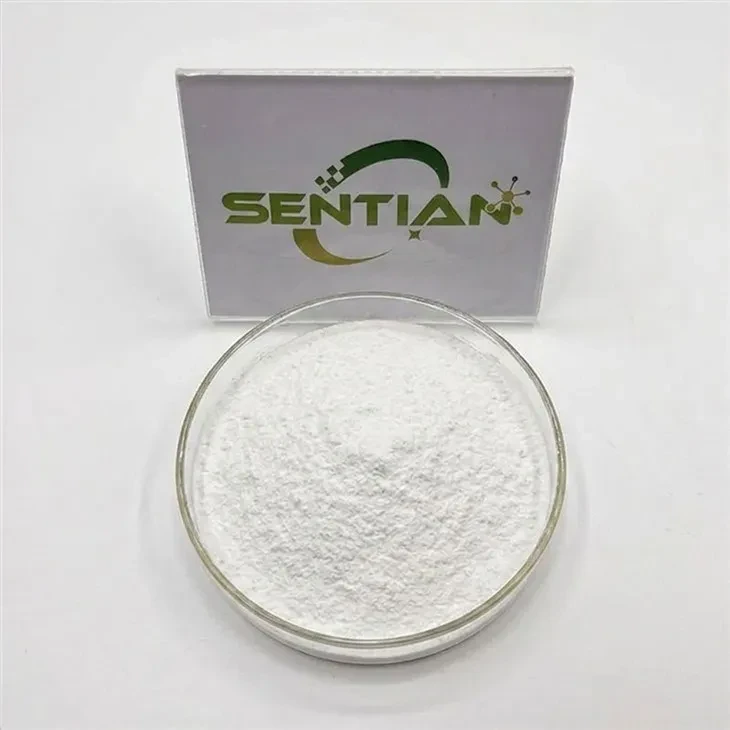
Xi'an Sentian Biotechnology Co., Ltd. is one of the leading manufacturers and suppliers of dihydromyricetin powder in China. We are committed to providing high quality customized service and OEM&ODM private label service for global clients. Please feel free to buy bulk dihydromyricetin powder in stock here from our factory. Also, free sample is available.
What is Dihydromyricetin Powder?
Dihydromyricetin Powder is mainly derived from the leaves of Ampelopsis grossedentata (vine tea) and is a standardized botanical compound applied in various industries such as food, beverage, nutraceutical, and cosmetic applications as a raw material. It is usually in fine powder form and is available in high-purity grade (typically light yellow to off-white), with high-purity grades typically being HPLC standardised, and is well suited to formulation systems due to its good stability. It is considered to be an active functional ingredient that can be added into capsules, tablets, functional drinks, powder mix, and cosmetics. The manufacturers who want to use it need to ensure the quality, traceability, and large-scale production of it. It has good formulation flexibility, but may be less soluble depending on the grade and particle size, and so is better suited to water-dispersible or micronized grades for use in beverage systems. It is usually packaged in bulk (1 kg foil bag or 25 kg fibre drum) to meet the requirements of large-scale production for OEM/ODM manufacturing. Additionally, it is a popular choice for purchasers due to its use as a botanical active ingredient in product innovation pipelines in the functional nutrition and plant-based product formulation sectors.
COA
.
| Item | Specification | Result |
| Appearance | White to off-white fine powder | White to off-white fine powder |
| Particle Size | 95% pass 80 mesh | Complies |
| Production Method | Water/Ethanol extraction, purification, drying | Complies |
| Dihydromyricetin Assay (HPLC) | ≥ 98.0% | 98.50% |
| Loss on Drying | ≤ 5.0% | 3.20% |
| Ash Content | ≤ 1.0% | 0.60% |
| Heavy Metals (Total) | ≤ 10 ppm | Complies |
| Lead (Pb) | ≤ 2.0 ppm | Complies |
| Arsenic (As) | ≤ 1.0 ppm | Complies |
| Cadmium (Cd) | ≤ 1.0 ppm | Complies |
| Mercury (Hg) | ≤ 0.1 ppm | Complies |
| Total Plate Count | ≤ 1,000 CFU/g | Complies |
| Yeast & Mold | ≤ 100 CFU/g | Complies |
| E. coli | Negative | Negative |
| Salmonella | Negative | Negative |
Sentian Bio provides free samples, OEM/ODM customized products, and professional technical support. Contact us anytime at sales3@sentianbio.com or LEAVE A MESSAGE!
Market Trends
The global movement towards naturally derived, plant-based functional ingredients and toward clean-label formulations throughout the global food, beverage, and nutraceutical value chains has created a market trend for DHM Powder. Manufacturers and brand owners are working hard to reformulate products to use botanicals instead of synthetic ingredients that have a standardized composition, a traceable source, and can be marketed under the "natural positioning" marketing approach. This has rendered it a useful ingredient in the growing group of flavonoid raw materials of functional beverages, food supplements, and cosmetic products. Buyers are now increasingly making suppliers responsible for offering them a COA that is stable over time, sustainable sourcing, and international food-grade and cosmetic-grade certifications. Furthermore, the world's supply chains are expressing increased preference for standardized plant extracts that can be easily incorporated into the development of OEM/ODM products, especially in powdered blends and ready-to-mix formulations. The market trend overall is towards more transparency, minimal raw material lists, and portfolios based on natural raw materials, aligning with it, which is a versatile botanical ingredient.
Features
It is a botanical ingredient of flavonoids, which has unique physicochemical properties for industrial use in the formulation. This is generally a fine powder of light to pale yellow colour and has a well-defined crystalline structure, good thermal stability under normal processing conditions, and is sensitive to excessive exposure to high temperatures, moisture, and strong light, which therefore demands careful storage and handling. It has several phenolic hydroxyl groups, causing it to be a polar compound that interacts with many excipients, making it a good ingredient for different delivery systems like capsules, tablets, dry blends, and functional powder formulations. It is not very soluble in water, and thus, in native form, it requires formulation strategies, such as particle size reduction, micronization, or application of dispersing systems to enhance its water application behavior. It is also compatible with commonly used food- and cosmetic-grade carriers, which enables flexible use in OEM/ODM product development. The formulation engineering aspect is important to consider consistency and batch-to-batch stability from a pH environment, Oxidation sensitivity, and uniform dispersion. Given these characteristics, Vine Tea Extract Dihydromyricetin can be considered a suitable botanical raw material for industrial use in taste-sensitive matrices due to its relatively neutral sensory profile, a characteristic that is favorable for large-scale production.
Benefits
1. Formulation versatility
Dihydromyricetin Bulk Powder works with a variety of product formats, including dry blends, capsules, tablets, and functional beverage systems-giving manufacturers the option to broaden the applications without significant changes to the formulation.
2. Natural-origin positioning support
It supports brands in reinforcing their "botanical" or "clean-label" positioning in their ingredient declaration and marketing system, as it is a plant-derived ingredient.
3. Scalable industrial processing
Can be used in bulk production processes, such as mixing, granulation, and encapsulation, ensuring uniformity in large-scale production.
4. Customizable specification options
In various purities and particle sizes, allowing formulators to choose the grades based on the solubility, dispersion, or process requirements.
5. Stable dry-state performance
Understands the ability to perform reliably in powder-based systems and enables long shelf-life formulation planning in controlled packing systems.
6. Mild sensory profile
Low odor and taste impact at typical inclusion rates, resulting in a good sensory balance of final products.
7. Compatibility with OEM/ODM development
Ideal for contract manufacturing and private label manufacturing, where flexibility and consistency of ingredients are paramount.
Factory

Certificate

Exhibition
