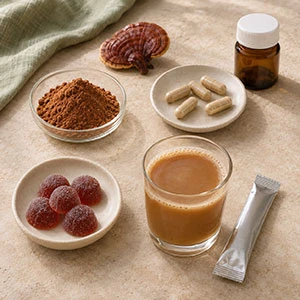
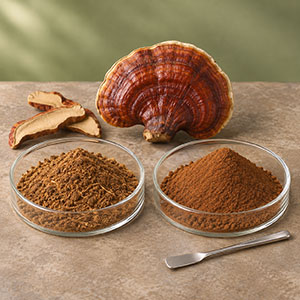
Reishi mushroom powder is simply dried and milled mushrooms, whereas Reishi Extract Powder is the extract of certain elements of the mushrooms, which can be dried into powder form. Both can appear the same, but have different formula components, specifications, and performance.
In this case, 'mushroom powder' refers to the unextracted whole mushroom powder and not a ready-to-mix drink. With supplement brands, it is not a matter of which name is more concentrated; it is a question of which ingredient fits the product brief. Begin with the identity of the source, similar test results, and the formula's requirements.
1. Reishi Mushroom Powder vs. Extract: A Quick Comparison
|
Comparison |
Whole Mushroom Powder |
Mushroom Extract Powder |
|
Main processing |
Drying and milling |
Extraction followed by further processing and drying |
|
Material retained |
Broad mixture of mushroom solids |
Components recovered by the selected process; composition varies |
|
Common specifications |
Identity, source part, particle size, and analytical results |
Identity, source part, extraction details, ratios, and analytical results |
|
Mixing behavior |
May leave suspended particles or sediment |
Depends on the extract; complete dissolution is not guaranteed |
|
Purchasing decision |
Suitability of the whole material |
Suitability of the documented extract composition |
2. Reishi Processing Changes More Than Particle Size
- Milling reduces size:
Drying a mushroom does not selectively concentrate a chemical fraction, but a smaller particle size of the dried mushroom does. The characteristics of the particle size and composition are different.
- Extraction selects components:
Different profiles are recovered by water-based or alcohol based processes. These differences are being utilized in reishi research to investigate the polysaccharides and triterpenes in the extract; this matters when interpreting an extract's composition.
- Drying produces a similar-looking form:
An extract is not necessarily an unextracted mushroom; it can be in dry powder form, and in a product name, the word powder does not necessarily refer to an unextracted mushroom.
Therefore, a process description is more informative than appearance. Discuss: What happened before the material was powdered? From a scientific research point of view, it is important to know about the composition of reishi even though the product is named as such.

3. Reishi Source Identity Comes Before Concentration
- Confirm the species:
Reishi is not actually a complete specification, but rather a common name given to the mushroom. Practice with commercial products has been reported to have difficulties in identification and labeling of Ganoderma.
- Determine material used:
The terms fruiting body, mycelium, and spore refer to the various materials. Any of these should not be replaced with "whole mushroom powder.
- Separate source from processing:
Descriptions of an extract do not provide proof of extraction, and the origin of a fruiting body does not indicate the part of the plant.
Before comparing percentages, be sure to record these facts. In other cases, a price comparison can be from different raw materials and/or different production methods. The context is gained from research on the identification of commercial reishi.
4. Compare Reishi Extract Content on the Same Basis
- Match the analyte:
Total polysaccharides are NOT equal to beta-glucans. The narrow-spectrum polysaccharide does not need to be reported as a measurement of beta-glucan.
- Match the test:
Compare results from appropriate methods, on the same basis of reporting. Mushroom beta-glucan methods are specific for differentiating out the relevant glucans; they do not measure all carbohydrates.
- Match the amount:
Only the weight of ingredients can not establish equal composition.
If the material were hypothetical, with 400mg in it and 20% of a measured marker, then there would be 80mg of the marker in the material. A 200 mg amount at 40% also provides 80 mg. This is not a dosage recommendation, nor is it proof of biological equivalence.

5. Compare Reishi Ingredient Cost per Planned Serving
- Begin with the product target:
Determine the purpose of the ingredient to be used, its identity and composition, before designing the amount of material needed for the formula. Don't assume it's an effective serving based on an extraction ratio.
- Calculate ingredient cost consistently:
Calculate the volume of food per individual serving and multiply by the price per kg of food and then divide by 1000.
- Include manufacturing consequences:
Compare the results of the tests, the usable yield, the filling requirements, and any additional work in the processing or flavoring of the test.
Don't necessarily expect to get a better price per kg to get a better end-product price. Similarly, the higher the price of an extract is, the higher is not necessarily the better value. Compare materials to meet the same established brief and then evaluate the cost of producing a material that meets the brief.
6. Test a Reishi Substitution Before Changing Production
- Hard capsules:
Test volume and fill of the proposed blend. Capsules can vary in size and/or number of capsules needed based on equal weights of each ingredient.
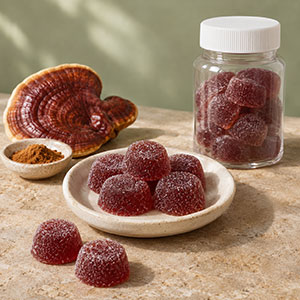
- Gummies:
Test the substitute in a test portion. The challenge of the mushroom development may be altered even if the amount of mushrooms is not changed, if ingredient solids are changed.
- Powder supplements:
Produce test samples (customer instructions). Make comparisons regarding sediment, mouthfeel, and appearance after the same settling period.
Formulation change is not a mere 'purchasing substitution' from whole powder to extract. During trials, and before final approval, ensure the formula is identified as the original and suggested formula.
Choosing Between Reishi Mushroom Powder and Extract
When the whole mushroom powder is identified in the formulation and mushroom product concept, then use whole mushroom powder. Select an extract that has a verified composition and/or processing properties that better serve the brief. Neither form is necessarily better; rather, who the source is, whether they are analytically similar, any application tests done, and the final product cost are more useful for making a decision.
Sentian's Reishi Mushroom Extract Powder has polysaccharide specifications from 10-50% and 10:1 and 20:1 ratios, for projects that require an extract. Be sure to check the selected grade against your formula specifications before moving on to samples.
Sentian Bio provides free samples, OEM/ODM customized products, and professional technical support. Contact us anytime at sales3@sentianbio.com or LEAVE A MESSAGE!
FAQ
Is reishi extract always more effective than whole mushroom powder?
No. If the word "extract" is used, it does not constitute effectiveness; there can be a change in composition. Evidence should be related to the actual preparation and quantity, and the goal.
Does a 10:1 reishi extract contain ten times as much beta-glucan?
Not necessarily. Extraction ratio is a ratio of some relationship between the starting material and the extraction, based on a given premise. The content of beta-glucans must be analysed separately and a separate result provided.
Can a finished reishi powder supplement contain extract?
Yes. Retail powder supplements can be in the form of mushroom powder, mushroom extract powder, or a mixture of mushroom powder and other ingredients. The powdered product is less informative about the ingredients than is the ingredient declaration.
Should a brand use both whole mushroom powder and extract?
Only if this combination is for the purpose of a clear formulation. Describe all the components, define their function and quantity, evaluate the mixture, and correctly describe the components rather than assuming that mixing them will make them more effective.
References
1. Wu, D.-T., et al. (2017). Evaluation on quality consistency of Ganoderma lucidum dietary supplements collected in the United States. Scientific Reports, 7, 7792.
2. Loyd, A. L., et al. (2018). Identifying the "Mushroom of Immortality": Assessing the Ganoderma Species Composition in Commercial Reishi Products. Frontiers in Microbiology, 9, 1557.
3. McCleary, B. V., & Draga, A. (2016). Measurement of β-Glucan in Mushrooms and Mycelial Products. Journal of AOAC International, 99(2), 364–373.
4. Megazyme. β-Glucan Assay Kit (Yeast and Mushroom), K-YBGL. Technical documentation.