


Ashwagandha Gummies are chewable gummies that provide a controlled dosage of Withania somnifera extract, targeted to stress-related wellness and relaxation. The actual properties of the extracts will depend on the quality of the extract and the size of the serving, the formula used to make the extract, and how it's stored; the gummy format doesn't guarantee a specific property.
What Do Ashwagandha Gummies Do in Everyday Wellness Products?
Botanical Serving: The amount of Ashwagandha Extract is clearly identified on each gummy, giving brands the opportunity to produce a constant amount of Ashwagandha extract, instead of a specified mix of herbs.
Accessible Format: A chewable gummy eliminates the swallowing requirement for capsules, but is subject to flavor, sweetness, texture, and number of capsules per serving.
Review Position Evidence: There are studies on some extracts and their effects on perceived stress and sleep, but the results differ depending on the extract and cannot be generalized to all Ashwagandha Gummies.
How Does Ashwagandha Extract Work in a Gummy Formula?
Determine the type of Plant Material: Root-only extract and root and leaf extract may have different chemical compositions. A label that specifies the botanical identity and plant part is important, as is a general "ashwagandha" label.
Review Extract Standardization: Withanolides are generally employed as analytes. A stated percentage only tells you how it is made up; it does not guarantee the level of benefit to consumers.
Restrict Ingredient Distribution: The extract needs to be evenly distributed throughout the gummy mass, with gummy mass samples taken from various parts of a batch having the required amount of extract.
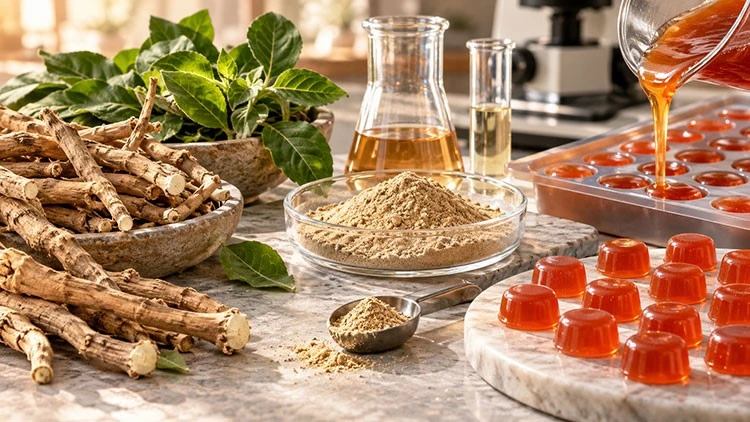
How Much Ashwagandha Is in Gummies?
Extract Weight from Marker Content: A 150mg extract (using withanolide content as markers) theoretically has 7.5mg of the markers, before taking into account analytical or production variations.
Each gummy of Full Serving has 150 mg of extract, which is 300 mg per serving. "Per gummy" and "per serving" should NOT be mixed up on a product specification.
Don't make a universal dose claim: Different studies have different amounts of extracts and dosages taken. The amount of evidence-based data to assume as appropriate for each gummy formulation is unknown.
Practical Loading: In some cases, high-load gummies may be difficult to develop, as the extract concentration can lead to higher bitterness and/or viscosity changes, and/or uniformity will be difficult.
What Makes Ashwagandha Gummies Taste and Feel Different?
Manage Botanical Bitterness: Earthy flavors, acid balance, and sweetener systems can help to soften the bitterness, but can also help to mask it in a few extracts.
Select the Gelling System: Pectin has a more plant-based profile, and gelatin has a different chew and processing profile. It can be said that neither one is better suited to carry ashwagandha.
Balance Moisture and Acidity – Water activity, pH, and solids concentration are important factors to consider for the texture and microbiological strength; adjustments to be made should be tried and then tested, and not copied from a standard confectionery recipe.

How Is Ashwagandha Gummy Stability Evaluated?
Measure Ingredient Retention: Stability tests should be performed on production and during storage, on selected extract markers by means of an appropriate validated analytical method.
Physical Change: Stickiness, hardening, color change, crystallization, flavor change that impact the acceptance of a gummy, even if it has the same shape.
Confirm Packaging Performance: Moisture-barrier containers, proper closures, and controlled storage will help to ensure the product's protection, but shelf life needs to be backed up by real data.
Review Processing Exposure: Mixing time, addition of ingredients to the process, and the addition point of the botanical should be evaluated for their impact on botanical content and gummy consistency.
Where Do Ashwagandha Gummies Fit in Supplement Development?
Single-Ingredient Concepts: Clear identity of the extract, easy serving instructions, and a taste that is ideally suited for everyday consumption.
Combination Concepts: Other botanicals or nutrients can be explored by brands but need to be reviewed separately, as well as the total amount in the product, label, and market-specific requirements.
Private-Label Differentiation: Exaggerated promises are not needed to differentiate products based on gummy shape, flavor, sweetener type, packaging count, and verified quality specifications.
What Do Ashwagandha Gummies Ultimately Do?
Ashwagandha gummies just supply a standardised herb that's offered in a flavored, measured pill form. Selected extracts of ashwagandha provide information to support the wellness claims, but the reliability of an ashwagandha finished gummy relies on the documented ashwagandha extract identity, a sensible serving design, standard production, and stability testing. Those factors will be more important than sweeping statements of what all gummies will be able to do.
Sentian Bio provides free samples, OEM/ODM customized products, and professional technical support. Contact us anytime at sales3@sentianbio.com or LEAVE A MESSAGE!
FAQ
1. What are Ashwagandha Gummies commonly used for?
Ashwagandha Gummies are typically marketed as an herb or natural supplement for daily general wellness, relaxation, and support for a healthy lifestyle in the face of stress. The outcome for consumers, however, is dependent on the extract and formulation used, and research bases should not be extended to all gummy products.
2. How many Ashwagandha Gummies should you take per day?
The number will vary based on the concentration of extract and the manufacturer's recommended serving size. It is important that consumers use product labels and any relevant professional advice and not presume that all Ashwagandha Gummies are the same.
3. Are Ashwagandha Gummies better than capsules?
There is no "best" way to do both of these formats. Gummies can be flavoured to taste to your preference, and capsules can have a higher dosage of ingredients without the need for sweeteners or gelling agents. The quality of the product, the specification of the extract, and the dosage form are more important than the dosage form itself.
4. Can Ashwagandha Gummies contain other ingredients?
Yes. It is possible to combine specific vitamins, minerals, or other botanicals into Ashwagandha Gummies. There should be compatibility, sensory properties, stability of the ingredients, and market regulations evaluated for each combination.
5. How should Ashwagandha Gummies be stored?
Ashwagandha Gummies are typically recommended to be stored in the correct packaging and at the recommended temperature as per the manufacturer's guidelines. Products may be affected by too much exposure to heat and moisture, which could affect their texture and quality. Guidelines for specific storage should be given following stability testing.
6. Are Ashwagandha Gummies suitable for everyone?
No. This is not suitable for everyone or for all ages, and cannot be used in conjunction with other products. There are no recommendations for the use of Ashwagandha in pregnant and breastfeeding women or for some people who may require more expert advice. There is limited information about the long-term safety.
References
1. Arumugam, V., Vijayakumar, V., Balakrishnan, A., Bhandari, R. B., Boopalan, D., Ponnurangam, R., Thirupathy, V. S., & Kuppusamy, M. (2024). Effects of Ashwagandha (Withania Somnifera) on stress and anxiety: A systematic review and meta-analysis. EXPLORE, 20(6), 103062.
2. Fatima, K., Malik, J., Muskan, F., Raza, G., Waseem, A., Shahid, H., Jaffery, S. F., Khan, U., Zaheer, M. K., Shaikh, Y., & Rashid, A. M. (2024). Safety and efficacy of Withania somnifera for anxiety and insomnia: Systematic review and meta-analysis. Human Psychopharmacology: Clinical and Experimental, 39(6), e2911.
3. Akhgarjand, C., Asoudeh, F., Bagheri, A., Kalantar, Z., Vahabi, Z., Shab-bidar, S., Rezvani, H., & Djafarian, K. (2022). Does ashwagandha supplementation have a beneficial effect on the management of anxiety and stress? A systematic review and meta-analysis of randomized controlled trials. Phytotherapy Research, 36(11), 4115–4124.
4. National Center for Complementary and Integrative Health. (2023). Ashwagandha: Usefulness and safety. National Institutes of Health.