


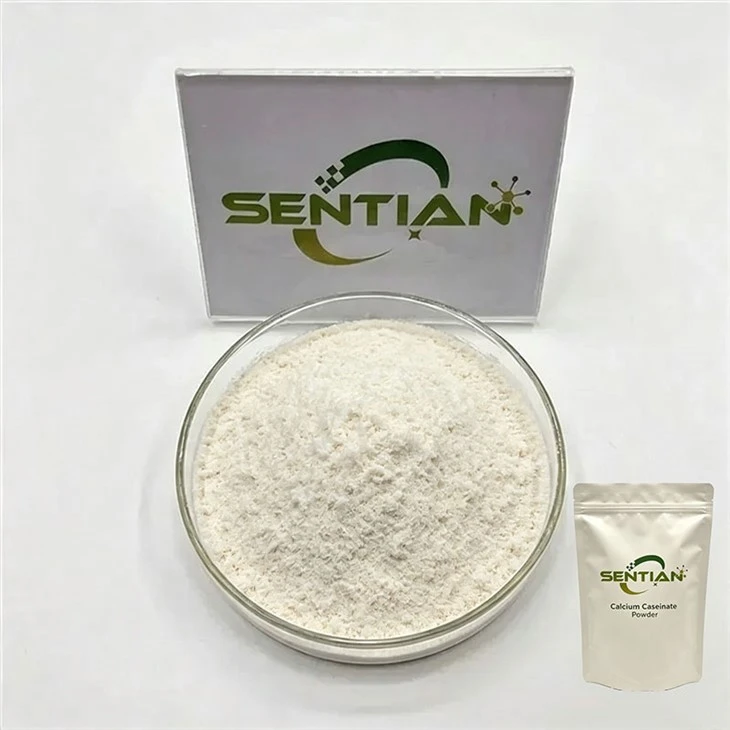
What is Calcium Caseinate Powder?
Calcium Caseinate Powder is a highly soluble and spray-dried milk protein ingredient that is produced by the controlled neutralization of fresh casein with calcium salts and is available as a versatile product to formulators as a slow-release protein source for industrial food and nutritional applications. It is made from top-quality skimmed milk powder and is a functional ingredient vital to manufacturers of commercial food, sport nutrition, dairy, and specialty beverages worldwide. It is used for its special combination of minerals, heat stability, and water-binding properties to enhance texture, structure, and viscosity in challenging matrix systems with minimal flavor impact. Its improved dispersibility enables its easy incorporation into high-temperature processes such as thermal extrusion, UHT, and high-protein baking formulations, among others, without any restrictions. It is extensively used in formulations for clean-label protein fortification in nutritional bars, meal replacement formulations, and processed dairy products, as well as for its smooth mouthfeel and controlled release properties. It is produced following stringent quality assurance procedures and is a very dependable and nutritious protein solution for complex, large-scale industrial product development projects for commercial clients.

COA
| Item | Specification | Result | Test Method |
| Appearance | Uniform cream to light yellow powder, free-flowing | Complies | Visual Inspection |
| Odor | Characteristic, clean, free from off-odor | Complies | Sensory Examination |
| Taste | Characteristic, mild dairy taste | Complies | Sensory Examination |
| Protein (Dry Basis) | ≥ 90.0% | 91.80% | Kjeldahl / ISO 8968 |
| Calcium (Ca) | 1.0–2.0% | 1.42% | ICP-OES |
| Casein Content | ≥ 90.0% | 91.20% | Calculated / Protein Analysis |
| Lactose | ≤ 1.0% | 0.32% | HPLC |
| Moisture | ≤ 5.0% | 3.18% | ISO 5537 |
| Ash | ≤ 8.0% | 6.24% | ISO 5984 |
| Fat | ≤ 2.5% | 1.16% | Soxhlet / ISO 1735 |
| pH (10% Solution) | 6.0–7.5 | 6.72 | Potentiometric Method |
| Dispersibility | ≥ 90% | 94.10% | Internal Method |
| Bulk Density | 0.35–0.65 g/mL | 0.48 g/mL | USP Method |
| Particle Size | ≥ 95% through 80 mesh | 98.20% | Sieve Analysis |
| Insolubility | ≤ 0.5% | 0.18% | Gravimetric Method |
| Lead (Pb) | ≤ 1.0 ppm | <0.10 ppm | ICP-MS |
| Arsenic (As) | ≤ 0.5 ppm | <0.05 ppm | ICP-MS |
| Cadmium (Cd) | ≤ 0.5 ppm | <0.05 ppm | ICP-MS |
| Mercury (Hg) | ≤ 0.1 ppm | <0.01 ppm | ICP-MS |
| Total Plate Count | ≤ 10,000 CFU/g | 1,200 CFU/g | ISO 4833-1 |
| Yeast & Mold | ≤ 100 CFU/g | <10 CFU/g | ISO 21527-2 |
| Coliforms | ≤ 10 CFU/g | <10 CFU/g | ISO 4832 |
| E. coli | Absent in 10 g | Absent | ISO 16649 |
| Salmonella | Absent in 25 g | Absent | ISO 6579-1 |
| Staphylococcus aureus | Absent in 1 g | Absent | ISO 6888-1 |
Sentian Bio provides free samples, OEM/ODM customized products, and professional technical support. Contact us anytime at sales3@sentianbio.com or LEAVE A MESSAGE!
Main Ingredients
Calcium Caseinate Protein is made from milk protein that is in its native form, and this is what is mainly used to provide nutrition in commercial formulations; this is the casein fraction, and it accounts for about 88% – 92% of the total dry matter in the powder. With an amino acid profile rich in essential amino acids, including branched-chain amino acids – leucine, isoleucine and valine – and glutamic acid, this complete protein provides a slow-digesting amino acid profile that is highly beneficial in the formulation of high-protein products. Elemental calcium is bound to the phosphate groups of the micellar phosphoprotein structure during the special neutralization process and is bioavailable. This structural binding not only offers a high protein density, but also a complementary dairy mineral matrix while maintaining the functional performance of the powder. The other composition is made up of naturally occurring milk minerals and has a very low residual lactose content and low bound fat content, which maintains a clean macronutrient base. For the industrial formulator, the presence of these intact phosphoproteins provides excellent water retention and thermal stability and will not change with various processing conditions. Its unique combination of high-purity protein fractions and bound calcium ions renders it a critical functional ingredient for technical applications to modify the nutritional profile of commercial food products, beverage bases, or specific nutritional matrices, allowing for control of the rheology.
Manufacturing Pathway
1. Acid Casein Curd Separation
Precipitation of the skimmed milk is carried out at a pH of 4.6, using food-grade mineral acid. This gives rise to acid casein curd, which is separated from the whey, washed several times with purified water to get rid of lactose and salt, and dewatered to a pure curd cake.
2. Calcium Slurry Neutralization
The wet curd is re-suspended in warm water to make a homogeneous slurry. Calcium carbonate or calcium hydroxide (food-grade) is fed into the system while the mixture is continuously stirred at 60°C–80°C, and the casein is converted to soluble calcium caseinate at neutral pH.
3. Maceration & Homogenization
The slurry goes through high-shear colloid mills and high-pressure homogenizers to ensure complete solubilisation and flowability of the colloidal particles, although they are characteristic.
4. Concentration & Spray Drying
After being homogenized, the solution is heated and concentrated in a thermal evaporator to raise the total solids content, before being atomized into a high-capacity spray drying chamber where hot filtered air quickly evaporates the moisture into fine, free-flowing powder-sized particles.
5. Cooling, Sifting & Packaging
Calcium Caseinate Protein Powder is fluidized, then screened through industrial safety sieves for the desired grain size and hygienically packed in multi-wall paper bags that have PE linings for bulk distribution.

Safety
Calcium Caseinate is a food-grade, purified milk protein derivative with a naturally high safety profile as a defined component of food production in accordance with the GRAS regulations of the U.S. FDA and fully compliant with EFSA guidelines for industrial food production. It is naturally found in pasteurised skimmed milk, and its main component is the whole casein phosphoprotein complex, which is combined with elemental calcium and is a stable biological macromolecule that nonreactively incorporates into a variety of food systems. The ingredient is shown to have high thermal stability in normal processing and will not be thermally degraded or form toxic derivatives during food production under high-temperature conditions. It is physically and chemically stable under normal packaging and storage conditions, in that it does not undergo autoxidation or chemical instability, maintaining the integrity of the macronutrients. It is derived from dairy products and therefore has only general dairy allergen concerns because of the presence of the native casein proteins. In commercial formulations, it is a proven and safe protein component in the formulation, which complies globally with food safety standards for commercial use.
FAQ
1. What is the shelf life and storage requirement for bulk calcium caseinate powder?
It will generally have a shelf life of 24 months when packaged in the original container in a cool, dry place with a relative humidity less than 65% and a temperature less than 25°C (77°F).
2. How does calcium caseinate compare to sodium caseinate in food processing?
Calcium caseinate has greater thermal stability and lower viscosity than sodium caseinate in high-concentration solutions, making it suitable for matrices that are heat-treated and in structural applications.
3. Does calcium caseinate powder fully dissolve in water?
It is a non-ionic, non-toxic, stable, milky product that is a colloidal suspension and not a clear solution, which means that it has high dispersion, excellent water-holding ability, and smooth emulsification in liquids.
4. Is calcium caseinate powder suitable for heat-processed applications?
Yes, its high thermal stability makes it suitable to handle thermal extrusion, UHT processing, and baking without breaking down the structure or altering flavors.
5. What regulatory certifications and allergen declarations apply to this product?
As a food ingredient, it meets the requirements of US FDA GRAS / EFSA. It is made from milk, so it must be declared as such on final product packaging.
Production Process

Certificate

Exhibition
