


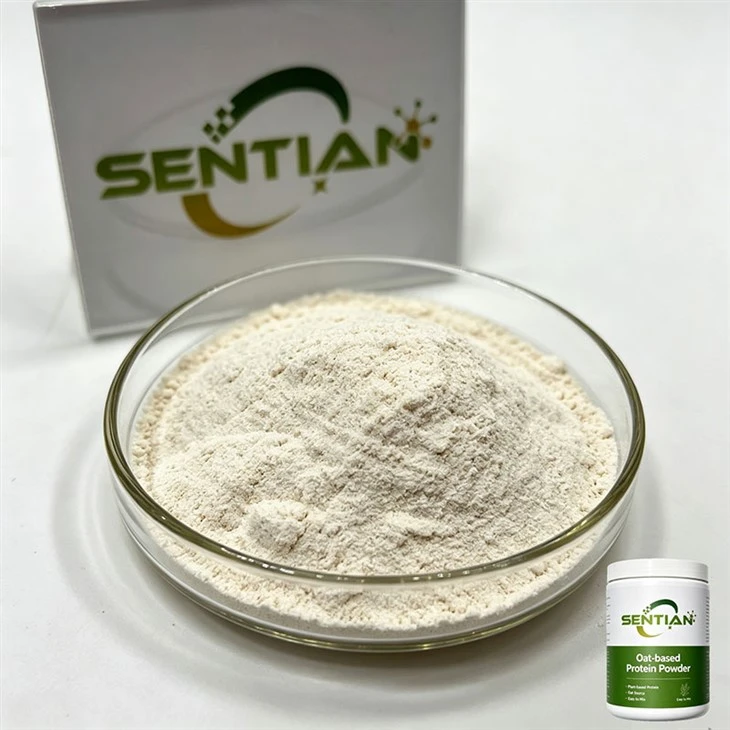
Xi'an Sentian Biotechnology Co., Ltd. is one of the leading manufacturers and suppliers of oat-based protein powder in China. We are committed to providing high quality customized service and OEM&ODM private label service for global clients. Please feel free to buy bulk oat-based protein powder in stock here from our factory. Also, free sample is available.
What is Oat-based Protein Powder?
Oat-based Protein Powder is a plant protein powder made from whole oats, which are processed to isolate the natural protein in the grain and preserve the beneficial dietary fibre and complex carbohydrates. We are the leading B2B supplier and ingredient manufacturer, offering high-purity, premium protein powder based on oats, specially formulated to satisfy the high-quality standards of global food, beverage, and nutrition brands. This multi-purpose ingredient provides a great amino acid profile, a neutral taste, and excellent techno-functional properties, making it a great choice for clean-label formulations. As a result, formulators are increasingly using oat protein in plant-based dairy alternatives, functional bakery foods, sports nutrition powders, and ready-to-drink beverages to create products with enhanced nutritional benefits and mouthfeel and to provide sustainable plant nutrition. It is sourced from non-GMO oats, providing the consistency in quality, allergen-friendly positioning, and batch-to-batch reliability required in industrial-scale production. B2B customers benefit from completely traceable, easily adaptable protein solutions to meet modern consumer expectations, with a focus on sustainable, allergen-free, and plant-based nutrition.

COA
| Item | Specification | Result | Test Method |
| Product Name | Oat-based Protein Powder | Oat-based Protein Powder | - |
| Protein Content (Dry Basis) | ≥ 50.0% | 52.60% | AOAC |
| Moisture | ≤ 8.0% | 5.40% | AOAC |
| Ash | ≤ 8.0% | 4.70% | AOAC |
| Dietary Fiber | ≤ 12.0% | 8.30% | AOAC |
| Fat | ≤ 8.0% | 5.10% | AOAC |
| Total Carbohydrates | ≤ 30.0% | 24.60% | Calculation |
| Particle Size | ≥ 95% Pass 80 Mesh | 98.2% Pass | Sieve Analysis |
| Bulk Density | 0.35–0.65 g/mL | 0.48 g/mL | USP |
| pH (10% Suspension) | 6.0–7.5 | 6.6 | pH Meter |
| Color | Cream to Light Beige | Conforms | Visual |
| Odor | Characteristic, Free from Off-Odor | Conforms | Organoleptic |
| Taste | Characteristic, Mild Oat-Like | Conforms | Organoleptic |
| Dispersibility | ≥ 85% | 91% | In-House Method |
| Solubility | ≥ 80% | 86% | In-House Method |
| Total Plate Count | ≤ 10,000 CFU/g | 1,200 CFU/g | USP <61> |
| Yeast & Mold | ≤ 500 CFU/g | 80 CFU/g | USP <61> |
| Coliforms | ≤ 100 CFU/g | <10 CFU/g | USP |
| E. coli | Absent/g | Absent | USP |
| Salmonella | Absent/25 g | Absent | USP |
| Staphylococcus aureus | Absent/g | Absent | USP |
| Aflatoxin B1 | ≤ 5 ppb | <1 ppb | HPLC |
| Total Aflatoxins | ≤ 10 ppb | <2 ppb | HPLC |
| Lead (Pb) | ≤ 1.0 ppm | 0.08 ppm | ICP-MS |
| Arsenic (As) | ≤ 0.5 ppm | 0.05 ppm | ICP-MS |
| Cadmium (Cd) | ≤ 0.5 ppm | 0.03 ppm | ICP-MS |
| Mercury (Hg) | ≤ 0.1 ppm | <0.01 ppm | ICP-MS |
| Gluten | ≤ 20 ppm | <10 ppm | ELISA |
| Allergen Status | Contains Oat; Gluten Status According to Raw Material & Process Controls | Conforms | Declaration |
| GMO Status | Non-GMO | Conforms | Declaration |
| Irradiation Status | Not Irradiated | Conforms | Declaration |
| Melamine | ≤ 2.5 mg/kg | <0.1 mg/kg | LC-MS/MS |
Sentian Bio provides free samples, OEM/ODM customized products, and professional technical support. Contact us anytime at sales3@sentianbio.com or LEAVE A MESSAGE!
Market Trends
The global market for Oat Protein Powder is witnessing healthy growth facilitated by macroeconomic trends moving towards sustainable agriculture, plant-forward nutrition, and the trend of clean labels. In recent years, consumers have been more concerned than ever about the transparency of food and drink sources, as well as their allergen levels and environmental impact, so industrial food and beverage companies are quickly incorporating plant-based proteins from cereals such as oats into new products. The macro-level growth is complemented by the diversification of the supply chains and by the various regulatory requirements related to the sustainable supply of agricultural ingredients; this makes products containing oats a key player in product innovation in the future. "Commercial demand has picked up in the bakery, dairy alternatives, and functional beverage categories for enterprises tapping into this momentum to scale up production capacity to meet the growing demands of their business." Moreover, progress in extraction technologies enables ingredient manufacturers to offer high-quality solubility and sensory properties as demanded by the commercial market for high-performing functional ingredients. With its adaptation to these industry-wide trends, B2B brands are poised to gain market share in the flourishing world of plant-based nutrition.
Features
It has unique physicochemical properties and functional characteristics that render it an extremely useful and versatile raw material in the development of sophisticated food and beverage products. Plant protein with an amino acid balance, neutral organoleptic properties, and good water-binding and emulsifying properties, which easily fits into complex food matrices without harming the food properties. It is a suitable product for industrial manufacturing production lines where thermal processing, extrusion, and homogenization processes are involved, thanks to its stable viscosity behavior in different pH and temperature conditions. The Protein Oats Powder's natural dispersibility and ability to work well with other hydrocolloids and plant ingredients enable R&D teams to fine-tune mouthfeel, decrease graininess of high-protein drinks, and enhance structuring in baked goods and dairy alternatives. Furthermore, the low allergenicity and low anti-nutritional factors reduce processing needs and fulfil clean labelling formulation criteria. These exact technical features enable food scientists and product developers to have the best possible rheological performance, obtain stability, and achieve reproducible quality in commercial-scale production runs.

Benefits
1. Enhanced Emulsification & Oil Retention:
Oat Protein has superior fat-binding properties, enabling the industrial food engineer to stabilize more complex oil-in-water emulsions in creamy plant-based food products, such as sauces and dressings, and processed oil-in-water analog products, without the use of synthetic chemical additives.
2. Optimized Thermal Stability:
Resists unwanted protein aggregation and precipitation during high-temperature processing, such as UHT pasteurization, retort canning, high-pressure sterilization, and continuous industrial extrusion lines, while maintaining structural integrity.
3. Viscosity Enhancement & Mouthfeel Modification:
Gives a natural smooth, creamy, and viscous texture to liquid food formulations, ensuring that there is no chalky aftertaste and that the functional beverages can reproduce the rich sensory mouthfeel of traditional dairy ingredients.
4. Synergistic Blend Compatibility:
Complements total amino acid profiles and overall functional performance in multi-ingredient nutritional formulations when blended with other legume proteins and cereal proteins, including pea protein isolate, rice protein isolate and soy protein isolate.
5. Reduced Syneresis in Gels:
Actively manages internal moisture migration and also prevents water separation in frozen desserts, puddings, dairy substitutes, and bakery fillings during extended commercial shelf-life storage periods, which ensures uniformity in product presentation and quality.
FAQ
Q1: What is oat-based protein powder?
A: It is an ingredient derived from plants that is processed to extract the natural proteins from whole oats, used by B2B brands within dairy alternatives, bakery products, and nutritional beverages.
Q2: What are its key physicochemical properties?
A: It has a balanced amino acid profile, neutral taste, and consistent water-binding, emulsifying, and gel-forming properties, which provide stable viscosity over a range of pH and temperature.
Q3: Is oat protein allergen-friendly and clean-label?
A: Yes, it can be naturally hypoallergenic and harvested through responsible processes without the use of synthetic solvents to support clear ingredient labelling.
Q4: How does it perform under high temperatures?
A: It provides maximum thermal stability, keeping structures intact and protein aggregation at bay while undergoing UHT pasteurization, retort canning, and extrusion.
Q5: Can it be blended with other plant proteins?
A: Yes, it has excellent synergistic compatibility with legume and cereal proteins such as pea protein isolate, rice protein isolate, and soy protein isolate to balance the functional performance in multi-ingredient formulations.
Production Process

Certificate

Exhibition
