


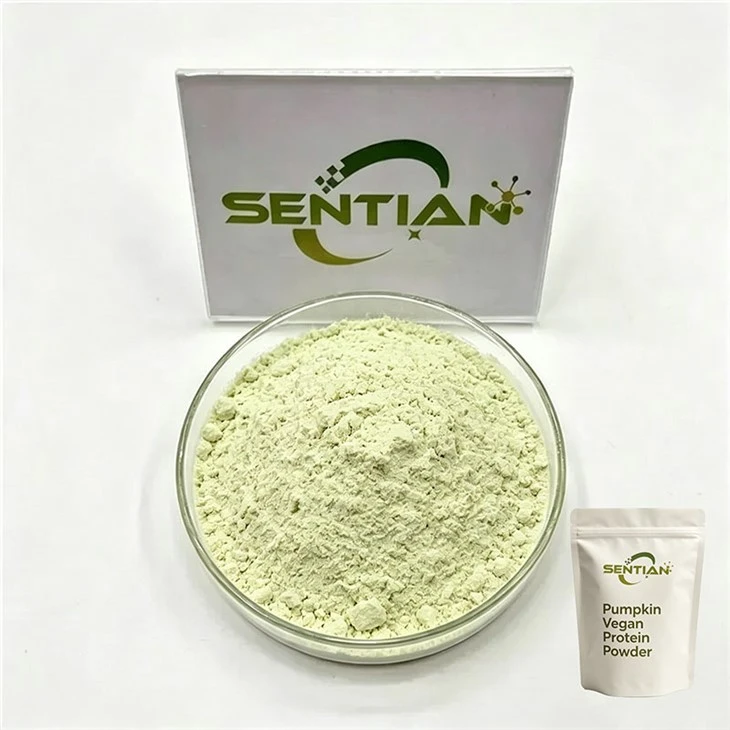
Xi'an Sentian Biotechnology Co., Ltd. is one of the leading manufacturers and suppliers of pure pumpkin seed protein powder in China. We are committed to providing high quality customized service and OEM&ODM private label service for global clients. Please feel free to buy bulk pure pumpkin seed protein powder in stock here from our factory. Also, free sample is available.
What is Pure Pumpkin Seed Protein Powder?
Pure Pumpkin Seed Protein Powder is a high-grade refined botanical protein isolate that is specifically developed for procurement, wholesale distribution, and bulk food and beverage processing. This premium-quality, concentrated vegetable ingredient is made from high-quality seeds of Cucurbita pepo, selected using precise mechanical pressing and multi-stage separation processes, resulting in a vegetable ingredient of exceptional nutritional value, without any complex chemical modification. It can be used as a key ingredient for companies developing new-generation sport nutrition supplements, functional bakery applications, extruded snack applications, and alternative dairy products. It is free from common allergens – including soy, dairy, gluten and tree nuts – making it an ideal natural ingredient for industrial formulators to create a safe and inclusive product portfolio that appeals to a variety of consumer markets. Of course, the powder has a fine particle architecture, reliable thermal stability and good moisture retention, which allows it to be easily added to automatic dry-blending and high-pressure extrusion lines. The clean label integrity in its mild, earthy, and pleasantly nutty sensory profile reduces the need for large amounts of artificial flavoring or masking agents. Rigorous international manufacturing certifications such as ISO, HACCP, and GMP ensure that this wholesale ingredient is reproducible from batch to batch, fully compliant with regulations and completely traceable from agricultural origin to commercial use.

COA
| ITEM | SPECIFICATION | TEST RESULT |
| Physical & Organoleptic Tests | ||
| Appearance | Fine free-flowing powder | Complies |
| Color | Light Green to Greenish-Brown | Complies |
| Odor | Characteristic, Nutty | Complies |
| Taste | Characteristic, Mild Nutty | Complies |
| Particle Size | NLT 95% through 80 mesh | 98.20% |
| Bulk Density | 0.30–0.70 g/mL | 0.52 g/mL |
| Chemical & Nutritional Analysis | ||
| Protein (Dry Basis) | NLT 60.0% | 64.80% |
| Moisture | NMT 8.0% | 5.72% |
| Ash | NMT 8.0% | 6.21% |
| Fat | NMT 12.0% | 8.46% |
| Crude Fiber | NMT 8.0% | 5.34% |
| pH (10% Suspension) | 6.0–7.5 | 6.72 |
| Heavy Metals | ||
| Lead (Pb) | NMT 0.5 mg/kg | 0.12 mg/kg |
| Arsenic (As) | NMT 0.5 mg/kg | 0.08 mg/kg |
| Cadmium (Cd) | NMT 0.5 mg/kg | 0.06 mg/kg |
| Mercury (Hg) | NMT 0.1 mg/kg | <0.01 mg/kg |
| Mycotoxins | ||
| Aflatoxin B1 | NMT 2.0 μg/kg | <0.5 μg/kg |
| Total Aflatoxins (B1+B2+G1+G2) | NMT 4.0 μg/kg | <1.0 μg/kg |
| Ochratoxin A | NMT 5.0 μg/kg | <1.0 μg/kg |
| Microbiological Analysis | ||
| Total Plate Count | NMT 30,000 CFU/g | 2,600 CFU/g |
| Yeast & Mold | NMT 300 CFU/g | 45 CFU/g |
| Coliforms | NMT 100 CFU/g | <10 CFU/g |
| E. coli | Negative | Negative |
| Salmonella | Negative / 25 g | Negative |
| Staphylococcus aureus | Negative / 25 g | Negative |
Sentian Bio provides free samples, OEM/ODM customized products, and professional technical support. Contact us anytime at sales3@sentianbio.com or LEAVE A MESSAGE!
Industry Background
The structure of the global market for botanical protein concentrates is undergoing a complete transformation, with the perceived need for new procurement criteria, the growing demand for commercial applications of circular use of agriculture, and the transformation of companies towards sustainable food systems. In this growing macrocosm, Pumpkin Seed Protein Powder has emerged as an essential, valuable raw material for commercial food, drink, and nutritional supplement companies around the world. With the increased scrutiny on food allergen labelling and environmental sustainability, industrial formulators are increasingly under pressure to find alternative sources for their crop-based ingredients and diversify into hypoallergenic, seed-based ingredients. Global consumer trends also support this trend towards more minimally processed components that come with a clean label and are traceable and transparent in their supply chain, starting from the agricultural origin and ending at the commercial packaging. In response, upstream producers and extraction equipment are stepping up to provide increased precision cold-pressing and multi-stage separation processes, reducing protein contamination and providing sensory neutrality, and eliminating batch-to-batch variation for industrial purchasers. As a result, the use of pumpkin ingredients has seen a growing uptake among global procurement teams all over North America, Europe, and Asia-Pacific, in the production of large production orders for sports nutrition, functional baking, and alternative dairy products, providing market stability and adhering to the strict food safety standards in the international market.
Development History
It is a part of the technological shift towards high-efficiency, dedicated botanical extraction from oilseed processing waste streams in the global plant-based ingredient market. Pumpkin seeds have been mainly grown for edible kernels and pumpkin oils for culinary uses, and the press cake from the seeds is often used as a low-value animal feed or organic fertilizer. Over the last 20 years, however, with the progress of food science and mechanical milling techniques, industrial researchers were able to appreciate the excellent nutritional and functional qualities that lay in the oilseed matrix. Initial commercialization stages used basic grinding methods to produce coarse dark meals that were poorly soluble and highly flavoured and so could only be used in simple livestock feed and simple formulations. Developers realized that the raw material could be upgraded into a refined, high-purity vegetable protein concentrate through continuing innovations in low-temperature cold-pressing, precise air-classification and multi-stage aqueous separation. The breakthroughs made in the manufacture of these products upstream achieved the elimination of bitter off-notes, enhancement of powder flowability, and the stabilization of protein content to meet the strict manufacturing criteria used to procure these products. The recent development of sustainable food engineering and the circular agriculture economy has created Pumpkin Protein Powder products as global commodities. Today, state-of-the-art extractions are carried out in strict industrial food manufacturing standards (ISO, HACCP, etc.) and delivered to the commercial food formulators of the world as reliable, scalable, and traceably sourced protein ingredients to support modern industrial food manufacturing.

Application
1. Sports Nutrition & Performance Powders:
Pumpkin Vegan Protein Powder formulated as part of bulk dry-blended supplement formulations, post-workout recovery mixes, and protein supplements for fitness brands, to provide clean, hypoallergenic, vegetable protein.
2. Functional Baking & Confectionery:
Combined with commercial bread doughs, cookies, energy slabs, and high-protein pastry formulations to improve structural properties and increase the nutrient value without reducing the activity of yeast.
3. Extruded Snack Manufacturing:
It is used as a key constituent of high-pressure textured snack nuggets, savory crisps and puffed breakfast cereals and is an industrial cooking base that resists heat.
4. Plant-Based Dairy Alternatives:
Vegan creamers, dairy-free yogurt formulations, and liquid beverage bases and ingredients used to enhance the mouthfeel, opacity, emulsion stability, and keep ingredient statements clean.
5. Meat Analogues & Culinary Formulations:
Used as a binding and functional texturing ingredient for plant-based burger patties, vegetarian sausage, and ready-to-eat meat products to create a meat bite texture.
FAQ
1. What is the standard bulk packaging and MOQ?
Answer: 20kg/25kg food grade lined paper bag or fiber drum; the MOQ can be increased or decreased according to customers' requirements and can be increased for pilot testing or production run.
2. How is the protein processed without chemical degradation?
Answer: It is produced by low-temperature mechanical cold-pressing and more precise air classification without using chemical solvents, to preserve the natural structure.
3. What export and compliance documents are provided?
Answer: Each batch comes with a Certificate of Analysis (CoA), non-GMO, allergen, and ISO/HACCP statements.
4. Can particle size or solubility be customized?
Answer: Yes. Parameters for grinding can be set according to the beverage, baking, or extrusion applications.
5. What are the recommended storage conditions and shelf life?
Answer: Keep out of direct sunlight and in a dry place, in closed containers. The shelf life is up to 24 months.
Production Process

Certificate

Exhibition
