


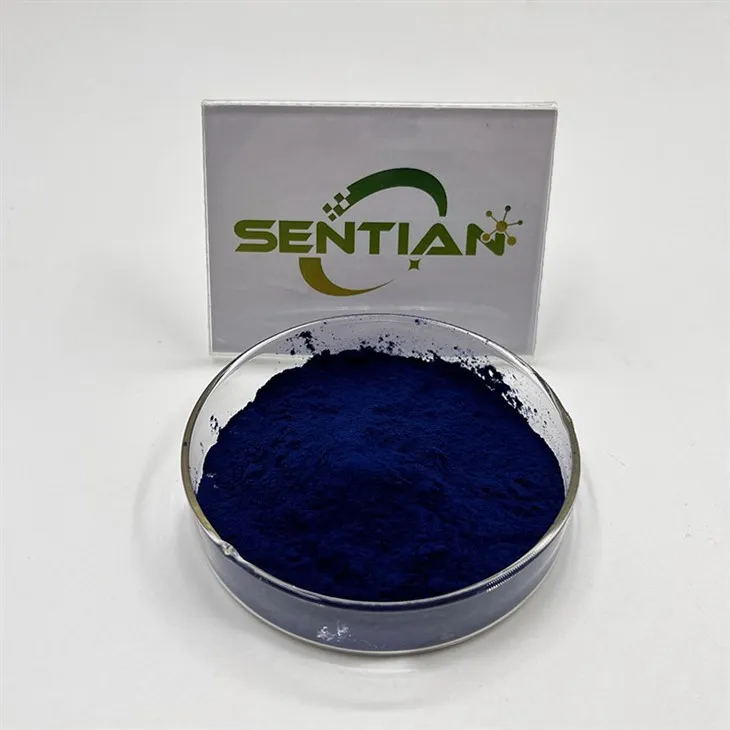
Xi'an Sentian Biotechnology Co., Ltd. is one of the leading manufacturers and suppliers of blue spirulina extract in China. We are committed to providing high quality customized service and OEM&ODM private label service for global clients. Please feel free to buy bulk blue spirulina extract in stock here from our factory. Also, free sample is available.
What is Blue Spirulina Extract?
The Blue Spirulina Extract is a natural blue pigment ingredient extracted from Spirulina biomass, which is mainly extracted and purified by the phycocyanin-based ingredient to be used as a natural blue pigment in industrial applications. It is targeted at manufacturers in the food, beverage, cosmetics, and formulation industry that are looking for a high-performing natural blue color solution that is stable and not plant-based. It is further processed to maximize the amount of color-containing products and to minimize the effect of the green chlorophyll, leading to a purer blue color, which can be used for a high-end product image positioning. In manufacturing, it is usually available in standard grades that are correlated with the color intensity, solubility, and purity consistency, which can be used to position the end product and process requirements. It is very soluble in water-based systems and can be used in beer, confectionery glazes, frozen desserts, plant-based alternatives to dairy and cosmetic emulsions where appearance is an important design consideration.

COA
.
| Test Item | Specification | Result | Method |
| Color Value (E1% 618nm) | ≥ E18 / Customized | Conforms | UV-Vis |
| Odor | Characteristic | Conforms | Organoleptic |
| Solubility | Soluble in water | Conforms | Solubility Test |
| Moisture | ≤ 7.0% | Conforms | AOAC |
| Ash | ≤ 10.0% | Conforms | AOAC |
| pH (1% solution) | 5.5 – 7.5 | Conforms | pH Meter |
| Phycocyanin Content | ≥ 20% / Customized | Conforms | UV / HPLC |
| Protein Content | Reported Value | Conforms | Kjeldahl |
| Chlorophyll | Within specification limit | Conforms | UV-Vis |
| Heavy Metals (Total) | ≤ 10 ppm | Conforms | ICP-MS |
| Lead (Pb) | ≤ 1.0 ppm | Conforms | ICP-MS |
| Arsenic (As) | ≤ 1.0 ppm | Conforms | ICP-MS |
| Cadmium (Cd) | ≤ 0.5 ppm | Conforms | ICP-MS |
| Mercury (Hg) | ≤ 0.1 ppm | Conforms | ICP-MS |
| Total Plate Count | ≤ 1,000 CFU/g | Conforms | AOAC |
| Yeast & Mold | ≤ 100 CFU/g | Conforms | AOAC |
| E. coli | Negative | Negative | AOAC |
| Salmonella | Negative / 25g | Negative | AOAC |
| Preservatives | None Added | Conforms | - |
| Residual Solvents | Not Detected | Conforms | GC |
| Irradiation | Non-irradiated | Conforms | Statement |
Sentian Bio provides free samples, OEM/ODM customized products, and professional technical support. Contact us anytime at sales3@sentianbio.com or LEAVE A MESSAGE!
Industry Background
The background is correlated with the transition of synthetic dyes to natural dye sources from plants in the food, beverage, and cosmetic industries. This change is motivated by the adoption of stricter rules for artificial additives, the popularity of clean-label positioning claims, and a growing desire for transparent and clear ingredient sourcing. Therefore, materials derived from Spirulina have emerged as an important part of the natural colorant market as they are easily renewable and can be used to produce blue pigment compounds, which are based on phycocyanin. Phycocyanin Powder is a refined ingredient of spirulina, extracted via a selective extraction/purification process to concentrate the blue pigment fraction and to reduce the content of chlorophyll and increase the clarity and consistency of the pigment in industrial applications. Technological developments in microalgae cultivation, such as controlled cultivation systems, better harvesting methods, and more efficient downstream processing (membrane filtration and stabilization technologies) in order to improve the stability and color performance reliability of the batches, contribute to its development. Industries like beverages, confectionery, plant-based foods, and cosmetic formulations are increasingly turning to natural blue color to enable product differentiation and achieve clean label strategies, among other reasons. Meanwhile, the traceability and the stability of the industrial supply have been made more standardized and scaled up, so as to have a more stable supply in the industry.
Development History
The development of Blue Spirulina Phycocyanin Powder mirrors the history of the utilization and technology of natural colorants in the world's ingredient industry, particularly that of microalgae. Potential applications in the early stage were primarily as a whole biomass source, for basic food and formulation, as its green colour was a hindrance in blue colour product design. As natural and uniquely colored products became in demand, the pigment portion of spirulina was of interest, particularly its blue coloring pigment phycocyanin. Initial products were developed using early extraction methods, which separated and concentrated this pigment fraction, but were limited in color stability and consistency, and were hard to scale up into industrial products due to relatively simple extraction processes. As the technology for grower systems and downstream processing was improved, more advanced systems and processes were developed, such as controlled grow environments, optimised harvesting processes, and multi-stage purification systems. The enhancements allowed the production of a higher concentration of pigment, increased color clarity, and more consistent color performance of batches. Advancements in membrane filtration and extraction processes put in place gentle extraction methods, which improved the product quality and allowed for minimizing unwanted colour interference, leading to an increased reliability of the industrial application. Meanwhile, there was an increasing demand for clean-label and plant-based ingredients, which drove its applications into beverages, confectionery, plant-based foods, and cosmetic formulations.

Application
1. Beverage Industry
Supporting product development with a unique and attractive blue color, used in still drinks, sparkling drinks, and flavored water systems as a natural colorant.
2. Confectionery Products
Blue Spirulina Powder is used for stable blue colouring in the appearance of sugar-based products such as candies, gummies, and sugar coating in order to improve the overall appearance of the product and to create a sense of shelf differentiation.
3. Plant-Based Food Formulations
Built into the dairy alternative products (dairy-free milk, dairy-free desserts, and plant-based yogurts) that are naturally coloured and where natural colour serves as a support to product identity and formulation aesthetics.
4. Bakery and Dessert Decoration
Used in icings, creams, toppings, and frozen desserts to give a uniform blue colour in the product designs, especially for seasonal and decorative products.
5. Cosmetic and Personal Care Products
Used in water-based cosmetic products like facial masks, gels, and emulsions for visual effect and added value of the product origin in the positioning of the product.
6. Functional Powder Blends
Used in dry mix formulations such as beverage powders, instant drink powders, and others, for visual differences in products when reconstituted.
Factory

Certificate

Exhibition
