


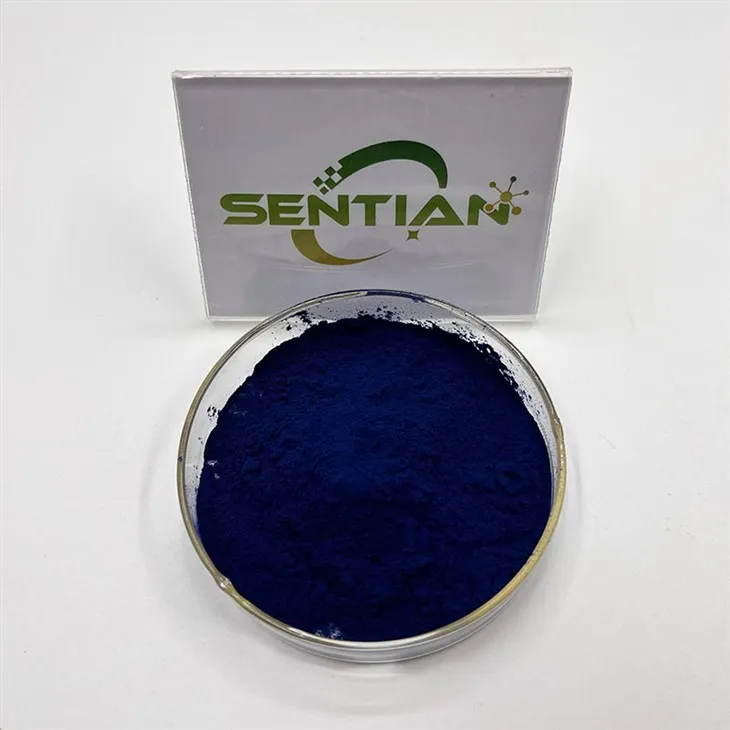
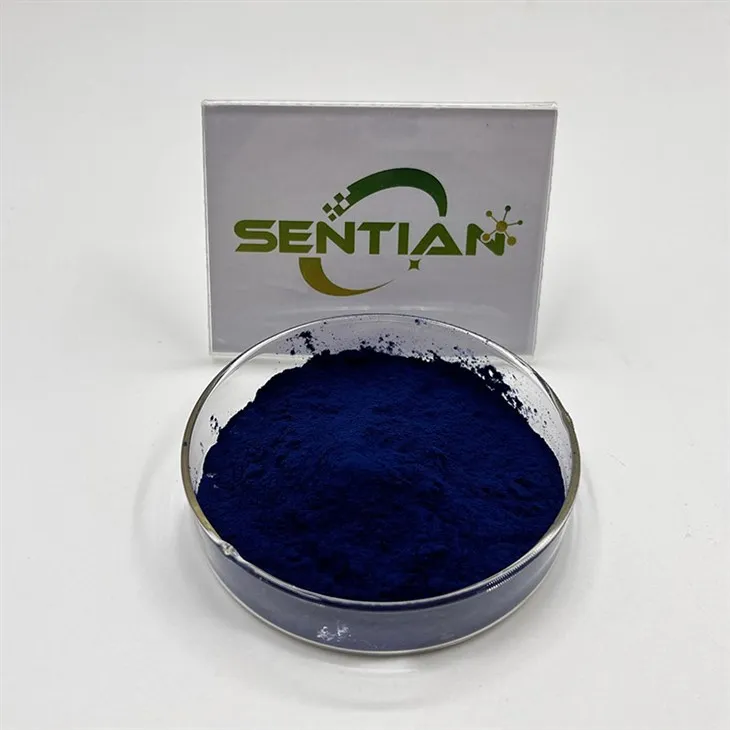
Xi'an Sentian Biotechnology Co., Ltd. is one of the leading manufacturers and suppliers of phycocyanin powder in China. We are committed to providing high quality customized service and OEM&ODM private label service for global clients. Please feel free to buy bulk phycocyanin powder in stock here from our factory. Also, free sample is available.
What is Phycocyanin Powder?
Phycocyanin Powder is a natural blue pigment-protein mainly extracted from Spirulina (Arthrospiris platensis) and is one of the most popular natural pigments and functional foods used in food, beverage, and cosmetic factories. It is a blue water-soluble phycobiliprotein that can be used as a dye in clean-label formulations, an alternative to synthetic dyes. The main properties are its high colour strength, ability to withstand processing under controlled conditions, and versatility with various product matrices such as beverages, confectionery, milk products, nutritional powders, and cosmetic products like masks and skin care products. It is usually provided in standardized grades, in relation to colour value (E6-E18 or above), purity, and extraction techniques based on a variety of markets and manufacturers' needs to position their product. It is often subjected to water extraction and purification processes to guarantee uniformity, traceability, and batch-to-batch consistency in order to provide large-scale production and export-oriented supply chains. It is a plant-based colour, which is suitable for the current need for natural colours in the food and personal care industry.

COA
| Test Item | Specification | Result | Test Method |
| Appearance | Blue Fine Powder | Conforms | Visual |
| Odor & Taste | Characteristic | Conforms | Organoleptic |
| Identification | Positive | Conforms | TLC |
| Color Value | E18 Min | E18.6 | UV-Vis Spectrophotometry |
| C-Phycocyanin | ≥ 15.0% | 0.16 | UV-Vis Spectrophotometry |
| Loss on Drying | ≤ 7.0% | 0.04 | USP <731> |
| Ash Content | ≤ 8.0% | 0.05 | USP <281> |
| Particle Size | 95% Through 80 Mesh | Conforms | USP <786> |
| Bulk Density | 0.30–0.60 g/ml | 0.48 g/ml | USP Method |
| Heavy Metals | ≤ 10 ppm | <10 ppm | ICP-MS |
| Lead (Pb) | ≤ 2.0 ppm | <0.5 ppm | ICP-MS |
| Arsenic (As) | ≤ 1.0 ppm | <0.2 ppm | ICP-MS |
| Cadmium (Cd) | ≤ 1.0 ppm | <0.1 ppm | ICP-MS |
| Mercury (Hg) | ≤ 0.1 ppm | <0.01 ppm | ICP-MS |
| Total Plate Count | ≤ 10,000 CFU/g | <1,000 CFU/g | USP <2021> |
| Yeast & Mold | ≤ 100 CFU/g | <10 CFU/g | USP <2021> |
| E. coli | Negative | Negative | USP <2022> |
| Salmonella | Negative/25g | Negative | USP <2022> |
| Staphylococcus aureus | Negative | Negative | USP <2022> |
Sentian Bio provides free samples, OEM/ODM customized products, and professional technical support. Contact us anytime at sales3@sentianbio.com or LEAVE A MESSAGE!
Market Trends
Blue Spirulina Powder market is projected to witness steady growth across the globe by highlighting the growing trend of using natural, clean-label, and plant-based ingredients in the food, beverage, cosmetics, and other industrial applications. With regulatory scrutiny rising around synthetic colourants in several countries, manufacturers are committing to accelerate the reformulation process and to use natural blue colourants to comply with labelling transparency and regulations. Meanwhile, end-user demand is growing as preference for a simple, easily recognized, and contained ingredient list is growing, further enhancing the role phycocyanin plays in mainstream and premium product development. Key applications like plant-based dairy alternatives, confectionery, bakery decoration systems, and cosmetic formulations use it for its strong visual performance and plant-based positioning of use. At a macro level, the market is also being driven by the advancement of technologies in spirulina cultivation, extraction, and purification. These include increased color intensity, stability, and batch consistency, which are advantages for the industrial market. This helps to ensure more consistent and widespread adoption and less formulation variability. Furthermore, the supply chain is becoming more structured and export-oriented, thus facilitating the dispersion of the products around the world and promoting a more homogeneous product.
Features
It is the natural pigment-protein extracted from Spirulina, extracted in a water-soluble form, and is a highly coloured, light-absorbing pigment in the orange-red part of the spectrum, allowing the use of relatively low dosage levels to achieve high colour efficiencies when used in industrial formulations. It is seen as fine flowing powder which disperses well in aqueous systems, and is easily incorporated into liquid and semi-liquid matrices without having to perform complicated pre-dissolution processes. When dissolved, it yields a clear to slightly translucent blue solution which can be used in beverage systems, syrups, dairy alternatives, confectionery coatings, and water-based cosmetic formulations of varying purity and concentrations. It is a protein-based pigment and has inherent sensitivity to handling procedures, such as high temperature, light, and extreme conditions of pH, which may cause instability in color and intensity of the pigments. It works best in a mild pH environment and is best for cold processing systems and/or post-thermal addition in manufacturing operations. Colour changes and degradation can occur in strong acid or alkaline conditions due to the change in pH, which is important in maintaining the uniformity of colour. Furthermore, Blue Spirulina Extract is sensitive to oxidative conditions because of its protein structure, and formulators often stabilise it by using an encapsulating technology, a protective carrier system, or a formulation matrix compatible with protein.

Benefits
1. Clean-label positioning advantage
Blue Spirulina Phycocyanin can be utilized in product labelling solutions focusing on natural ingredients and meeting the new market expectations for clean labels and transparency.
2. High visual differentiation efficiency
Gives a high-quality, easily differentiated blue colour and enhances the visual appeal and product identity of the product designs in competitive product categories.
3. Formulation flexibility in aqueous systems
It is water-soluble, making it possible to be added to a variety of liquid formulations, and its formulation efficiency could be used to reduce the complexity of dispersion.
4. Low dosage effectiveness
With its high tinting strength, only small amounts are needed for colour effect and can help to optimize formulation balance in industrial production.
5. Plant-derived sourcing compatibility
Being an ingredient based on spirulina, it is well positioned in the positioning of products of plant origin, in line with the procurement trends, which are increasingly geared towards the use of renewable and bio-based raw materials.
6. Broad application adaptability
It lends its versatility to various product categories, including beverages, coatings for confectionery, dairy alternatives, and cosmetic systems, and can be formulated in a variety of different product categories.
7. Support for product innovation development
It is available in a very special blue colour, allowing to develop differentiated product concepts, advancing the innovation of new product launches, or to formulate with a seasonal colour.
Production Process

Certificate

Exhibition
