


Creatine Gummies are an effective formulation of creatine when they contain the proper dose of creatine, contain stable ingredients, and are made with quality control assurance.
What Makes Creatine Gummies Effective as a Supplement Format?
Creatine gummies are an updated form of supplement that contain creatine in a chewable capsule. They work best because of the amount and quality of creatine they have as opposed to the gummy structure itself.
Creatine gummies require manufacturers to optimize the nutritional value and the product experience, unlike traditional creatine powder, which is a combination of active ingredients and a functional food matrix.
Here are some of the most important factors to consider when it comes to the effectiveness of creatine gummies:
Creatine content per serving: This will relate to the amount of creatine that the product has, and determine whether it's worth supplementing creatine with in contrast to other creatine forms.
Creatine raw materials: High-quality raw materials, particularly creatine monohydrate, are often chosen for commercial products, as there is a history of use.
Consumer convenience – the ease of consumption could impact regular use, a key factor to consider when designing a supplement.
Quality of manufacturing: Good manufacturing practice to ensure uniformity, taste and shelf-life of products.
For supplement brands, creatine gummies are not only a "candy" style product, but a technical product that needs to be managed properly.
How Do Creatine Gummies Compare With Traditional Creatine Powder?
Creatine gummies and creatine powder are both forms of creatine which serve the same purpose. The main difference between the two is in the flexibility of dosage, convenience, and manufacturing.
Key comparisons are:
Dosage flexibility: Creatine powder doesn't have any gummy size or texture limitations, so you're able to take in more active ingredient.
Portability: Creatine gummies are easy to take on the go, eliminating the need for water mixing.
Taste experience: Gummies can have added flavors and sweetening systems, which can increase consumer acceptance.
Production complexity: Stable creatine gummies need more formulation knowledge as creatine needs to be uniformly distributed within the gummy matrix.
Industry-wise, the creatine gummies are seen as a premium alternative to all creatine powder applications, and not as a direct replacement.

Formulation Technology Behind Effective Creatine Gummies
Creating a good creatine gummy isn't as simple as it may seem, as there are a number of factors that need to be considered to ensure that the product is both effective and stable over time. There are some technical problems in the gummy manufacturing process which are required to be solved by professional control.
The primary factors to consider in formulating a medication are:
Even dispersal of the creatine in the batch of gummies: It is important to ensure that all parts of the batch of gummies have the same amount of creatine.
Gelling system selection: Pectin, gelatin, or other hydrocolloids can be chosen based on the positioning of the product, such as conventional or plant-based formulation.
Sweetener optimization: Sugar, natural sweeteners, or alternative sweetening systems affect the taste, texture, and consumer preference.
Moisture management: Control of moisture because excessive moisture may be detrimental to texture and ingredient stability.
Adjusting pH: The pH needs to be controlled during processing and storage to ensure product quality.
Working together among the ingredient supplier, food scientists, and quality team is essential to a professional creatine gummy formula.
Creatine Gummies Dosage Factors and Product Design
Dosing a creatine gummy is directly related to its effectiveness. Due to the limitation of the physical size of gummies, manufacturers have to be mindful of how much creatine they can deliver to every single one of their gummies.
Factors to consider when determining the dosage are:
Creatine concentration: There should be a definite concentration of creatine in each gummy, as per the product specification.
Recommendation for serving: The serving size of the gummies can be determined based on the user's convenience and nutritional goals.
Raw material compatibility: The higher the level of creatine, the more it might cause the gummy texture to require formulation changes.
Label accuracy: Finished products should be laboratory tested to ensure actual levels of creatine.
For private label supplement manufacturers, the optimization of dosage is crucial as it can impact the production cost, customer experience, and positioning in the market.
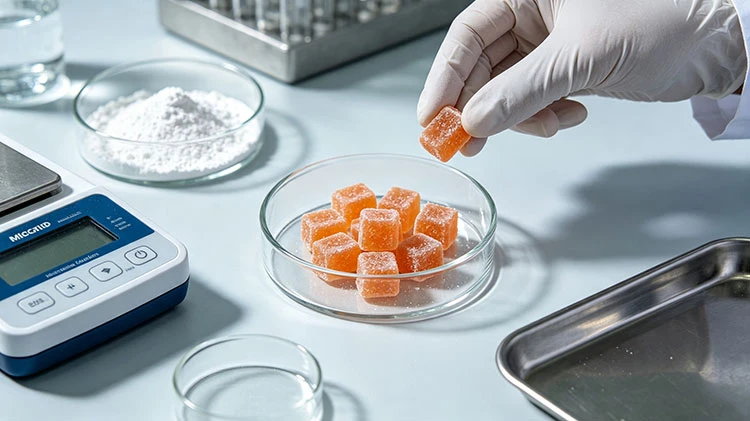
Stability Testing and Quality Control of Creatine Gummies
The active ingredients in creatine gummies are coupled with food systems that contain moisture, so an exhaustive stability test is needed. Appropriate quality control assists in ensuring product performance during the product's shelf life.
Critical quality tests are made up of the following:
Creatine assay analysis: This analysis will prove that the final product contains the required amount of creatine.
Microbial Examination: Gummies are moisture-sensitive and are intended for food use; therefore, they need microbiological examination.
Physical: Texture, appearance, hardness, and flavor stability should be measured during storage.
Packaging Assessment: Moisture-resistant packaging solution for preserving the quality of gummies.
Production monitoring (batch consistency testing): Each production batch is monitored to ensure it falls within certain specifications.
Good creatine gummy manufacturers usually supply the documentation like COA, specification sheets, and stability testing records to the brand customers.
Contact Us Directly or email sales3@sentianbio.com to get the supplement solutions you need.
Industry Applications of Creatine Gummies in Nutrition Products
Creatine gummies have gained popularity in various supplement sectors due to their convenient format and their convenience. Creatine gummies are popular in various supplement categories because of their ease of use and convenient format. They deliver in a very unique way, which means there are opportunities for brands to be different.
These are some common uses in the industry:
Creatine gummies: An alternative form of "active lifestyle" products.
Functional nutrition products: Brands can use creatine in conjunction with other nutritional products to develop special formulas.
Private label supplements: Manufacturers are able to adapt the flavor, packaging, serving size, and formulation to various markets.
Creative supplement forms: Creatine gummies are easy to consume, which makes them ideal for retail sales online or in-store.
The development of creatine gummies in the future may focus on creating more efficient formulations, reducing sugar content, ensuring greater stability, and using cleaner ingredients.
Do Creatine Gummies Work?
With the proper manufacturing process, accurate creatine dosage, stable formulations, and strict quality control systems, creatine gummies can be considered an effective supplement form. What they offer is most notable is that they are a useful way to deliver creatine to the consumer in a convenient, portable, and more palatable format. Effective formulation expertise, consistent production quality, and reliable raw materials are crucial for supplement manufacturers and brands to create successful creatine gummy products.
FAQ
1. Are creatine gummies effective compared with creatine powder?
Creatine gummies will be effective if they contain an acceptable amount of creatine in each dose. Creatine gummies and creatine powder don't differ in terms of creatine itself, but rather in their delivery and formulation and how easy they are to use.
2. What factors determine creatine gummies effectiveness?
Creatine gummies can be effective depending on the quality of the creatine, the accuracy of the dosage, the stability of the ingredients, the manufacturing, and consistent use of the product.
3. How should manufacturers formulate effective creatine gummies?
To create stable creatine gummy products, manufacturers need to pay more attention to dispersion, gummy texture control, moisture management, flavor optimization, packaging protection, and laboratory testing of creatine gummy products.
4. Are creatine gummies suitable for private label supplement products?
Creatine powder can be used for both private label supplement manufacturing and private label formulation since it offers the ability to tailor the formula, flavor, packaging format, and specifications to the market needs.
References
1. Antonio, J., et al. (2021). Common questions and misconceptions about creatine supplementation: What does the scientific evidence really show? Journal of the International Society of Sports Nutrition, 18, 13.
2. Kreider, R. B., & Stout, J. R. (2021). Creatine in health and disease: Current evidence and future perspectives. Nutrients, 13(10), 3536.
3. Gualano, B., Rawson, E. S., & Stout, J. R. (2022). Creatine supplementation and exercise performance: Current perspectives. Nutrients, 14(12), 2486.
4. International Society of Sports Nutrition (ISSN). (2021). International Society of Sports Nutrition position stand: Safety and efficacy of creatine supplementation in exercise, sport, and medicine. Journal of the International Society of Sports Nutrition, 18, 1-18.