


Peptides that are powdered tend to be very useful functional ingredients, as they offer very high bioavailability, rapid intestinal absorption, and formulation stability, which is not possible with whole intact proteins. With the development of enzymatic hydrolysis technology, food scientists, dietary supplement formulators, and cosmetic manufacturers are more and more considering these short-chain amino acid compounds as a method to enhance the nutritional density and physical performance of modern bioactive products.
What Are Powdered Peptides and How Do They Work?
Peptides are short chains of amino acids (usually two to twenty amino acid residues linked by peptide bonds) obtained by performing a controlled enzymatic breakdown of a protein of plant or animal origin. Proteins are present in food as macromolecules, which have to be broken down to a much greater extent by stomach acid and the enzymes of the pancreas before they can be absorbed. This kinetic barrier has been overcome by the peptides in powder form in two ways:
1. Direct Mucosal Transport:
Small peptides (dipeptides and tripeptides < 1,000 Daltons) can be taken up by the intestine much more rapidly than free amino acids or native proteins via specific PepT1 hydrogen-coupled transporters located in the intestinal brush border.
2. Low Molecular Mass Profiles:
The decrease in molecular mass lowers the viscosity of solutions and eliminates macromolecular aggregation so that physiological bioaccessibility is maintained in various digestion conditions.
3. Preserved Bioactive Motifs:
The controlled enzymatic processing preserves certain sequence motifs, e.g., hydrophobic or aromatic amino acid sequences, which would otherwise elicit immunogenic reactions but have a signaling function in the cell.
Key Formulation Advantages of Powdered Peptides in Product Development
A powdered peptide is a more technically advantageous addition to commercial ingredient decks for R&D specialists and industrial manufacturers than a traditional intact protein isolate:
1. Complete Thermal and pH Stability:
Hydrolyzed powdered peptides do not denature, coagulate, or precipitate under extreme pH or conditions, do not require special precautions for pasteurization, retort, or UHT processing, and remain 100% soluble in a wide pH range (2.0 - 10.0).
2. Neutral Sensory Profile:
Taste profile requirements are now more about a clean, palatable taste; with the help of advanced membrane filtration and de-bittering technologies, traditional off-flavours are avoided, and there is no requirement for heavy masking agents.
3. Enhanced Emulsification and Water Binding:
Low-molecular-weight powdered peptides are amphiphilic, which has an impact on moisture-holding capacities, foam stability, and emulsification capabilities in complex food or cosmetic matrices.
4. High Powder Flowability:
Powdered peptides have a uniform particle size distribution and low variation in bulk density, which helps to streamline the automated, high-speed capsule filling, tableting, and sachet packaging processes.

Dosing Considerations and Bioavailability Factors
Optimizing the nutritional efficiency of powdered peptides involves optimizing the dosage regimen, the purity of the ingredients, and their interaction with the matrix:
1. Target Molecular Weight Distribution:
Usually, when the peptide fractions are smaller than 1000-2000 Dalton, the optimal physiological bioaccessibility is reached, and this will be the case when more than 80-90% of the peptide fractions are smaller.
2. Daily Intake Parameters:
Typical commercial applications call for doses of 1.0 to 10.0 grams per day, depending on the functional application, such as a sports nutrition recovery formula or a skin hydration support formula.
3. Synergistic Matrix Integration:
Powdered peptides with additional nutrient drivers (vitamin C, organic minerals, soluble fibers, etc.) provide a more stable and metabolizable product.
4. Hygroscopicity Management:
Amino acid terminals are very hydrophilic and are the most exposed part of a peptide, which means that powdered peptides generally need to be processed in climatically controlled areas (RH < 50%) during bulk manufacturing to prevent clumping.
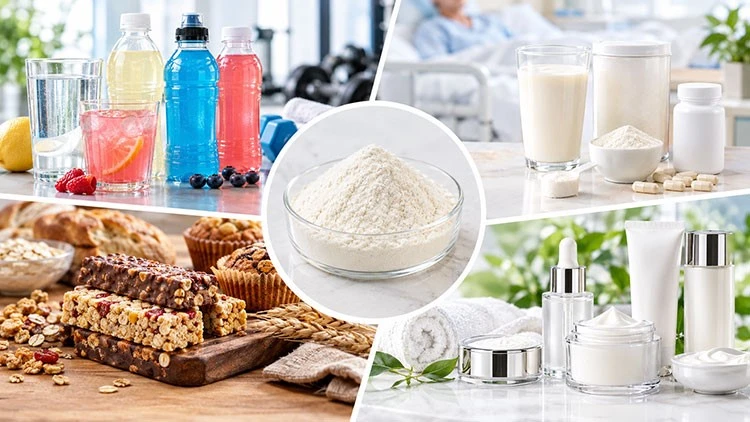
Industrial Applications of Powdered Peptides Across Global Markets
Commercial powdered peptides can be applied to various consumer and industrial product sectors around the world:
1. Ready-to-Drink (RTD) & Sports Beverages:
Nitrogen source used in a clear, non-clouding formula, added to acidic protein water, sports recovery drinks, and low pH functional juices.
2. Specialized & Clinical Nutrition Blends:
Provides a digestible source of protein for enteral nutrition, for dietary supplements for the elderly, and for hypoallergenic meal replacements.
3. Nutritional Bars & Baked Goods:
Works effectively as a moisture binder to keep protein bars soft and pliable, as well as preserve the shelf life of the product without becoming hard over time.
4. Topical Cosmetics & Personal Care:
Firmly formulated into advanced anti-aging serums, anti-aging face creams, and hair care products to support the function of the moisture barrier and surface hydration of the skin.
Quality Standards and Industry Compliance for Powdered Peptides
For commercial enterprise buyers considering powdered peptide suppliers, it's vital to ensure that the supply is consistent and compliant with regulatory standards from batch to batch.
1. Non-GMO and Clean-Label Sourcing:
Quality powdered peptides come from identity-preserved, non-GMO, sustainable animal- or plant-based sources treated with no harsh chemical solvents.
2. Strict Heavy Metal Limits:
Enterprise-grade materials are designed to meet demanding purity requirements and contain only minimal quantities of lead, arsenic, and cadmium, generally at ≤ 0.5 mg/kg, which is significantly lower than the global food safety guidelines.
3. Controlled Ash and Moisture Content:
Premium manufacturing gives a low total ash (≤ 7.0%) and low moisture (≤ 6.0%), which provides long-term shelf stability (24 months) under cool, dry storage.
4. Global Quality Certifications:
Manufacturing facilities need to be used in line with the international standard operating procedures.
Are powdered peptides good for you?
Finally, powdered peptides are a very versatile, bioavailable, and technically advanced functional ingredient. These materials, which have been developed to provide rapid intestinal transit through PepT1 pathways, excellent thermal and acid solution stability, and seamless processing to fit into beverage, dietary supplement, and cosmetic product matrices, address formulation challenges while providing reliable nutritional value to modern product matrices.
Sentian Bio provides free samples, OEM/ODM customized products, and professional technical support. Contact us anytime at sales3@sentianbio.com or LEAVE A MESSAGE!
FAQ
Q1: How do powdered peptides differ from standard protein isolate powders?
Controlled enzymatic hydrolysis of powdered peptides creates short-chain dipeptides and tripeptides from the large macro proteins. This provides quicker absorption in the gut, lower viscosity, full solubility in acid, and better heat stability than whole protein isolates.
Q2: Are powdered peptides stable in high-heat manufacturing processes?
Yes. Low-molecular-weight peptide powders are not denatured or precipitated at high temperatures, which makes them highly suitable for UHT processing, pasteurization, high heat extrusion, and hot-fill beverage operations.
Q3: What is the optimal molecular weight for effective powdered peptides ingredients?
Ingredients that are < 1,000 Da in molecular weight have the highest biological accessibility, with the exception that short-chain oligopeptides are not only partially digested, but can also be directly absorbed by the enterocytes without further digestion.
Q4: Can powdered peptides be combined with other plant or dairy proteins in formulations?
Absolutely. Powdered peptides have excellent physical and chemical compatibility with whey isolates, pea protein, collagen, and carbohydrates, and are useful for enhancing the flowability of a total slurry or in combination with carbohydrates and other ingredients for preventing slurry phase separation.
References
1. Agyei, D., & Udenigwe, C. C. (2021). Enzymatic production and technical applications of bioactive peptides in functional foods. Current Opinion in Food Science, 39, 122–129.
2. Gilbert, E. R., Wong, E. A., & Webb, K. E. (2020). Board-invited review: Peptide absorption and utilization in food producing animals and humans. Journal of Animal Science, 98(4), skaa085.
3. Miner-Williams, W. M., Moughan, P. J., & Fuller, M. F. (2022). The organoleptic and functional properties of bioactive peptides derived from dietary proteins. Comprehensive Reviews in Food Science and Food Safety, 21(2), 1450–1472.
4. Udenigwe, C. C., & Aluko, R. E. (2023). Food protein-derived bioactive peptides: Production, isolation, and structural characterization for industrial applications. Trends in Food Science & Technology, 131, 88–99.