


There are potential negative aspects of a 5-HTP Supplement, such as gastrointestinal upset, sleepiness, formulation concerns, interaction issues, etc., and manufacturers need to be mindful of dosage design, ingredient combinations to address formulation issues, raw material quality, and product labelling.
5-HTP is a well-characterized nutritional supplement ingredient that is typically obtained from Griffonia simplicifolia seeds. Since it is a component of the serotonin biosynthesis pathway, product developers must take into account the technical aspects of the active ingredient and not just be able to simply mix it into the formula at a convenient level. Being aware of potential limitations is crucial for manufacturers of 5-HTP supplements in order to formulate products responsibly and ensure a consistent quality.
What Are the Common 5-HTP Supplement Downsides?
Digestive disturbance: In some people, digestive disturbance (nausea, abdominal discomfort, or diarrhea) is linked to commercial 5-HTP products. Therefore, the design of serving sizes and finished product placement are crucial factors.
Drowsiness: Some product labels list drowsiness as an effect; this may impact the design and messaging of evening-oriented 5-HTP products.
Individual variability: Users may have different reactions to the product, and manufacturers should not give the same dosage to every user.
Some applications have limited evidence: Human research is still product- and dose-specific, population-specific and use-specific. For instance, the study-specific evidence should not be considered as a one-size-fits-all solution: a recent randomised trial has tested 100 mg/day for 12 weeks in older people.
5-HTP Supplement Dosage: Why Does It Matter?
An increase in 5-HTP powder does not necessarily mean an increase in commercial value of the final formula; an increase in tolerability may occur, but other factors can also impact tolerability.
Balance of serving sizes: Capsule capacity, frequency of serving, and combinations of ingredients should be taken into account, along with the intended placement of the finished product.
Evidence-based specification: There are various levels of dosage levels published in research studies, so product developers have to be careful to recognise that there are differences between research protocols and commercial dosage recommendations.
Pilot formulation development: Manufacturers can use pilot batches to assess the uniformity of the blend, sensory characteristics, and performance of the finished product prior to commercial manufacture.
Label consistency: The specified amount of 5-HTP on the label should match the actual specification of the finished product and appropriate analysis.
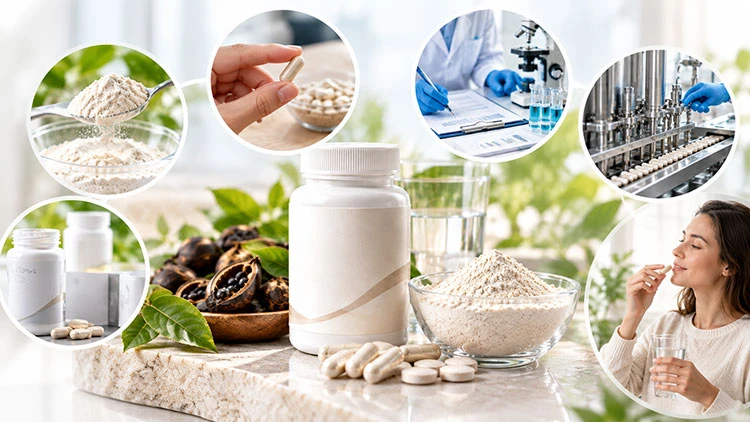
5-HTP Ingredient Interactions and Formula Compatibility
Ingredients that can affect serotonin metabolism: Since 5-HTP is involved in serotonin metabolism, products with other components that may affect serotonin metabolism should be reviewed by the manufacturer.
Multiple botanicals or functional ingredients: This can complicate the compatibility and quality control aspects of formulas.
Targeted positioning: A simpler formula can make dosage communication, analysis, and documentation of the quality easier.
Regulatory review: The claim(s) and warning(s) should be finished product tested for the destination market, not simply taken from another supplier label or market.
When formulation needs a major consideration of interaction, the manufacturer should have a proper technical and regulatory review prior to commercialization.
5-HTP Powder Stability and Manufacturing Challenges
Moisture exposure: 5-HTP powder should not be unnecessarily exposed to moisture during blending, filling, transport, and storage.
Environmental control: The specification for storage of raw materials should include temperature control, humidity control, packaging and handling conditions.
Blend uniformity: Since 5-HTP is used in relatively small amounts in the multi-ingredient formula, it is important for manufacturers to ensure that 5-HTP is evenly distributed throughout the formula.
Analytical control: It is important to identify and assay to ensure that each batch conforms to the agreed specification.
Batch traceability: COAs, lot records, source information, and retention samples are useful tools for the quality management system.
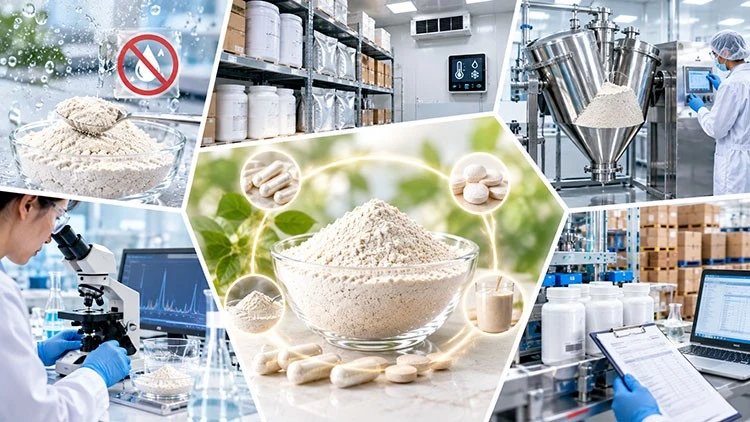
How Can Manufacturers Reduce 5-HTP Formulation Risks?
Use standardized materials: Make sure ingredients for 5-HTP are standardized, meaning they have a defined assay and documented botanical source.
Confirm raw materials: Identity, Assay, microbiological parameters, contaminants, moisture, etc., and other agreed specifications.
Prevent interaction between 5-HTP, excipients, botanical extracts, and other active ingredients: assess interaction prior to scale-up.
Choose appropriate packaging: Choose packaging which provides moisture and environmental protection.
Ensure documentation: A thorough COA, specification sheet, storage recommendation, shelf-life data, and batch traceability will enhance supplier qualification.
Quality monitoring of finished products: Quality management must not stop at the end of production – stability and quality monitoring must also be performed. Contaminants, residual solvents, heavy metals, packaging, stability, labeling, and post-market monitoring are other aspects of dietary supplement safety that are stressed by current industry guidelines.
5-HTP Supplement Applications: Where Do These Considerations Matter?
For sleep positioning products, timing, ingredients, and labeling should be taken into account when developing sleep products.
Mood and relaxation formulas: The ingredients can be used as part of general wellness programs, but they shouldn't be used outside the regulatory guidelines.
Single ingredient capsules: These are relatively easy to dose and control from the analysis point of view.
Multi-ingredient blends: These offer a wider range of formulation options but involve more in-depth compatibility and quality tests.
For private label products, it is important to choose standardized raw materials and full technical documentation when creating a custom 5-HTP supplement.
Sentian Bio provides free samples, OEM/ODM customized products, and professional technical support. Contact us anytime at sales3@sentianbio.com or LEAVE A MESSAGE!
Is there a downside to taking 5-HTP?
The danger of 5-HTP supplementation isn't just one simple problem; there are a number of formulation and quality parameters that must be dealt with collectively. From the manufacturer's point of view, the simplest way is to control the serving size, to check the combinations of ingredients, to safely process and store the 5-HTP powder, to test each batch of product analytically, and to keep up to date product documentation. This makes 5-HTP a well-defined ingredient of a properly formulated supplement and not a "one-size-fits-all" supplement.
FAQ
1. What are the common disadvantages of taking 5-HTP?
Side effects mentioned with 5-HTP supplements are gastrointestinal upset and drowsiness. This may depend on the individual, so product developers should not assume that one formulation or serving size is always appropriate.
2. Can too much 5-HTP cause side effects?
Doses higher than this may cause undesirable effects in some individuals. The correct way for manufacturers is to define the serving size for the finished product, based on the evidence, formulation needs, and market considerations, instead of maximizing the amount of 5-HTP in the product.
3. What should manufacturers consider when formulating 5-HTP supplements?
Factors such as 5-HTP Assay, Serve Size, Ingredient Compatibility, Blend Uniformity, Moisture Control, Analytical Testing, Packaging, Stability, and Labeling Requirements are all important factors.
4. How should 5-HTP powder be stored?
Generally, 5-HTP powder should be stored in a controlled, cool, and dry place, away from excessive moisture and unfavorable storage conditions. The final specification should be based on supplier stability information.
5. Is 5-HTP suitable for combination supplements?
Yes, 5-HTP can be added to combination formulations, but manufacturers should test the entire formula to ensure the use of ingredients that do not affect the way the product works, or other ingredients that could have a relationship with the product's biochemical pathway.
References
1. Maffei, M. E. (2021). 5-Hydroxytryptophan (5-HTP): Natural occurrence, analysis, biosynthesis, biotechnology, physiology and toxicology. International Journal of Molecular Sciences, 22(1), 181.
2. Bernstein, I. B. G., & Bolte, K. L. (2022). Is My Patient Taking an Unsafe Dietary Supplement? AMA Journal of Ethics, 24(5), E390–E395.
3. Sutanto, C. N., Xia, X., Heng, C. W., et al. (2024). The impact of 5-hydroxytryptophan supplementation on sleep quality and gut microbiota composition in older adults: A randomized controlled trial. Clinical Nutrition, 43(3), 593–602.
4. Safety considerations for dietary supplement manufacturers in the United States. (2024). Food and Chemical Toxicology.
5. Zhu, H., Yang, X., & Zhao, Y. (2024). Recent advances in current uptake situation, metabolic and nutritional characteristics, health, and safety of dietary tryptophan. Journal of Agricultural and Food Chemistry, 72(13), 6787–6802.