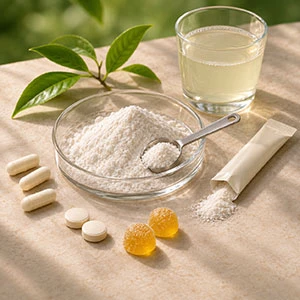
L-theanine Powder provides an amount of amino acid content that can be measured and used in supplements and beverages, but has only been studied in small groups of healthy adults and in small studies for task-specific attention, not a known effect. It might be utilized in a product contingent upon the amount given, the different ingredients, and the structure of the product. Capsules, tablets, gummies, or drinks must be tested separately.
What Is L-Theanine Powder in a Formula?
1. A defined ingredient:
L-theanine is a compound that is naturally found in tea. The L-theanine powder is the specific powder that doesn't contain other compounds found in tea. Check the source of the lot selected and ensure that it is not described as tea-derived.
2. A measurable input:
Determine the amount of powder needed based on the amount of L-theanine in the assayed powder. The color of powder, or the name of an ingredient, is not enough to identify it, nor is it enough to show the batch result.
What Does L-Theanine Powder Show in Research?
1. Selected attention measures:
Some simple reaction, selective-attention tests show differences in controlled studies. Findings with more complex measures have not been as consistent. One task result may not provide a general statement regarding the performance of everyday tasks.
2. Specific study settings:
The results are dependent on the dose, test time, age group, and study design. Note: Outcomes for one blend may not be the same as for another.

How Is L-Theanine Powder Used in Different Formats?
1. Capsules:
Inspect the blend flow, fill weight, shell capacity, and uniformity of contents. If the amount of L-theanine is small and the carrier fraction is large, it is advisable to use a graded blend of L-theanine.
2. Tablets:
Discuss the properties of compression, friability, disintegration, and unit size. Failing a raw material assay does not mean that a compressed tablet will fail the assay.
3. Gummies:
Verify the addition point during the gel process. Test pieces for content area, water loss, and piece weight for delivery, as these will impact content.
4. Drink powders:
Make up the serving as described using the volume and temperature of water. Taste, dispersion, and residue after standing, not clarity, indicate content.
How Do You Set an L-Theanine Powder Serving?
1. Read research doses in context:
The dosage of 100, 200 and 400 mg has been studied under specific conditions. These are trial quantities, not instructions for all products/markets.
2. Account for assay:
For calculation purposes, if one wanted 200 mg of L-theanine in a product, and the material was tested at 98% L-theanine, then it would be approximately 204 mg of material before it was processed. Taking into account the actual specification and calculation basis of the selected lot.
3. Verify the final unit:
The brief will be impacted by other ingredients, the number of units, and permitted use. Measure the finished product; don't assume that the input weight is the stated weight.
What Matters When Blending L-Theanine Powder?
1. Purpose of the combination:
If the recipe has caffeine added, determine the amount of caffeine per recipe. The evidence for the one L-theanine and caffeine ratio should not be applied to another tea blend.
2. Distribution:
It can be helpful to use staged mixing if L-theanine is a minor component of a batch. Take samples of important blend sites to test for uniformity before filling/compression.
3. Sensory fit:
Sometimes, an active such as an acid, flavors, sweeteners, and other actives will alter a gummy or a drink. Assess the entire ready-to-serve product, not single items.
How Stable Is L-Theanine Powder in Production?
1. Dry handling:
Reduce the amount of moisture absorbed and caking in the selected pack. There are two different types of checks: powder flow and chemical assays, which may be important in storage.
2. Process exposure:
Content is measured before and after the actual sequence of real-time temperature and pH when making heated gummies or beverages. The results obtained with one food matrix cannot be used as a guarantee of shelf life for another food matrix.
3. Format-specific evidence:
A 2024 study revealed that there were variations in L-theanine levels retained in dried tea product formulations and tea infusion. This comparison is used to test each completed matrix and does not set a standard for stability of purified bulk material.
4. Shelf-life checks:
Investigate the content of the product(s) during an appropriate stability program, along with moisture, texture, appearance, and package integrity, as applicable.
Where Is L-Theanine Powder Used by the Industry?
1. Single-ingredient lines:
When a specified amount is achieved as a result of finished-unit testing, the capsules or tablets can be declared.
2. Combination formulas:
Evaluate the importance of each ingredient and whether the entire dish is appropriate for the format.
3. Powdered drinks:
Mixing directions, flavor, and storage characteristics are critical development considerations when using stick packs or sachets.
Sentian provides free samples, OEM/ODM customized products, and professional technical support. Contact us anytime at sales3@sentianbio.com or LEAVE A MESSAGE!
Thus, L-theanine powder is a specific ingredient of various supplement forms, and research indicates minimal, context-specific attention benefits. The most useful application of its value is when someone can verify who it is, how much it has, a well-calculated serving, and its actual finished product tested during its intended shelf life.
FAQ
Does L-theanine powder contain caffeine?
Differences between L-theanine and caffeine. It is important to determine whether a certain L-theanine powder qualifies for a caffeine-free requirement based on the source of material, specification, and/or the test results of the material.
How much L-theanine powder should go into one capsule?
The input will vary with the desired level of L-theanine, the assay of the material used, and the capsule formula. Calculate it from the actual batch specification, then check the content of finished capsules.
Can L-theanine powder be used in a hot drink mix?
Can be considered for a hot beverage application, but final formulation must be tested in the conditions under which it is intended to be prepared and stored. A dry ingredient specification will not set the flavour or shelf-life of the drink.
What is the difference between L-theanine powder and green tea extract?
L-theanine powder is targeted toward the amount of L-theanine. Green tea extract is a more complex extract, due to the variety of ingredients present, depending on the variety and extraction details. They should be considered as distinct formulation input components.
Can L-theanine powder be blended with caffeine?
The combination of formulas is possible. The amount of caffeine should be calculated for each source of caffeine, and the ratio/actual product and the results should not be assumed for a different formula that has been published.
References
1. Dassanayake, T. L., Wijesundara, D., Kahathuduwa, C. N., & Weerasinghe, V. S. (2023). Dose-response effect of L-theanine on psychomotor speed, sustained attention, and inhibitory control: A double-blind, placebo-controlled, crossover study. Nutritional Neuroscience, 26(11), 1138–1146.
2. Karunaratne, U. W., & Dassanayake, T. L. (2025). Effect of L-theanine on selective attention in a traffic-related reaction task in sleep-deprived young adults: A double-blind placebo-controlled, crossover study. Nutritional Neuroscience, 28(4), 471–480.
3. Nawarathna, G. S., Ariyasinghe, D. I., & Dassanayake, T. L. (2025). High-dose L-theanine–caffeine combination improves neurobehavioural and neurophysiological measures of selective attention in acutely sleep-deprived young adults: A double-blind, placebo-controlled crossover study. British Journal of Nutrition, 134(3), 195–204.
4. Allameh, M., & Orsat, V. (2024). Freeze drying and spray drying for the retention of the active components, L-theanine and caffeine, and antioxidant activity of tea-based ingredients. International Journal of Food Science & Technology, 59(7), 5038–5046.