


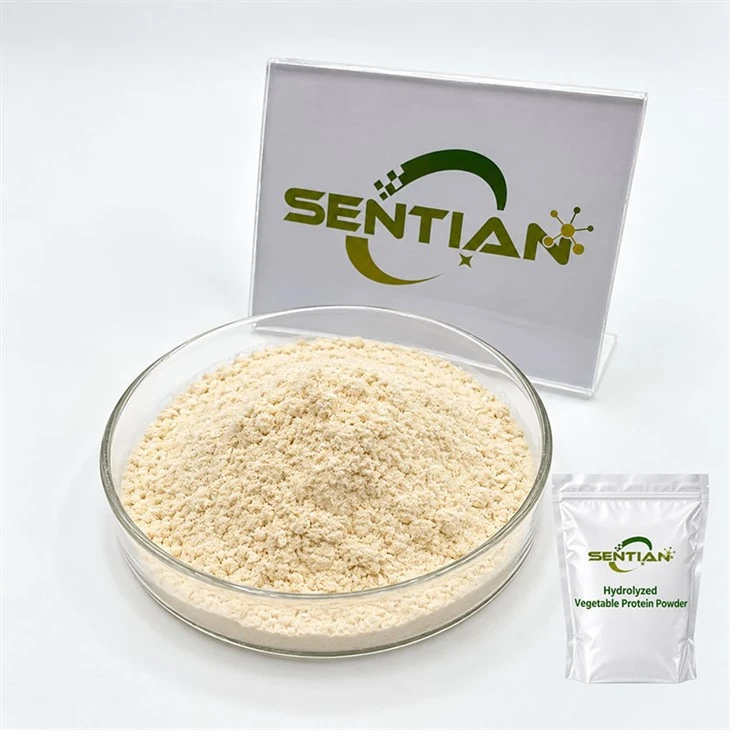
What is Hydrolyzed Vegetable Protein Powder?
Hydrolyzed Vegetable Protein Powder is a high-potency, plant-based flavor enhancer prepared under controlled conditions by acid or enzymatic hydrolysis of vegetable proteins like soy, maize, or wheat into amino acids, mainly free glutamic acid. HVP powder provides a high level of umami taste and kokumi effect, which helps maintain and enhance the overall flavor integrity of various formulations, especially for those used in the food processing and seasoning manufacturing sectors and in industrial food applications. It is used by industrial food manufacturers as an economical and versatile ingredient for producing a complex taste foundation in dehydrated type of soups, instant noodles, meat products, gravies, processed snack foods, and savory sauce bases. Its high solubility, resistance to high-temperature degradation, and ability to maintain a uniform sodium-binding property make it an essential tool for food technologists seeking to enhance flavour and savoury characteristics, reduce the need for costly monosodium glutamate (MSG) additions, and balance the overall flavour and savoury profile. It is available in different customizable grades and protein source bases that match the requirements of the food supply chain for non-GMO, kosher, and allergen-free, and provides food developers with a high degree of process reliability, extended shelf life, and uniform dispersion in liquid systems and dry blend matrices.

COA
| Item | Specification | Result | Test Method |
| Appearance | Free-flowing light yellow to brown powder | Complies | Visual Inspection |
| Odor | Characteristic, free from abnormal odor | Complies | Sensory |
| Flavor | Characteristic savory, salty and umami | Complies | Sensory |
| Total Nitrogen | ≥ 4.0% | 4.62% | Kjeldahl Method |
| Amino Nitrogen | ≥ 2.5% | 3.18% | Formaldehyde Titration |
| Sodium Chloride (NaCl) | ≤ 42.0% | 38.70% | Mohr Method |
| Moisture | ≤ 7.0% | 4.36% | Gravimetric Method |
| Ash | ≤ 50.0% | 46.20% | AOAC |
| pH (1% Solution) | 5.0–6.5 | 5.62 | Potentiometric Method |
| Water Activity (aw) | ≤ 0.60 | 0.31 | Water Activity Meter |
| 3-MCPD | ≤ 1.0 mg/kg | 0.08 mg/kg | GC-MS |
| Lead (Pb) | ≤ 1.0 mg/kg | <0.10 mg/kg | ICP-MS |
| Arsenic (As) | ≤ 0.5 mg/kg | <0.05 mg/kg | ICP-MS |
| Total Heavy Metals | ≤ 10.0 mg/kg | <0.50 mg/kg | ICP-MS |
| Total Plate Count | ≤ 10,000 CFU/g | <1,000 CFU/g | AOAC |
| Yeast & Mold | ≤ 100 CFU/g | <10 CFU/g | AOAC |
| Coliforms | ≤ 3 MPN/g | <3 MPN/g | AOAC |
| E. coli | Negative/g | Negative | AOAC |
| Salmonella | Negative/25 g | Negative | ISO 6579 |
| Staphylococcus aureus | Negative/g | Negative | ISO 6888 |
| Foreign Matter | Absent | Absent | Visual Inspection |
Sentian Bio provides free samples, OEM/ODM customized products, and professional technical support. Contact us anytime at sales3@sentianbio.com or LEAVE A MESSAGE!
Market Trends
At the macro level, the growing use of plant-derived ingredients and the rapid development of the global ultra-processed food and global convenience food market are stimulating the global market for HVP Powder. Food processors and flavor houses are actively replacing artificial flavor enhancers with natural umami flavors such as HVP as customers globally become more aware of what's on their food label and want to know what is clean and familiar. The commercial transition tracks another industry's trend towards sustainably grown plant agriculture, upcycled protein, and flavorful profile innovations for ready-to-eat meals, plant-based meat alternatives, and dehydrated seasoning blends. Moreover, the supply chain dynamics of the present times also prefer its use because of its longer shelf life, consistency, and cost-effectiveness as compared to the extract bases, thus giving multinational brands the flexibility to maintain the same profile of their products in the various regions. Asia-Pacific and Latin America are potential growth markets with high urbanization and increasing demand for HVP packaged bases, while non-GMO and allergen-free HVP variants are attracting the attention of manufacturers in Europe and North America, as these markets are subject to strict regulatory requirements, and consumers are seeking raw materials that are transparent and ethically sourced.
Features
It has unique physical and chemical properties that are specifically beneficial for use in food formulation in industry. Highly concentrated with a rich umami flavor but devoid of the additional maturation and fermentation processes used in more traditional methods, HVP is chemically characterized as a high concentration of free amino acids, most notably glutamic acid, and derivatives of complete protein digestion, short-chain peptides. The physical properties of the powder indicate excellent cold-water solubility, fast dissolution characteristics, and low hygroscopicity under standard moisture barrier packaging, which will not cake in high-speed dry blending processes. Food formulators will benefit from the non-enzymatic Maillard reaction precursor properties, as it has the ideal combination of reducing sugars and free amino groups that allow for more predictable color development and enhance the aromatic properties during thermal processing like extrusion, baking, or retort sterilization. It provides structural and organoleptic stability throughout a broad pH range (pH 3.0 to 8.0) and across severe freeze-thaw cycles, and is ideal for use in acidic sauce systems, frozen entrée and shelf-stable liquid concentrate systems. Furthermore, Hydrolyzed Plant Protein is naturally ionic and has a sodium-compatible matrix, helping formulators fine-tune the amount of sodium chloride required to achieve the desired amount of saltiness in complex savory product formulations while keeping them perceptually salty and maintaining accurate analytical control of the viscosity, osmotic balance, and saltiness of these products.

Benefits
1. Flavor Profile Optimization:
Hydrolyzed Vegetable Protein provides a full, well-rounded umami flavor profile to fill in gaps, balance complementary flavors, and add savoriness to a dish without overwhelming the more prominent hero spices.
2. Sodium Reduction Efficiency:
Often makes food taste even saltier than it is, which enables food scientists to reduce the amount of sodium chloride used in the formulation and still provide a full-bodied taste satisfaction.
3. Superior Processing Resilience:
Excellent thermal and shear tolerance, maintaining the taste-enhancing ability and aroma during high-temperature retort, UHT processing, extrusion, and extended boiling.
4. Clean-Label MSG Alternative:
A naturally-derived savory building block that enables food brands to prevent unnecessary synthetic additive callouts and provide recognizable, plant-based ingredients that consumers are demanding.
5. Cost-Effective Formulation:
Offers an economical source of concentrated savory flavors, thus decreasing the need for expensive meat extracts, yeast hydrolysates, or complex food flavors in large-scale food production.
6. Consistent Powder Rheology:
Exhibits excellent flowability, consistent particle size, and very rapid dissolving, which allows it to be easily added to automated dry-mixing equipment and handled in the factory without dust.
FAQ
What is the shelf life and optimal storage condition for HVP powder?
Generally has a shelf life of 24 months in a cool, dry environment in the original, moisture-barrier package.
Can HVP powder replace Monosodium Glutamate (MSG) in food formulations?
Yes, its high content of naturally occurring free glutamic acid gives it a deep umami flavor and makes it easy for the food industry to cut back or eliminate added MSG.
Is Hydrolyzed Vegetable Protein Powder suitable for thermal processing?
It is very heat stable, maintaining a savory taste and desirable structure in extrusion, retorting, UHT, and baking.
Which plant sources are utilized to manufacture your HVP powder?
Our HVP powder is made from soy, maize, or wheat protein that is not GMO (unless specifically requested by the supply chain) and can be customized to address specific supply chain and allergen needs.
How does HVP powder perform in liquid and dry blend applications?
Its high cold water solubility, low hygroscopicity, and good flowability allow it to blend easily into dry seasoned blends and liquid sauce bases.
Production Process

Certificate

Exhibition
