


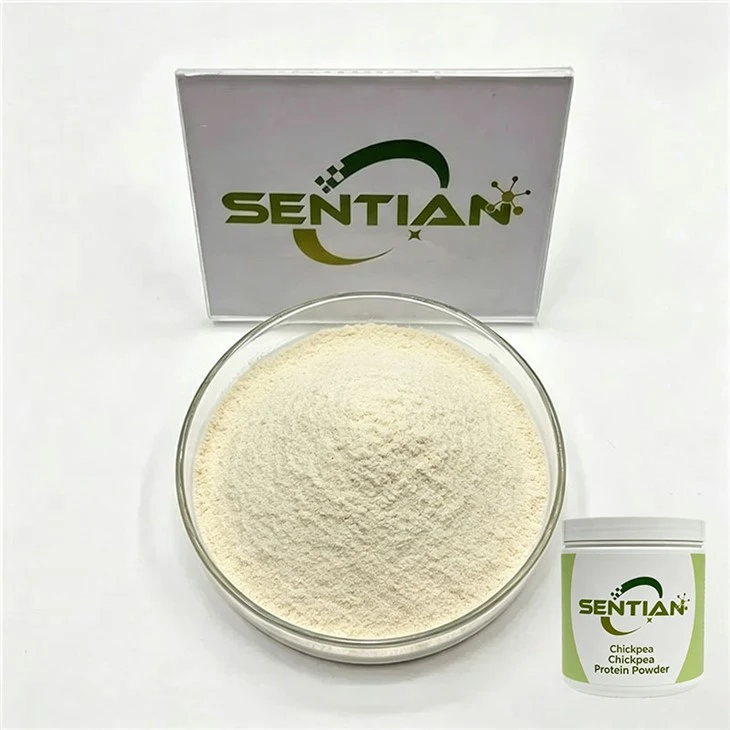
What is Chickpea Protein Isolate Powder?
Chickpea Protein Isolate Powder is a high-purity botanical protein powder, which is extracted from premium-quality chickpeas (Cicer arietinum) with a high protein content (>80%) that is suitable for demanding industrial applications. Designed to suit the needs of enterprise-level food, beverage, and nutritional product manufacturers, this is a specially formulated bulk raw material, offering a clean, smooth answer for formulators who require maximum functional performance without the extra carbohydrate levels of traditional protein flour. The powder is extremely soluble thanks to the advanced extraction and purification methods, and it also has an excellent emulsification ability, a neutral sensory profile, and is great for high-protein drinks, nutrition supplements, or advanced meat and milk substitute products. It can be a dependable ingredient for commercial buyers looking to enhance the nutritional profile of their products, make them clean-label, non-GMO, and allergen-free without the risk of allergens like soy, gluten, or dairy. In addition, the addition of this high-concentration pulse isolate is consistent with the enterprise sustainability goals, given that the crop has low water needs and enriches the soil, to satisfy the demanding requirements of companies for ESG and market transparency.

COA
| Item | Specification | Test Method |
| Appearance | Fine Powder | Visual Inspection |
| Color | Off-white to Light Yellow | Visual Inspection |
| Odor | Characteristic, Neutral | Organoleptic |
| Taste | Characteristic, Free from Foreign Taste | Organoleptic |
| Particle Size | ≥95% Pass 80 Mesh | Sieve Analysis |
| Protein Content (Dry Basis) | ≥80.0% | Kjeldahl Method |
| Moisture | ≤8.0% | AOAC 925.10 |
| Ash Content | ≤8.0% | AOAC 923.03 |
| Fat Content | ≤3.0% | Soxhlet Extraction |
| Total Carbohydrate | ≤10.0% | Calculation |
| Dietary Fiber | ≤5.0% | Enzymatic-Gravimetric Method |
| pH (1% Solution) | 6.5 - 8.0 | pH Meter |
| Protein Solubility | ≥70% | Solubility Test |
| Water Absorption Capacity | ≥2.0 g/g | Functional Property Test |
| Oil Absorption Capacity | ≥1.5 g/g | Functional Property Test |
| Phytic Acid | ≤0.5% | Colorimetric Method |
| Urease Activity | ≤0.05 pH Unit | Urease Activity Test |
| Heavy Metal Analysis | ||
| Lead (Pb) | ≤0.5 ppm | ICP-MS |
| Arsenic (As) | ≤0.5 ppm | ICP-MS |
| Cadmium (Cd) | ≤0.5 ppm | ICP-MS |
| Mercury (Hg) | ≤0.1 ppm | ICP-MS |
| Microbiological Analysis | ||
| Total Plate Count | ≤10,000 CFU/g | AOAC / USP |
| Yeast & Mold | ≤100 CFU/g | AOAC / USP |
| Coliforms | ≤30 CFU/g | AOAC |
| Escherichia coli | Negative / 10g | AOAC |
| Salmonella | Negative / 25g | AOAC |
| Staphylococcus aureus | Negative / 25g | AOAC |
| Bacillus cereus | ≤100 CFU/g | ISO Method |
| Mycotoxin Analysis | ||
| Aflatoxin B1 | ≤5 ppb | HPLC |
| Total Aflatoxins (B1+B2+G1+G2) | ≤10 ppb | HPLC |
Sentian Bio provides free samples, OEM/ODM customized products, and professional technical support. Contact us anytime at sales3@sentianbio.com or LEAVE A MESSAGE!
Industry Background
Commercial pulse applications globally are undergoing a fundamental transformation with growing investments in the agricultural processing industry by enterprises seeking to ensure sustainable food systems and use new botanical fractionation technologies. As one of the most dynamic sectors in the industry, Chickpea Protein Isolate has become a key ingredient, meeting the urgent need of the food and beverage sector for high-purity, hypoallergenic, and eco-friendly ingredients. All over the world, manufacturers are making every effort to move beyond animal-derived and legacy crop proteins to reduce their exposure to the supply chain and comply with the high standards that their companies place on their ESG practices. It is being driven by intensifying regulation on allergen disclosure, as well as corporate pledges to lower carbon footprints and shift to circular economy models, all of which are macroeconomic shifts. It is being driven by the tightening of regulation with respect to the disclosure of allergens as well as commitments from companies to reduce their carbon footprints and implement circular economy models, all of which are macroeconomic shifts. New optimized extraction procedures enable industrial suppliers to extract functional components of resilient pulse crops that are concentrated and suitable for the technical and scalability demands of changing food science and technology. Thus, enterprise procurement teams are more and more considering specialised legume isolates as a key element of their future transparently sourced commercial product portfolios instead of an alternative option.
Development History
The commercial development shows the systematic development of agricultural biotechnology, industrial fractionation, and engineering of pulse processing that has taken place over the last few decades. Until now, however, chickpeas (Cicer arietinum) have been mainly used as whole beans or as simple grain flours in traditional food markets, due to the limited industrial applications of complex food systems, which were only possible with advanced milling equipment. But with the increasing global demand for food, industry scientists and processing engineers began to concentrate on research to isolate useful plant-based macronutrients from pulse crops. Initial industrial work was aimed at maximizing the wet and dry separation processes for selectively concentrating protein and removing the undesirable antinutrients and strong leguminous flavors. These technology advancements made it possible to separate the protein from the ingredients of chickpea, which were once commodity agricultural products, into high-purity protein fractions with protein levels greater than 80%. In recent years, the solubility and technical performance of the isolate have been improved greatly, and the flavor is neutral, due to continuous improvement in enzymatic hydrolysis, gentle thermal processing, and advanced membrane filtration. The legacy of technical innovation today is enabling manufacturers to easily incorporate high-quality Chickpea Protein Powder into state-of-the-art commercial formulations, which now represent the highest standards for quality, sustainability, and functionality in the global plant-based ingredients market.

Application
1. Plant-Based Dairy and Beverages:
Garbanzo Bean Protein Powder is used by formulators to make high-protein plant milk and ready-to-drink nutrition shakes, with its great solubility and neutral sensory profile offering an ideal consistency with no chalk.
2. Advanced Meat Analogs:
The ingredient is a functional binder in vegetarian burgers and sausages, which has excellent gelling and water-holding properties and makes a significant contribution to the bite, firmness, and moisture retention properties that are desirable in commercial food processing.
3. Sports Nutrition Supplements:
The high-purity powder is blended with a protein powder or nutritional bar and is used as an ingredient mix for enterprise brands to get a good protein punch without compromising the purity of the protein ingredient list, which is important for allergen-free consumers.
4. Bakery and Extruded Snacks:
Commercial producers use the isolate in gluten-free breads and snack pellets to improve internal moisture during baking, internal structure (stability), and shelf life.
5. Confectionery and Frozen Desserts:
The powder is added to food products in plant-based fillings and desserts; it has surface-active properties which help emulsion stabilization and modification without dairy or soy allergens.
6. Culinary Sauces and Prepared Meals:
The ingredient is used throughout the food supply chain as a natural stabiliser in ready-to-eat foods and gravies, providing a way to assure product consistency from processing through freeze-thaw.
Production Process

Certificate

Exhibition
