


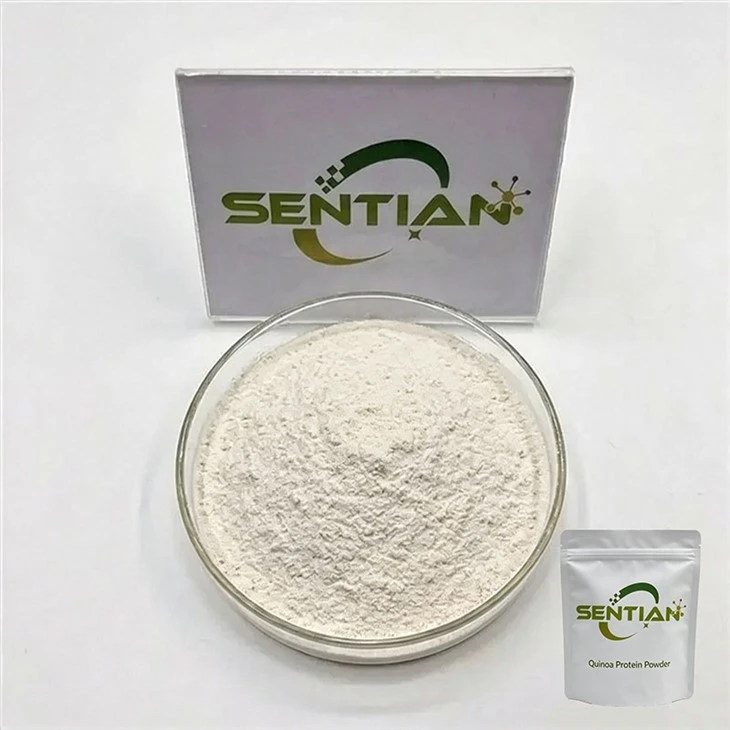
Xi'an Sentian Biotechnology Co., Ltd. is one of the leading manufacturers and suppliers of quinoa protein powder in China. We are committed to providing high quality customized service and OEM&ODM private label service for global clients. Please feel free to buy bulk quinoa protein powder in stock here from our factory. Also, free sample is available.
What is Quinoa Protein Powder?
Quinoa Protein Powder is an advanced plant protein, specifically developed for commercial food, beverage, and nutritional manufacturing, from the nutritious pseudo-cereal Chenopodium quinoa. This versatile ingredient is suitable for use in the food industry, allowing food processors, supplement manufacturers, and functional beverage producers to create high-quality products that appeal to today's consumers with their clean label and allergen-free nutrition. A complete protein source with a well-balanced profile of all nine essential amino acids, it is an excellent source of protein that can substitute for dairy, soy, and wheat proteins. Product developers use it to improve the nutritional attributes of plant-based beverages, nutritional bars, baked goods, and dry-blended mixes. The manufacturing process has the ability to separate and isolate the protein in the form of a fine powder, which has mild organoleptic properties which are readily incorporated into various industrial formulations. For commercial buyers, this ingredient is selected due to its functional properties like its solubility, emulsification, and water-binding properties, which facilitate large-scale production. Moreover, using quinoa protein will enable the enterprise's portfolio to become more sustainable because this grain is highly resistant to drought conditions and requires little water to grow. This ingredient can be easily incorporated in order to achieve a brand's positioning in the clean label and plant-based segment in commercial packaging.

COA
| Item | Specification | Result |
| Botanical Source | Chenopodium quinoa Willd. | Complies |
| Appearance | Fine, uniform powder | Complies |
| Color | Cream to light beige | Complies |
| Odor | Characteristic, free from off-odor | Complies |
| Taste | Characteristic, free from abnormal taste | Complies |
| Protein (Dry Basis) | ≥ 80.0% | 82.60% |
| Moisture | ≤ 8.0% | 5.42% |
| Ash | ≤ 6.0% | 3.18% |
| Total Fat | ≤ 5.0% | 2.36% |
| Dietary Fiber | ≤ 8.0% | 4.71% |
| Saponins | ≤ 0.10% | 0.04% |
| Bulk Density | 0.40–0.65 g/mL | 0.52 g/mL |
| Particle Size | ≥ 95% pass 80 mesh | 98.20% |
| Dispersibility | ≥ 85% | 91.40% |
| pH (5% Suspension) | 6.0–7.5 | 6.62 |
| Foreign Matter | None Detected | Complies |
| Total Plate Count | ≤ 10,000 CFU/g | 420 CFU/g |
| Yeast & Mold | ≤ 500 CFU/g | 35 CFU/g |
| Coliforms | ≤ 100 CFU/g | <10 CFU/g |
| E. coli | Absent in 10 g | Negative |
| Salmonella | Absent in 25 g | Negative |
| Staphylococcus aureus | Absent in 10 g | Negative |
| Lead (Pb) | ≤ 1.0 ppm | 0.08 ppm |
| Arsenic (As) | ≤ 0.5 ppm | 0.06 ppm |
| Cadmium (Cd) | ≤ 0.5 ppm | 0.03 ppm |
| Mercury (Hg) | ≤ 0.1 ppm | <0.01 ppm |
Sentian Bio provides free samples, OEM/ODM customized products, and professional technical support. Contact us anytime at sales3@sentianbio.com or LEAVE A MESSAGE!
Market Trends
The macro-economic environment is shaping the global commercial world of ingredients from plants in a profound way in favour of sustainable agriculture and traceable supply chains. Food and nutrition enterprise procurement teams of all kinds are strategically moving towards alternative proteins like Quinoa Protein with reduced environmental impact. This macro change is to some degree impacted by increasing consumer demand for clarity, less processed and natural ingredients that align with modern diets. To meet industry demand, ingredient companies are working on increasing the processing scale of their industrial facilities and implementing new fractionation technologies to gain functional versatility for large-scale production. Commercial developers are putting significant resources into innovations built around pseudo-cereals counterparts to gain a foothold in the market for plant-based beverages and so-called 'functionals' that are snack foods. In addition, brands need to guarantee that raw materials are sourced in a certified and sustainable manner in order to meet corporate expectations of adhering to ESG principles. As a result, suppliers form direct agricultural partnerships in order to ensure tracking of the volume and the origin of agricultural products, which enables enterprises to comply with commercial needs for clean-label agricultural products in a competitive global market.
Features
It has excellent physicochemical and techno-functional properties that enable food scientists and industrial formulation engineers to have accurate and reliable parameters for the advanced development of food products. The chemical composition is in large part made up of globulins and albumins, with a good balance of amino acid spectrum, particularly high in essential amino acids, like lysine, which is often deficient in common cereal protein sources. Physically, it shows very desirable water-holding and oil-absorption properties, enabling the formulators to control the moisture-holding capacity, structural elasticity, and mouthfeel in complex food matrices such as gluten-free baked goods, nutritional snack bars, and textured analogs. In addition, it has surface-active characteristics which provide reliable emulsification capacity and foam stability, making it very useful to stabilize oil-in-water emulsions in plant-based dairy alternatives, soups and dressings. The protein profile also has favourable solubility characteristics which enable the protein to be easily incorporated into liquid food products such as nutritional beverages, without too much particle aggregation or sedimentation occurring during storage, particularly at neutral to moderately alkaline pH. Moreover, Quinoa Powder Protein has thermal gelation characteristics which help the formulators to develop the required firmness and structure during high-temperature extrusion or baking.

Benefits
1. Allergen-Free Formulation Integration:
Commercial brands can create a universally inclusive product line for sensitive consumer segments without compromising on product performance or taste, since Quinoa Protein Powder is naturally free from major food allergens like gluten, soy, and dairy.
2. Balanced Nutritional Enrichment:
Provides a broad range of essential amino acids that are plant-based only, ideal for food manufacturers to easily boost the protein content and protein quality of their everyday food products, snacks, and drinks.
3. Clean-Label Enhancement:
It serves as a strong recognition value, low-processing botanical ingredient to enable clear ingredient listing for consumer-facing retail packaging, which meets rising consumer demand for simple, clean, and understandable food labeling.
4. Versatile Matrix Compatibility:
Works well in a variety of industrial applications and processes, such as dry-blended powder products, high-temperature extruded products, baked goods, and other applications without adding unwanted after-tastes and without overpowering the delicate flavor profiles.
5. Supply Chain Sustainability Support:
It originates from a highly resilient and water-efficient pseudo-cereal crop which grows in marginal areas and assists enterprise-level brands to meet their strict environmental, social, and governance (ESG) goals along with their long-term sustainable sourcing goals.
FAQ
Q: What is Quinoa Protein Powder for B2B applications?
A: It's a plant raw ingredient that has been modified for use in food processing, beverages, and dietary supplements.
Q: What are its key techno-functional properties?
It has a good water-holding capacity, good oil absorption, good solubility, and emulsifying properties, which enable the formulator to maximize the water-holding capacity of the commercial product, its moisture retention, and viscosity.
Q: Is this ingredient free from major allergens?
A: Yes, it is naturally gluten-, soy-, dairy-, and nut-free and is perfect for developing a line of products that is accessible to consumers with gluten, soy, dairy, and nut allergies.
Q: How does it support clean-label product positioning?
A: It's derived from plants, but minimally processed, which means that it can be added to easy-to-use ingredient decks to help brands satisfy commercial demand for clear, plant-focused labels.
Q: Which industrial processing methods are compatible?
A: It has superior matrix compatibility for dry blending, thermal extrusion, and dispersion in bars, baked goods, and ready-to-drink beverages.
Production Process

Certificate

Exhibition
