What is Thermostable Alpha Amylase?
Thermostable alpha-amylase is a high-temperature industrial enzyme, typically derived from Bacillus licheniformis, that hydrolyzes starch into sugars (maltose/glucose) at 80–110°C. It is crucial for starch liquefaction, reducing viscosity, and preventing bacterial contamination during processing, with optimal activity often around pH 5.8-7.0 and 95-105°C.
Everything You Need to Know
Is alpha-amylase thermostable?
The addition of CaCl2 significantly enhanced thermostability, with the enzyme retaining more than 95% of its initial activity at 70 °C after 30 min. Our findings indicate that α-amylase from B. licheniformis 104. K is a functional, thermostable enzyme with potential industrial applications.
What happens if amylase is denatured?
At low temperatures the amylase will break starch down slowly due to reduced kinetic energy. At high temperatures the amylase will break starch down slowly or not at all due to denaturation of the enzyme's active site close active siteRegion of an enzyme where the substrate attaches.
At what temperature is alpha-amylase stable?
The conversion of starch by a-Amylase increases in rate with rising temperature to a maximum of about 80oC. Heating above this temperature begins to destroy the amylase. Good stability occurs at the gelatinization range of starches (70 - 80oC). Below this range, however, the conversion is quite slow.
Can enzymes become denatured?
Yes, enzymes can be denatured. Denaturation occurs when an enzyme loses its specific three-dimensional shape-particularly its active site-due to extreme temperatures, pH changes, or other environmental stressors. This structural breakdown renders them unable to bind to substrates and catalyze reactions, usually permanently.
Main Details:
Key Characteristics and Applications:
Source: Primarily produced by thermophilic bacteria, including Bacillus licheniformis, Geobacillus, and Anoxybacillus.
Optimal Conditions: High thermal stability (>90°C) and broad pH functionality (acidic to neutral).
Mechanism: Endo-acting enzyme breaking 𝛼-1,4-glycosidic linkages in starch.
Industrial Use: Widely used in starch-sugar processing, brewing, baking, and the production of cyclodextrins for pharmaceuticals.
Enhancement: Addition of calcium ions (𝐶𝑎𝐶𝑙2) significantly enhances stability at extreme temperatures.

Main Industrial Advantages:
Increased Efficiency: Higher temperatures enhance substrate solubility and reaction rates while reducing slurry viscosity.
Contamination Control: Operating at high temperatures reduces the risk of contamination by common microorganisms.
Durability: Suitable for harsh industrial conditions compared to conventional mesophilic enzymes.
Common Products:
Food-grade heat-stable 𝛼-amylase, available in liquid form, maintains >90% activity at 25°C for 3 months.
Recombinant versions are used for improved performance in specific industries.
ANALYTICAL RESULTS
| Test Item | Method / Ref. | Specification | Result | Conclusion |
|---|---|---|---|---|
| Identification | In-house ID / label claim | Thermostable Alpha Amylase | Conforms | Pass |
| Appearance | Visual | Light brown to tan powder | Light brown powder | Pass |
| Enzyme Activity | Supplier method / Amylase Assay | NLT 50,000 U/g | 53,200 U/g | Pass |
| Activity Unit Definition | Supplier-defined unit | Report only | U/g reported | Pass |
| pH (1% solution) | pH meter | 5.0 – 7.5 | 6.2 | Pass |
| Loss on Drying | Gravimetric / USP 731 | ≤ 8.0% | 4.5% | Pass |
| Lead (Pb) | ICP-MS / ICP-OES | ≤ 5.0 mg/kg | 0.18 mg/kg | Pass |
| Arsenic (As) | ICP-MS / ICP-OES | ≤ 3.0 mg/kg | 0.12 mg/kg | Pass |
| Cadmium (Cd) | ICP-MS / ICP-OES | ≤ 0.5 mg/kg | < 0.05 mg/kg | Pass |
| Mercury (Hg) | ICP-MS / ICP-OES | ≤ 0.5 mg/kg | < 0.01 mg/kg | Pass |
| Total Plate Count | Plate count | ≤ 50,000 CFU/g | 2.1 × 10³ CFU/g | Pass |
| Coliforms | Plate count | ≤ 30 CFU/g | < 10 CFU/g | Pass |
| E. coli | Absence Test | Negative / 25g | Not Detected | Pass |
| Salmonella | Absence Test | Negative / 25g | Not Detected | Pass |
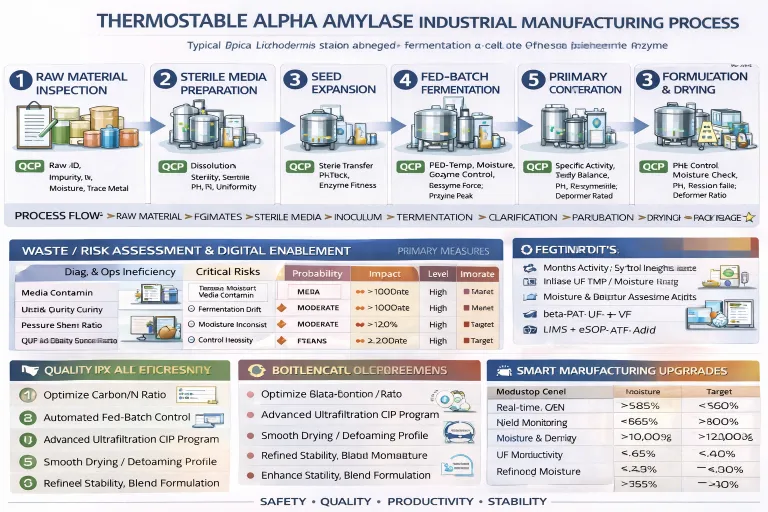
Production Process