


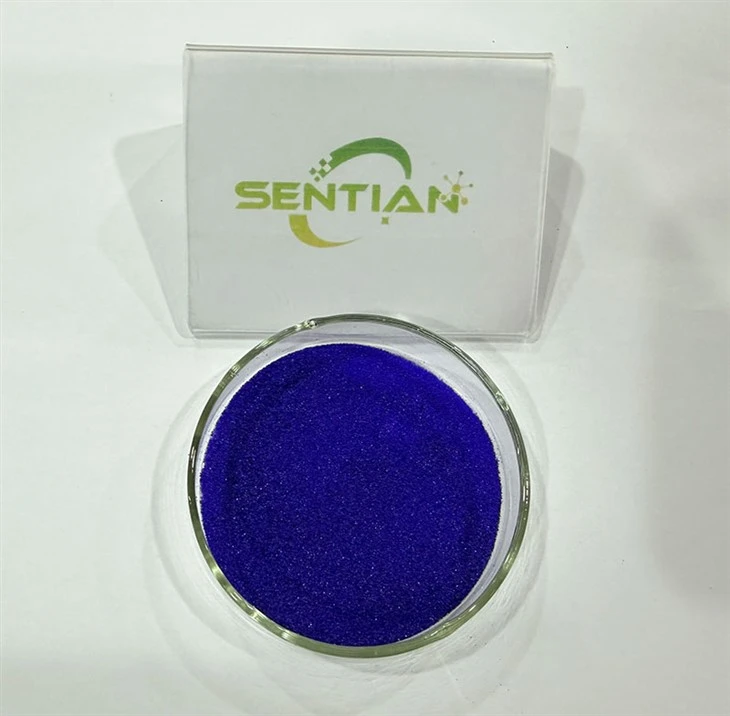
What is Copper Tripeptide-1 Powder?
Copper Tripeptide-1 Powder consists of glycyl-L-histidyl-L-lysine (GHK) complexed with copper (Cu²⁺), a synthetic peptide which is commonly used as an active ingredient in cosmetics, toiletries, and personal care products. It comes as a fine blue to deep blue powder, and is made by carefully controlling the peptide synthesis process, then by introducing the correct amount and purifying the peptides to guarantee the uniformity of the molecular structure and batch quality. It is well known for its high purity grades, well-defined structure, and ability to fit current formulation systems, and is widely utilized in advanced skin care, dermocosmetics, and hair care product development pipelines. The copper ion is not free in solution, but is structural and therefore has a predictable behaviour in aqueous and emulsified systems and is chemically stable. Industrial-grade materials are usually formulated to be standardised in terms of peptide identity, ratio, residual impurities, and moisture content, and are usually analysed for these parameters and others, including HPLC and elemental analysis. This ingredient is often added to the formulation in multiple specification grades that give formulation developers the flexibility to choose the grades that are appropriate for various product architectures and performance requirements. It is also highly water-soluble, making it easy to be formulated into serums, emulsions, gels, etc., and other cosmetic bases without the need for the use of complex solubilization systems.

COA
.
| Item | Specification | Result |
| Appearance | Blue to violet crystalline powder | Conforms |
| Identification | Positive | Positive |
| Assay (Copper Tripeptide-1) | ≥98.0% | 99.15% |
| Copper Content | 7.5–9.5% | 8.42% |
| Peptide Purity | ≥98.0% | 99.08% |
| Solubility | Freely soluble in purified water | Conforms |
| pH (1% Solution) | 6.0–8.0 | 687.00% |
| Loss on Drying | ≤5.0% | 2.31% |
| Sulfated Ash | ≤1.0% | 0.18% |
| Heavy Metals | ≤10 ppm | <10 ppm |
| Lead (Pb) | ≤1.0 ppm | 0.12 ppm |
| Arsenic (As) | ≤1.0 ppm | 0.05 ppm |
| Cadmium (Cd) | ≤0.5 ppm | 0.03 ppm |
| Mercury (Hg) | ≤0.1 ppm | 0.01 ppm |
| Total Plate Count | ≤100 CFU/g | <10 CFU/g |
| Yeast & Mold | ≤50 CFU/g | <10 CFU/g |
| Escherichia coli | Negative/g | Negative |
| Salmonella | Negative/25 g | Negative |
| Staphylococcus aureus | Negative/g | Negative |
Sentian Bio provides free samples, OEM/ODM customized products, and professional technical support. Contact us anytime at sales3@sentianbio.com or LEAVE A MESSAGE!
How Copper Tripeptide-1 Powder works?
GHK-Cu Powder acts in a precisely known coordination structure, in which the tripeptide (glycyl-L-histidyl-L-lysine) coordinates with the copper ion (Cu²⁺) to create a stable bioactive complex which interacts with the biochemical environments in the cells and in the extracellular space. It is primarily involved with the delivery in a controlled manner (delivered by peptides) and, therefore, is involved in the regulation of availability in localized biochemical processes where copper is a cofactor for various enzymatic reactions. It is involved in redox-related pathways, where it is involved in transfer reactions of electrons that are associated with the modulation of oxidative balance in biological systems. GHK peptide sequence is also known to bind to cell surface receptors and extracellular matrix (ECM) components, at a biochemical signaling level, affecting structural protein synthesis and matrix remodeling processes. The complex also shows affinity for binding and stabilizing some proteins and metal ions, which helps to maintain the microenvironment and facilitates the normal communication dynamics between cells. It is said to have a multifunctional activity: metal ion transporting activity and peptide-mediated signaling activity give rise to its functional profile in cosmetic and bioactive ingredient systems. It is not a single-path compound, but is a coordinated system which is known to be a combination of metal ion chemistry and peptide-based biological signaling modulation in a controlled and dose-dependent manner.
Why it popular?
1. Strong scientific foundation and research interest
It has been widely studied in the cosmetic science field and is cited in numerous biochemical and dermatological studies. It has a well-defined molecular structure and has been shown to interact with biochemical pathways requiring copper, making it an interesting ingredient for formulators looking for ingredients with a solid scientific basis.
2. Multifunctional molecular profile
It is a multi-mechanism ingredient as it has a peptide signaling activity as well as a copper ion coordination activity. The double structure allows it to be used in formulations with various cosmetic performance objectives in the same active system that will minimize the need for ingredient stacking.
3. Compatibility with modern formulation systems
It has a good water solubility and is compatible with Cosmetic Formats (Serums, Emulsions, Gels, Leave-on). This versatility allows the product to be used in a variety of product categories and helps product designers to formulate products.
4. Clean-label and minimalist formulation appeal
It is a single, well-defined molecule, and it is clearly defined by the INCI name, thus it's in line with the clean-labels trend in cosmetics. It is a commonly used active ingredient in cosmetics by brands for its visibility and science-based benefits and properties, which helps to keep the ingredient list simplified and transparent.
5. High consistency in industrial production
The chemical characterisation by advanced synthesis and purification techniques like SPPS and HPLC guarantees a consistent purity, a controlled content, and repeatable performances in different batches. This reliability becomes more crucial in large-scale manufacturing and supply chains around the world.
6. Strong formulation flexibility and brand positioning value
Copper Peptide Powder is used widely in high-end cosmetic product formulations as it has a contemporary biotech look, and brands can leverage their formulations into the premium segment of advanced peptide and bioactive ingredient products, which are highly sought after in competitive cosmetic markets.

Suitable For
Blue Copper Peptide Powder can be used in cosmetic product formulation for many applications developed by cosmetic manufacturers to address the needs of today's personal care consumers of all ages and sensitivities. Often used in high-quality skin care lines for consumers who prefer science-based, biotechnology ingredients and short INCI formulations. It's ideal for end-users looking to create sophisticated cosmetics like leave-on formulations, emulsions, and functional skin serums and creams with more modern positioning concepts than those featuring the typical cosmetic additive. The ingredient is also often used in cosmetics targeted to customers whose skin is in contact with environmental situations found in urban settings, where the need for multifunctional cosmetics providing general skin appearance maintenance within day-to-day skin care activities is greater. Moreover, it can easily be incorporated in product portfolios of mature consumer target groups looking for peptide and mineral complexes in their anti-aging positioning strategies in the cosmetic market. Another important segment includes younger consumers who are using preventative skin care and ingredient-driven beauty products, including those that actively look to obtain clean-label, biotech-derived actives in their personal care products. In general, it is marketed by manufacturers as a multi-functional cosmetic active component that can be used in a variety of cosmetic formulations and used in the mass to premium/premium-high category of products in different global markets.
Factory

Certificate

Exhibition
