


Sodium Caseinate is a protein ingredient derived from milk, which is safe, highly digestible, has a wide range of functional properties, and is well recognized by global food safety authorities as a beneficial macronutrient and additive for commercial applications.
It is a high-nutrition, controlled-neutralized and spray-dried bovine casein that provides important physical stability to a variety of formulations and is a quality ingredient. Sodium caseinate, from the industrial and dietetic perspectives, is a valuable protein component of modern food technologies and not a harmful chemical agent, as it is a highly concentrated source of complete proteins and essential amino acids.
Understanding Sodium Caseinate Raw Material Usage and Processing Mechanics
For certain product formulations, food scientists test the physical behavior of sodium caseinate in the food product during the production process to determine if it can be used. It has an amphiphilic character and can act as a bridge between the phases of oil and water.
The caseinate powder must be hydrated in a controlled manner, as this is critical for achieving optimal functionality, and is referred to as the Hydration Protocol. The sodium caseinate powder must be hydrated in a controlled way, which is called the Hydration Protocol, and this is critical to achieve optimal functionality. When dissolving the powder under high shear agitation in warm water (between 50°C and 60°C), the result is that no lumps form and the molecule is fully hydrated.
pH Sensitivity and Isoelectric Behavior: It is most soluble and emulsifies best at neutral to slightly alkaline pH (6.0-7.2). The formulators should be aware that at the isoelectric point of casein (pH 4.6) solubility will fall, leading to possible premature precipitation in very acidic systems.
Thermal Processing Tolerance: Native whey proteins are susceptible to denaturation with heat, whereas sodium caseinate is resistant to processing with such high heat as ultra-high temperature (UHT) or retort sterilisation, ensuring the integrity of the emulsion in challenging conditions.
Advanced Formulation Strategies for Sodium Caseinate Integration
Formulation with sodium caseinate is based on the ability to exploit its surface-active properties to improve texture, stability and sensory properties of commercial matrices.
In oil-in-water emulsions (non-dairy creamers and sauces), sodium caseinate quickly moves to the surface of the oil to form an emulsion. It creates a stable interfacial film against coalescence and phase separation in the course of long-term storage of fat droplets.
The rheological profile of liquid and semi-solid systems can be manipulated by varying sodium caseinate concentration, Texture and Viscosity Control. It also brings a creamy, smooth texture and substance to low-fat or low-calorie products.
Synergistic networks with complementary stabilizers: When sodium caseinate is combined with other complementary stabilizers, like carrageenan, xanthan gum, or guar gum, synergistic networks are formed. The use of this method enhances the gel structure of cultured dairy products and air cell retention in whipped dessert systems.
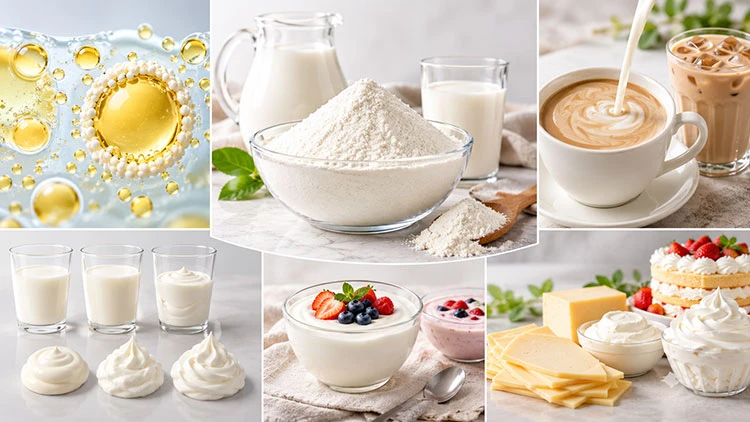
Dosage Factors and Functional Limits in Industrial Applications
It is essential to set the appropriate inclusion rate of sodium caseinate for the desired technical properties without loss of product quality and production efficiency.
Typical Usage Ranges: In commercial food processing, typical usage ranges are 0.5% to 3.0% by weight, with the upper limits depending on the primary purpose, which may be emulsification, water binding, or protein enrichment.
Allowances for Protein Fortification: >5.0% for sports nutrition beverages and meal replacement powders. Balancing the protein density with an increase in viscosity is necessary to retain the consumer-friendly attribute of "drinkability" in the drink.
Excessive viscosity and overly dense textures or subtle milky off-flavors are possible consequences of overdosing; the need for accurate batch calculations for scale up, being emphasized.
Thermal Stability and Physical Properties of Sodium Caseinate Matrices
Sodium caseinate is structurally stable and therefore a good choice of raw material for international distribution networks.
Water-Binding Capacity: Sodium caseinate is a very flexible protein, which allows high water-binding capacity. This property of being ice crystal growth retarding and purge-loss-reducing is important in processed meats and in systems of frozen desserts.
The ability to encapsulate lipid particles with sodium caseinate is called Fat Encapsulation Efficiency. This protective matrix will help to reduce fat oxidation, provide longer shelf life, and rapid rehydration when reconstituted for use.
Resistance to Mechanical Shear: This is when sensitive ingredients are broken down by industrial mixing, homogenization, and pumping. Sodium caseinate is resistant to high mechanical shear without affecting its emulsifying properties.

Widespread Industrial Applications of Sodium Caseinate
The versatile uses of sodium caseinate span several industries in the worldwide food, beverage, and nutritional manufacturing sectors.
Processed Meat and Poultry Products: Used as a binder and emulsifier in sausages and deli meats, sodium caseinate makes meats easier to slice, holds the natural juices, and makes the fat content consistent.
Non-Dairy Creamers and Beverage Systems: Used as the main stabilizing agent in any powdered coffee whitener, liquid creamers, and RTD protein drinks, it helps to prevent oil separation and feathering when combined with hot liquids.
Dairy Analogs and Processed Cheeses: Improves melting, extensibility, and hardness of products such as cheese analogues and spreadable dairy products without the addition of synthetic stabilizers.
Nutritional and Sports Formulations: Nutritional and Sports Blend formulations are high-protein dry mixes, clinical nutrition beverages, and dietary supplements containing the full range of amino acids, as well as the use of high digestibility and neutral flocculent base.
Sentian Bio provides free samples, OEM/ODM customized products, and professional technical support. Contact us anytime at sales3@sentianbio.com or LEAVE A MESSAGE!
Is sodium caseinate good or bad for you?
To sum up, the attributes of sodium caseinate as a food ingredient and its industrial applications seem to outweigh any negative findings of its suitability or unsuitability for human consumption. Sodium caseinate is a natural milk ingredient that is safe and provides excellent protein nutrition, in addition to essential functional attributes for the food industry. If used within the set formulation parameters and according to the correct dosage, it is an effective and valuable raw material that ensures structural stability, longer shelf life, and very strict food standards in the world.
FAQ
Is sodium caseinate considered a safe food additive?
Yes, the U.S. Food and Drug Administration (FDA) recognizes sodium caseinate as a GRAS ingredient; it is approved by the EFSA and approved by Codex Alimentarius (FAO/WHO).
Does sodium caseinate contain lactose?
Ninety-nine percent of lactose is eliminated in the sodium caseinate's extraction and refinement. It is almost lactose-free, but people who are very sensitive to milk protein should be careful that it is a milk product.
What is the primary difference between sodium caseinate and whey protein?
Sodium caseinate is a fraction of milk commonly used as a source and has slow-digesting properties and is very heat-stable. Whey protein is more easily denatured by heat, digests more rapidly, and is the liquid whey by-product of cheese making.
How does sodium caseinate improve the shelf life of packaged foods?
The addition of sodium caseinate creates strong interfacial films around oil droplets and locks up free moisture, which results in fat not separating, syneresis, and structural breakdown during long storage and transportation periods.
References
1. Fox, P. F., & Brodkorb, A. (2008). Significance of casein micelles and caseinates in dairy technology. International Dairy Journal, 18(7), 677-684.
2. Southward, C. R. (2003). Casein and Caseinates: Manufacture and Properties. Encyclopedia of Food Sciences and Nutrition, 943-951.
3. Singh, H. (2011). Functional properties of milk proteins: Industrial applications of caseinates. Comprehensive Reviews in Food Science and Food Safety, 10(2), 112-121.
4. U.S. Food and Drug Administration. (2022). Code of Federal Regulations Title 21: Direct Food Substances Affirmed as Generally Recognized as Safe - Sodium Caseinate (21 CFR 184.1747). U.S. Government Publishing Office.