


The most important effects of Creatine Supplements are that they boost the level of phosphocreatine in cells in skeletal muscle, thereby facilitating the quick regeneration of ATP in the cells during repeated intense exercise.
How Creatine Supplements Work in Muscle Energy Metabolism
The purpose of the supplement is to build up the body's creatine pool, and the most widely used form for nutritional purposes is creatine monohydrate.
Availability of phosphocreatine - Phosphate is readily donated by phosphocreatine to aid ATP regeneration during short, intensive bouts of activity, inside the skeletal muscle.
It is important to have more phosphocreatine available for high-intensity exercise support, especially for repeated resistance sets, sprint intervals, jumps, and other high-power activities that last for a short duration.
Training-volume interaction - training sessions and creatine do not mix. It is also highly applicable to repeated, high-intensity exercise capacity, especially related to sport nutrition products.
Creatine Monohydrate Supplementation and Dosage Factors
Dosage strategy is one of the key formulation variables in the formulation of creatine supplements under development by manufacturers.
Typical daily dose - One popular regimen is to take around 3 to 5 grams of creatine monohydrate every day. This approach builds up muscle creatine stores over time and avoids a loading phase.
Loading protocol - For a short term (or initial ingestion), a higher amount of about 0.3 g/kg/day (usually split into a few servings can be used to increase muscle creatine stores more quickly. There may be a maintenance period after the loading period.
No-loading formulation: If a product is formulated for ease of daily use, it can be a product with a consistent serving size of 3–5 g per day. The main difference being the time it takes to achieve high levels of muscle creatine, and not in the actual mechanism of action.
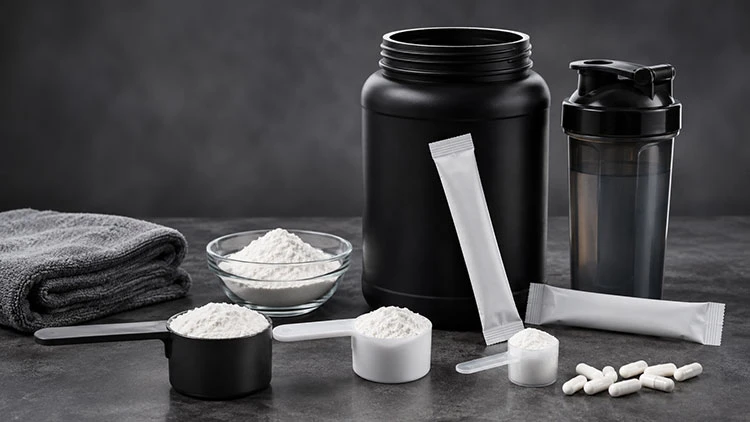
Serving-size engineering - When designing a new product for B2B manufacturers, the size of the serving should be considered in conjunction with the size of the scoop, the capsule size, the size of the sticks, flavor system, and the intended finished product format.
Creatine Supplement Formulation and Mixing Considerations
Creatine monohydrate is very appropriate for powder product forms, but the physicochemical behavior of the product becomes more significant when liquid product forms are developed.
Powder stability: Creatine monohydrate is reasonably stable when it comes to powders and powders in dry blends (under normal storage conditions).
The solubility in water - Creatine monohydrate is not very soluble in water at room temperature. Dissolution may be enhanced at higher temperatures, but this may not necessarily translate to greater biological activity.
Solution sensitivity to pH - Creatine is less stable in an aqueous solution as the pH increases and temperature increases. These factors must all be considered when evaluating the pH, processing temperature, holding time, and shelf-life requirements of the formulation.
Liquid-product strategy - For ready-to-drink formulations, not only are initial specifications important, but creatine assay stability and/or degradation products should be assessed during the intended shelf life.
Creatine Supplement Formulation with Carbohydrates and Protein
Creatine can be added to multi-ingredient sports nutrition products, but the matrix around it has to be carefully designed.
Carbohydrate systems - Carbohydrates can also be incorporated into recovery powders, drink mixes and mass gain products and provide sweetness, solids and energy density.
Protein combinations: Creatine monohydrate may be included with other protein sources, such as whey, casein, plant or amino-acid based systems in dry products for sports nutrition.
Flavor compatibility - The creatine monohydrate formulation challenge is often with the overall flavor and mouthfeel of the complete formulation, not masking an attractive inherent flavor.
Moisture control - Hygroscopic ingredients and high moisture matrices have the potential to affect powder flow and physical stability. Therefore, appropriate packaging, control of the water activity, and the storage conditions should be taken into account during product development.

Creatine Supplements in Sports Nutrition Applications
Creatine supplements are widely applicable in commercial sports nutrition, as they can be formulated in various packaging types.
Creatine powder - Pure or flavored creatine powder is one of the simplest forms of creatine and makes it easier for the manufacturer to control the final product to ensure that they are getting the exact dose they intend to give the consumer.
Pre-workout products - Creatine may be used as an ingredient in multi-ingredient pre-workout products; however, the pre-workout formulation must differentiate between the use of creatine and stimulants and other performance-enhancing ingredients.
Post-workout products - Protein-and-creatine powders can be formulated with two widely used sports nutrition ingredients, and reduce the cost and complexity of marketing to consumers.
Solid oral forms such as capsules or tablets may be convenient for unit dosing but may have to be carefully considered due to the fact that a relatively high dose of creatine is normally used per day.
Functional beverages: Liquid-based applications will be significantly more challenging than dry powders, as creatine can be impacted by pH, processing, storage time, and temperature.
Quality Control for Creatine Monohydrate Products
A creatine supplement's quality to the buyer rests on more than just the assay that it claims to contain.
Confirm identity by analytical technique - It is important to use an appropriate analytical technique to verify the identity of the raw material before production.
Assay and purity - Quantitative tests should confirm that the product contains creatine as per the agreed specification, and additional quality information may be obtained from the presence of related substances and degradation products.
When using creatine in automated blending or filling operations, the following physical properties may be pertinent: Particle size, appearance, bulk density, moisture, and flow properties.
Microbiological quality - Finished specifications shall contain suitable microbiological limits, depending on the type of product to be finished and market specifications.
Traceability documentation - A commercial COA should contain information regarding batch, manufacturing date, parameters tested, specification limits, analytical results, and release status.
Contact Us Directly or email sales3@sentianbio.com to get the supplement solutions you need.
What do creatine supplements actually do?
This in the real world means that creatine supplements boost the amount of creatine present in muscles and phosphocreatine, which helps power quick bursts of exercise. The consideration of creatine use in a manufacturer's formulation is not just the amount of creatine used, but the dosage form/dosage, moisture, pH, processing conditions, packaging, and shelf-life requirements all play a part. Creatine monohydrate is a technically proven product for powders and dry sports nutrition products, but liquid products need to be more thoroughly developed.
FAQ About Creatine Supplements
1. What do creatine monohydrate supplements actually do?
Creatine monohydrate raises the amount of creatine and phosphocreatine in muscle stores and thus facilitates quick ATP resynthesis during multiple bouts of intense exercise. It is most applicable for sports nutrition supplements focused on strength, power, and repeated effort training.
2. How much creatine monohydrate should be used in a supplement?
The typical maintenance dose is 3-5 grams per day. A few preparations require a brief loading dose (about 0.3g/kg/day) followed by a maintenance dose. The final serving instructions should be set based on the product form and market.
3. Is creatine monohydrate stable in powder form?
Yes. Dry creatine monohydrate is much more stable than creatine in water. But manufacturers should still monitor moisture, temperature, packaging integrity, and conditions of storage during the shelf life of the product.
4. Can creatine monohydrate be used in ready-to-drink beverages?
Yes, but liquid creatine formulations will need extra stability development. The pH, temperature, duration, processing conditions, and beverage matrix can affect creatine degradation; hence, real-time and accelerated stability testing is important in commercial beverage formulation.
References
1. Antonio, J., Candow, D. G., Forbes, S. C., Gualano, B., Jagim, A. R., Kreider, R. B., Rawson, E. S., Smith-Ryan, A. E., & VanDusseldorp, T. A. (2021). Common questions and misconceptions about creatine supplementation: What does the scientific evidence really show? Journal of the International Society of Sports Nutrition, 18, 13.
2. Pashayee-Khamene, F., Heidari, Z., Asbaghi, O., Ashtary-Larky, D., Goudarzi, K., Forbes, S. C., Candow, D. G., Bagheri, R., Ghanavati, M., & Dutheil, F. (2024). Creatine supplementation protocols with or without training interventions on body composition: A GRADE-assessed systematic review and dose-response meta-analysis. Journal of the International Society of Sports Nutrition, 21(1), 2380058.
3. Desai, I., Wewege, M. A., Jones, M. D., Clifford, B. K., Pandit, A., Kaakoush, N. O., Simar, D., & Hagstrom, A. D. (2024). The effect of creatine supplementation on resistance training-based changes to body composition: A systematic review and meta-analysis. Journal of Strength and Conditioning Research, 38(10), 1813–1821.
4. Huang, D., Wang, X., Gonjo, T., Takagi, H., Huang, B., Huang, W., Shan, Q., & Chow, D. H.-K. (2024). Effects of creatine supplementation on the performance, physiological response, and body composition among swimmers: A systematic review and meta-analysis of randomized controlled trials. Sports Medicine - Open, 10, 115.
5. Zhang, H., Lan, T., Yan, X., & Gu, H. (2025). Effects of creatine supplementation on muscle strength gains-a meta-analysis and systematic review. PeerJ, 13, e20380.