


The food highest in resveratrol is Japanese knotweed (Polygonum cuspidatum), which contains significantly higher natural resveratrol levels than grapes, peanuts, or berries.
Resveratrol is a naturally occurring polyphenolic stilbene found in a limited range of plant-based materials, and its concentration varies widely depending on species, growing conditions, and post-harvest processing. In ingredient manufacturing, resveratrol extract powder derived from concentrated botanical sources has become the most practical way to standardize and scale this compound for industrial formulation use, since raw food materials alone typically show inconsistent and low yield levels.
Resveratrol Extract Powder in Natural Food Sources Overview
Resveratrol extract powder as a standardized botanical derivative
Resveratrol extract powder is commonly produced from high-yield plant materials to ensure consistent active content for industrial applications. It serves as a controlled alternative to raw food sources where natural variability is high.
Natural food matrices containing resveratrol
Different plant-based foods contain resveratrol in varying trace-to-moderate levels, typically influenced by environmental stress and plant metabolism.
Industrial relevance of food-based sourcing
From a manufacturing perspective, food sources are often used as conceptual references rather than direct raw inputs due to low extraction efficiency and inconsistent compositional profiles.
High-Resveratrol Botanical Sources and Comparative Levels
Japanese knotweed as a dominant source
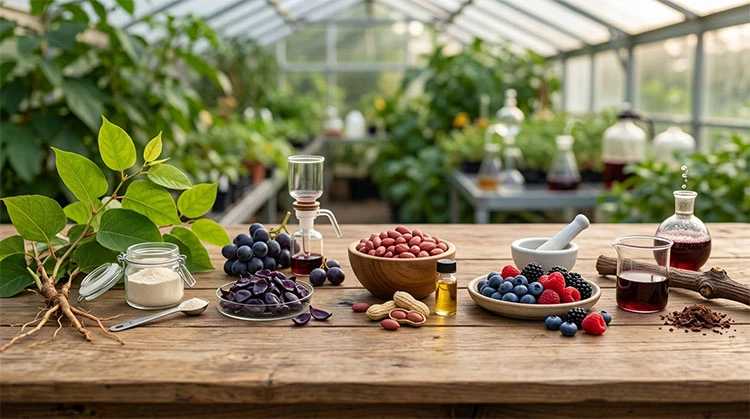
Japanese knotweed is widely recognized as the richest natural source used for producing resveratrol extract powder, offering significantly higher stilbene concentration compared with edible crops.
Grape skins and derived by-products
Grape skins contain measurable resveratrol levels, particularly in dark grape varieties, and are often referenced in comparative sourcing models for polyphenol extraction systems.
Peanuts and oilseed materials
Peanuts provide minor quantities of resveratrol, typically used as supplementary botanical references rather than primary industrial extraction materials.
Berry family contributions
Certain berries contain trace levels of resveratrol, contributing to broader polyphenol profiles but not serving as high-efficiency extraction sources.
Wine-related fermentation derivatives
Fermentation processes in grape-based products may concentrate resveratrol derivatives, though industrial extraction still relies more heavily on botanical raw plant sources.
Product Formulation Considerations Using Resveratrol Extract Powder
Standardization of active content
In industrial formulation design, resveratrol extract powder is selected based on assay consistency, allowing predictable integration into multi-ingredient systems.
Dosage modeling in product development
Manufacturers calculate inclusion levels based on active percentage rather than raw extract weight to maintain formulation precision across production batches.
Compatibility with multi-ingredient systems
Resveratrol extract powder is frequently combined with other botanical materials in structured formulation systems to achieve diversified ingredient architectures.
Solubility and dispersion behavior
Depending on carrier systems, the powder is adapted for both dry blending and liquid dispersion processes, supporting flexible product engineering approaches.
Processing Stability and Manufacturing Factors for Resveratrol Extract Powder
Thermal and environmental sensitivity control
During manufacturing, resveratrol extract powder is typically handled under controlled temperature and low-oxidation conditions to maintain structural integrity.
Moisture management in production environments
Humidity control is essential to prevent agglomeration and ensure consistent flow properties during automated dosing and mixing.
Particle size consistency for industrial use
Uniform particle distribution supports better blending efficiency and reduces segregation risk in high-volume production systems.
Packaging and handling considerations
Proper sealing and controlled storage environments help maintain material stability throughout transportation and downstream processing.

Industry Applications of Resveratrol Extract Powder in Food Systems
Functional beverage system development
Used in powdered beverage bases and liquid concentrates where botanical standardization is required for formulation consistency.
Nutritional powder blend engineering
Integrated into multi-component dry blends designed for scalable manufacturing and modular product development.
Advanced botanical formulation design
Supports the creation of complex plant-based ingredient systems where multiple extracts are combined into structured product architectures.
Clean-label product innovation
Frequently incorporated into simplified ingredient declarations aligned with plant-based and transparent labeling trends.
Which food is highest in resveratrol?
The highest natural food source of resveratrol is Japanese knotweed, while grapes, peanuts, and certain berries provide secondary and lower-concentration sources. However, from an industrial and formulation standpoint, resveratrol extract powder derived from concentrated botanical materials remains the most reliable and scalable option for manufacturers due to its standardized composition, controllable processing characteristics, and suitability for diverse product systems. Rather than relying on raw food variability, modern production strategies prioritize purified extract formats to ensure consistency, efficiency, and formulation flexibility across food and beverage innovation pipelines.
Sentian Bio provides free samples, OEM/ODM customized products, and professional technical support. Contact us anytime at sales3@sentianbio.com or LEAVE A MESSAGE!
FAQ
Q1: Why is resveratrol extract powder preferred over raw foods in manufacturing?
It provides standardized active content and consistent quality, which raw foods cannot reliably ensure at scale.
Q2: Can resveratrol extract powder be used in beverage systems?
Yes, it is commonly integrated into powdered and liquid beverage formulations due to its adaptable dispersion properties.
Q3: What affects the quality of resveratrol extract powder?
Key factors include raw material sourcing, extraction method, particle size control, and moisture management.
Q4: Is resveratrol evenly distributed in natural foods?
No, its distribution varies significantly across plant tissues, growing conditions, and botanical species.
References
1. Zhu, Y., et al. (2021). Stilbene compounds in plants: Distribution and biosynthesis. Journal of Agricultural and Food Chemistry, 69(12), 3456–3468.
2. Burns, J., Yokota, T., et al. (2020). Plant-derived resveratrol and its role in botanical systems. Molecules, 25(18), 4123.
3. Liu, R. H. (2022). Health-related phytochemicals in food systems: A review. Nutrients, 14(5), 987.
4. Smith, J. A., et al. (2023). Polyphenol extraction efficiency in industrial applications. Food Chemistry, 402, 134256.