


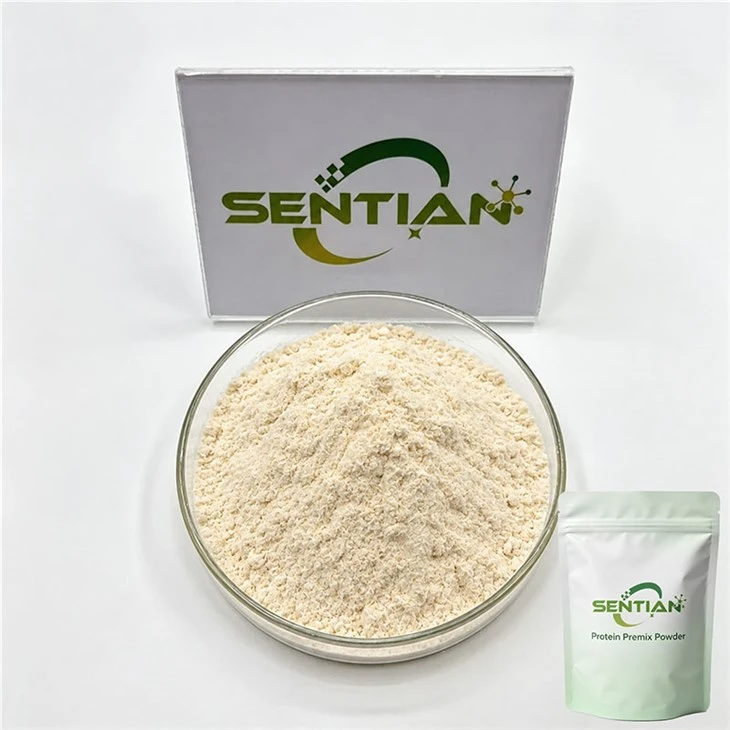
What is Protein Premix Powder?
Protein Premix Powder is a specially formulated, customized mix of concentrated protein with suitable micro-ingredients for ease of commercial food & beverage manufacturing on a large scale. This pre-formulated compound is primarily suited to functional food, sports nutrition, beverage processing, and the dietary supplement industries, and offers clients an efficient, scalable solution to help alleviate the complexity of their supply chain logistics and to ensure consistent nutrient distribution across the batch and reduce inconsistencies significantly in high-volume applications. It combines high-quality plant or dairy protein bases (including isolated soy, pea protein, whey protein, or rice protein) with optimized functional carriers, natural flavor systems, stabilizers, and precise matrices of micronutrients, all in one, enabling manufacturing brands to decrease inventory overhead, avoid multi-component dosing mistakes, and minimize total labor expenses. Moreover, these industrial-grade blends are designed to further enhance the physical processing parameters, such as powder dispersibility, particle size uniformity, bulk density, and heat stability in the UHT process, as well as in extrusion and dry blending processes. Convenient, clean label, and fortified end-products have become more important than ever across the worldwide market, and a standardized, turnkey protein premix allows brand owners, contract manufacturers, and private label producers to speed up their product development timelines, adhere to strict regional market regulations, control quality, and ensure consistent physical performance in a variety of functional product matrices.

COA
| Item | Specification | Result | Test Method |
| Appearance | Uniform Free-Flowing Powder | Conforms | Visual Inspection |
| Color | White to Light Cream / Product-Specific | Conforms | Visual Inspection |
| Odor | Characteristic, Free from Foreign Odor | Conforms | Organoleptic Examination |
| Taste | Characteristic, Free from Off-Taste | Conforms | Organoleptic Examination |
| Particle Size | ≥95% Pass 80 Mesh | Conforms | Sieve Analysis |
| Bulk Density | 0.35–0.75 g/mL | Conforms | USP <616> |
| Moisture | ≤7.0% | Conforms | AOAC 925.10 |
| pH (10% Solution) | 6.0–8.0 | Conforms | USP <791> |
| Dispersibility | ≥90% | Conforms | Internal Method |
| Wettability | ≤120 sec | Conforms | Internal Method |
| Total Plate Count | ≤10,000 CFU/g | Conforms | USP <61> |
| Yeast & Mold | ≤100 CFU/g | Conforms | USP <61> |
| Coliforms | ≤10 CFU/g | Conforms | USP <62> |
| Escherichia coli | Absent/10 g | Conforms | USP <62> |
| Salmonella | Absent/25 g | Conforms | USP <62> |
| Staphylococcus aureus | Absent/25 g | Conforms | USP <62> |
| Bacillus cereus | ≤100 CFU/g | Conforms | ISO 7932 |
| Total Aflatoxins | ≤10 μg/kg | Conforms | HPLC/LC-MS |
| Lead (Pb) | ≤2.0 mg/kg | Conforms | ICP-MS |
| Arsenic (As) | ≤1.0 mg/kg | Conforms | ICP-MS |
| Cadmium (Cd) | ≤1.0 mg/kg | Conforms | ICP-MS |
| Mercury (Hg) | ≤0.1 mg/kg | Conforms | ICP-MS |
| Residual Solvents | Meets Applicable Food-Grade Requirements | Conforms | GC |
| Foreign Matter | None Detected | Conforms | Visual Inspection |
| Allergen Declaration | According to Formula / Applicable Regulations | Conforms | Formula Review |
| GMO Status | Non-GMO / According to Formula | Conforms | Supplier Declaration / PCR |
| Irradiation Status | Non-Irradiated | Conforms | Supplier Declaration |
| Microbiological Status | Complies with Applicable Food Ingredient Standards | Conforms | Microbiological Analysis |
Sentian Bio provides free samples, OEM/ODM customized products, and professional technical support. Contact us anytime at sales3@sentianbio.com or LEAVE A MESSAGE!
Market Trends
Global trends towards Active lifestyle nutrition and Holistic health and wellness are fueling the commercial market for Protein Blend Powder in the food processing, functional beverages, and dietary supplement applications. At the macroeconomic level, the principles of clean-label formulation are very strong and are gaining ground steadily with the growing concern of global end-consumers for transparent supply chains, recognizable origin (botanical or dairy), non-GMO certification, and limited artificial processing. Food manufacturers, brand owners, and private label formulators are putting in a lot of effort to shift away from synthetic additives and complicated multi-ingredient panels to turnkey, standardized functional matrix systems, which meet this consumer demand for clean and naturally derived ingredients. Conventional commercial manufacturers are using custom protein premixes to simplify large-scale manufacturing, achieve greater batch-to-batch nutrient consistency, and overcome physical processing issues, such as solubility and thermal stability, with minimal impact on their clean-label product. Moreover, the synergy of plant-based protein innovation and the development of advanced micro-encapsulation technology unlocks the potential for creating ready-to-mix (RTM) powders, functional snacks, and fortified food lines for buyers to meet market regulatory requirements and the global demand for sustainable, naturally fortified, everyday nutrition.
Features
It is technologically and physiochemically unique in its processing versatility, batch uniformity, and structural stability, making it very useful for food technologists and commercial formulators in various food processing situations. The physical matrix is designed for excellent particle dispersion and dry bulk density, making it easy to rapidly hydrate, disperse in cold water, and minimize dust generation during high-speed automated dry blending or liquid reconstitution. The chemically pre-blended system is designed to preserve high amino acid integrity and has an optimized isoelectric profile, so as to avoid undesirable denaturation, phase separation, or sedimentation during high-temperature short-time (HTST) or ultra-high temperature (UHT) thermal processing. The powder's rheological properties are well controlled, and its properties of excellent viscosity management, controlled gelation capacity, and high oil-water emulsion stability in complex matrices (with varying pH, ionic strength, or TDS) are beneficial to the formulators. Moreover, the micro-encapsulation and even dispersion of the carrier used in these premixes prevent the sensitive active micro-ingredients from environmental oxidation, moisture, and thermal degradation during storage. Protein Powder Blend enables formulators to simplify product development, achieve accurate dosing across large production volumes, and resolve typical formulation challenges like gritty texture, protein cross-linking, and flavor masking.

Benefits
1. Streamlined Multi-Ingredient Purchasing:
Protein Powder Mix reduces the number of raw materials, carrier systems, and functional micro-ingredients to a Single Stock Keeping Unit (SKU), significantly simplifying raw materials procurement, vendor management, and inventory footprints.
2. Enhanced Manufacturing Dosing Precision:
Micro-ingredient segregation and batch-to-batch variation are controlled during automated processing, resulting in a uniform distribution of nutrients, accurate dosing of active compounds, and adherence to batch production records when blending is pre-homogenized.
3. Optimized Operational Cost Efficiency:
Resolves and removes multi-step weighing and pre-blending work on the factory floor, which requires a lot of labor; shortens the cycle, reduces dust emission, reduces raw material waste, and lowers the cost of labor.
4. Superior Organoleptic & Textural Performance:
The engineered particle structure and integrated stabilisation matrices help to conceal any natural raw protein isolate off-flavours and aid in achieving cold water solubility, viscosity control, and good mouthfeel in liquid and dry applications.
5. Accelerated Time-to-Market for New Formulations:
Commercial formulators and private-label brand owners can skip the time-consuming iterations in the lab and reduce the need for pilot-scale trials and scaling up to their final product launch in functional food and beverage categories by utilizing turn-key ingredient integration.
6. Extended Shelf-Life & Physicochemical Stability:
Ensuring proper moisture control and protective carriers are balanced to achieve optimum hygroscopicity, oxidation, and protein aggregation over time, which will aid storage stability and maintain flowability during extended supply chain transit.
FAQ
Q1: Can Protein Premix Powder be customized to meet specific nutritional profiles or plant-based standards?
A: Yes. We can provide OEM/ODM formulation services to provide clients with protein sources (soy, pea, rice, whey), carriers, and micro-ingredient matrices that are designed for clean label or vegan options.
Q2: How does a protein premix improve production efficiency compared to raw ingredient blending?
A: It brings all the raw materials into a single SKU that is already pre-homogenized in a single batch to eliminate the need for weighing, reduce purchasing overhead, lower labor costs, and shorten the batch processing time.
Q3: What are the primary B2B applications for Protein Premix Powder?
A: It is commonly used in commercial processing for ready-to-mix (RTM) powders, ready-to-drink (RTD) liquid products, functional nutrition bars, extruded snack foods, and dietary supplements.
Q4: How does this powder perform during thermal processing like UHT or HTST?
A: It has high resistance to heat and keeps the viscosity of the material even, does not cause phase separation, and is free from any irregularities in viscosity during high-temperature heat treatment.
Q5: What are the recommended storage conditions and shelf-life parameters for bulk orders?
A: Keep in unopened, cool, and dry places. The premix is stable over long storage times, hygroscopic, and has excellent flowability under optimal storage conditions.
Production Process

Certificate

Exhibition
