


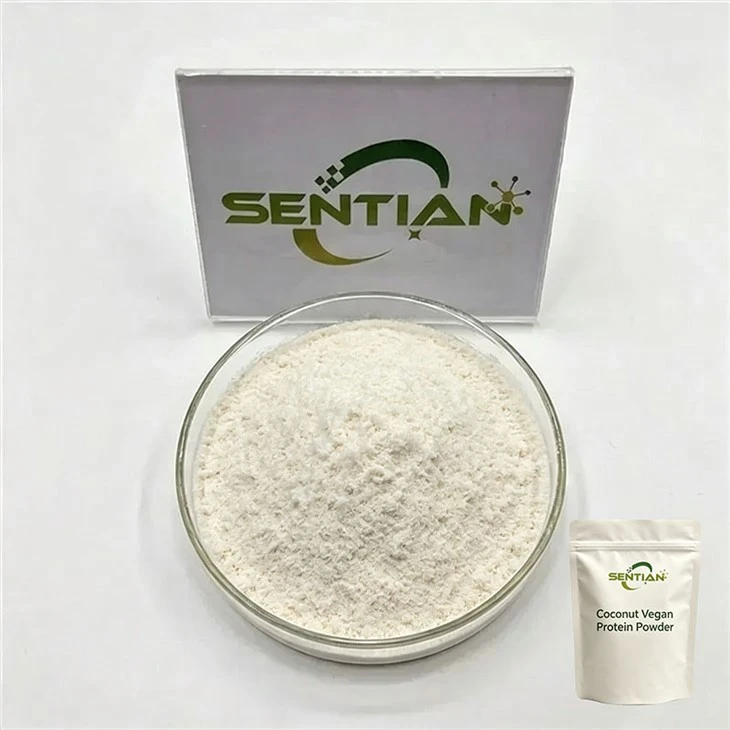
Xi'an Sentian Biotechnology Co., Ltd. is one of the leading manufacturers and suppliers of coconut vegan protein powder in China. We are committed to providing high quality customized service and OEM&ODM private label service for global clients. Please feel free to buy bulk coconut vegan protein powder in stock here from our factory. Also, free sample is available.
What is Coconut Vegan Protein Powder?
Coconut Vegan Protein Powder is a nutritional ingredient obtained from a plant that can be used to create commercial food and beverage formulations without the presence of allergens, and is based on nutrients from the coconut. The special botanical protein is tailor-made for companies looking for functional proteins for versatile, label-friendly applications in the growing consumer packaged goods market, where dairy-free, soy-free, and gluten-free are becoming the new norm. This ingredient is used by manufacturers to improve the nutritional content of sports nutrition bars and powders, meal replacement drinks and powders, baked goods, and functional drinks while avoiding major allergens and artificial ingredients. It has good blendability, smooth mouthfeel, and a natural aroma that can be used in different flavors and is perfect for both supply chain and formulation. It is also very stable under industrial processing conditions and hence is the best material for industrial large production runs in various functional food applications. Moreover, the incorporation of this type of plant protein can align with brand initiatives focusing on clean label transparency and sustainable sourcing. Commercial procurement teams take advantage of this ingredient to meet the needs of changing regulations and consumer demands for special dietary products, as their demand for specialized solutions grows.

COA
| Item | Specification | Result | Test Method |
| Source | Coconut (Cocos nucifera L.) | Complies | Organoleptic / Documentation |
| Appearance | Fine, uniform powder, free-flowing | Complies | Visual Inspection |
| Color | Creamy white to light beige | Complies | Visual Inspection |
| Odor | Characteristic of coconut, free from off-odors | Complies | Sensory Evaluation |
| Taste | Mild, characteristic coconut flavor | Complies | Sensory Evaluation |
| Particle Size | ≥95% pass through 80 mesh | 98.20% | Sieve Analysis |
| Protein Content (Dry Basis) | ≥60.0% | 62.80% | Kjeldahl / AOAC |
| Amino Nitrogen | ≥3.0% | 3.46% | Titrimetric Method |
| Moisture | ≤7.0% | 4.82% | AOAC |
| Total Fat | ≤12.0% | 9.15% | Soxhlet Extraction |
| Total Ash | ≤8.0% | 5.26% | AOAC |
| Crude Fiber | ≤8.0% | 5.71% | AOAC |
| Carbohydrates | ≤15.0% | 11.38% | Calculation |
| Solubility | ≥80% | 86.40% | Gravimetric Method |
| Bulk Density | 0.35–0.65 g/mL | 0.48 g/mL | USP / Internal Method |
| Water Activity (aw) | ≤0.30 | 0.21 | Water Activity Meter |
| Peroxide Value | ≤5.0 meq O₂/kg | 2.1 meq O₂/kg | AOCS |
| pH (1% Suspension) | 5.5–7.5 | 6.42 | Potentiometric Method |
| Lead (Pb) | ≤1.0 mg/kg | 0.18 mg/kg | ICP-MS |
| Arsenic (As) | ≤0.5 mg/kg | 0.09 mg/kg | ICP-MS |
| Cadmium (Cd) | ≤0.5 mg/kg | 0.07 mg/kg | ICP-MS |
| Mercury (Hg) | ≤0.1 mg/kg | <0.01 mg/kg | ICP-MS |
| Total Plate Count | ≤10,000 CFU/g | 1,200 CFU/g | ISO 4833 |
| Yeast & Mold | ≤500 CFU/g | 80 CFU/g | ISO 21527 |
| Coliforms | ≤10 CFU/g | <10 CFU/g | ISO 4832 |
| E. coli | Absent in 10 g | Absent | ISO 16649 |
| Salmonella | Absent in 25 g | Absent | ISO 6579 |
| Staphylococcus aureus | Absent in 1 g | Absent | ISO 6888 |
Sentian Bio provides free samples, OEM/ODM customized products, and professional technical support. Contact us anytime at sales3@sentianbio.com or LEAVE A MESSAGE!
Main Ingredients
Coconut Protein Powder's key active ingredients focus on the high concentration of botanical amino acids and the naturally occurring plant-based macronutrients from the coconut matrix. The most prominent constituent is its complete or supplemental plant protein fraction, comprising essential and non-essential amino acids that aid in fortifying industrial food and beverage products with nutrition. This coconut-derived ingredient offers a natural alternative to animal-derived ingredients, as it provides a distinctive combination of structural proteins that includes some dietary fiber and medium-chain triglycerides (MCTs) that remain in the natural raw material source. The co-existing components not only add to the total nitrogen and protein content needed to label food for nutrition but also provide functional techno-functional attributes that increase emulsion stability and mouthfeel in commercial foods. Product developers and formulators assess these key ingredients to make sure that their macronutrient profile is accurately targeted while creating clean label sports nutrition products, vegan meal replacements and functional bakery products. The large amount of naturally bonded lipids and dietary fibre fraction present in the protein matrix helps to retain moisture and gives thermal stability during high-temperature industrial processing operations. Commonly used nutrients in food products are standardized, allowing ingredients to be consistently incorporated into enterprise products that are allergen-free and made from plants.
Manufacturing Pathway
1. Raw Material Preparation & Defatting:
The initial production step starts with high-grade dried coconut meat or copra, which is cleaned, mechanically sized, and cold-pressed to extract most of the natural coconut oils to produce defatted coconut meal or coconut flakes.
2. Aqueous Protein Extraction:
The defatted coconut material is combined with purified water at controlled pH and temperature, and the proteins of the target plant species are selectively solubilized and extracted, with the insoluble fibrous material separated.
3. Centrifugal Separation & Clarification:
Industrial multi-stage centrifuges can be used for separating liquid protein extract from solid by-products, and for removing any "chunks" that remain after the extraction process.
4. Membrane Ultrafiltration & Concentration:
This clarified liquid is treated by the process of ultrafiltration to concentrate the protein molecules, thereby removing any traces of soluble sugars, salts, and other low-molecular impurities, and increasing the level of purity.
5. Industrial Spray Drying:
Concentrated liquid protein slurry is fed to automated spray drying towers, which achieve a fine, uniform, and stable powder with functional solubility using precise thermal parameters.
6. Sifting, Quality Testing & Packaging:
Final microbial and compositional testing for compliance, meticulous testing in the laboratory, high-precision vibratory sieves to ensure uniform particle size distribution, and sealing the Coconut Protein Powder in bulk industrial packaging for enterprise distribution.

Safety
Derived from edible parts of the coconut, the Coconut Protein has a solid safety profile, as it was documented. The isolated protein fraction is completely non-toxic, has been tested, and is free of harmful synthetic additives and hazardous chemical residues when produced by standard separation and purification procedures in industry. The raw material is derived from a food used by everyone and does not contain any endogenous toxins or other harmful secondary plant metabolites in the commercial products. The raw material consistently fulfils the strict international maximum residue limits in rigorous batch testing for heavy metals, pesticide residues and environmental pollutants and thus meets global food safety standards. In addition, through regular microbiological testing, the total absence of pathogenic microorganisms, coliforms and mycotoxins is ensured, so the biochemical stability and sanitary integrity are guaranteed during storage and handling. The processing processes are mechanical separation, aqueous extraction, and controlled thermal drying, which are processes free of the use of harsh chemical reagents, thus avoiding the production of toxic degradation byproducts. This intrinsic chemical stability and lack of harsh synthetic processes make the ingredient safe and stable for enterprise product developers using plant protein as an ingredient in commercial products on a larger scale.
FAQ
Q: What is coconut vegan protein powder?
A: A nutritive ingredient based on defatted coconut parts, which is an allergen-free and sustainable protein source for B2B nutraceutical and food and beverage formulations.
Q: What are its key functional benefits for manufacturing?
A: It is highly emulsifying, has a smooth mouthfeel, and has a mild profile, which allows formulators to add smoothness and protein to dairy-free and gluten-free consumer products.
Q: How is this botanical protein powder produced?
A: It is produced by conventional industrial processes such as defatting by mechanical, aqueous protein extraction, centrifugal separation, ultrafiltration, and a controlled spray-drying process.
Q: What quality and safety standards are met?
A: All batches are supported by a thorough Certificate of Analysis (COA), and commercial production adheres to extremely rigorous food safety procedures, including GMP, HACCP and ISO.
Q: What are the standard packaging and storage options?
A: Bulk industrial packaging, either multi-wall or in fiber drums with a protective liner, is supplied, and the product needs to be stored in a cool and dry location to ensure stability.
Production Process

Certificate

Exhibition
