


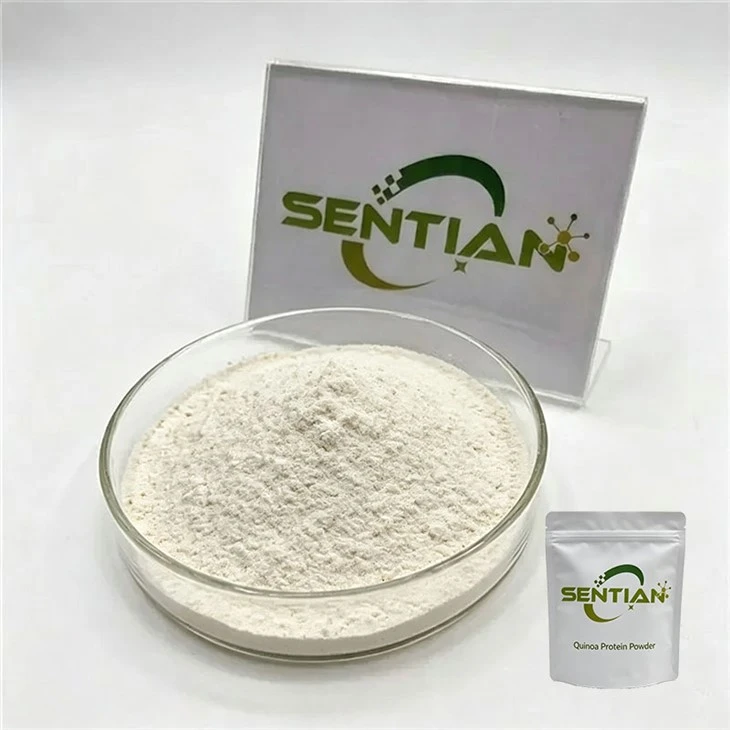
Xi'an Sentian Biotechnology Co., Ltd. is one of the leading manufacturers and suppliers of quinoa powder protein in China. We are committed to providing high quality customized service and OEM&ODM private label service for global clients. Please feel free to buy bulk quinoa powder protein in stock here from our factory. Also, free sample is available.
What is Quinoa Powder Protein?
Quinoa Powder Protein is designed specifically for use as a high-quality plant-based raw ingredient in enterprise-level sourcing and commercial product formulation for beverages, food processors, and nutritional product manufacturers around the world. This specialised ingredient is obtained by a combination of advanced aqueous and mechanical fractionation technologies on high-purity grains of Chenopodium quinoa and represents a concentrated source of macromolecules from a vegetable origin to boost industrial production. Procurement teams incorporate this pseudo-cereal derivative into a variety of commercial applications, from high-temperature extruded snack food to nutrition bars, plant-based dairy alternatives and dry-blended powder mixes, and are seeking to tap into growing markets for sustainable, plant-based nutrition. The final product is a fine, free-flowing powder with a neutral organoleptic profile which allows the product to not dominate the flavours of the foods to which it is added, and to be incorporated into complex food systems without altering the existing flavour characteristics. Its reliable techno-functional properties, such as controlled water retention, controlled oil absorption, surface-active emulsification, and dispersion stability over a neutral pH range, are used in large-scale production runs by commercial formulators to determine the optimal structural viscosity, mouthfeel, and batch consistency.

COA
| Test Parameter | Specification | Result |
| Appearance | Fine, homogeneous powder | Complies |
| Color | Cream to light beige | Light beige |
| Protein Content (Dry Basis) | ≥ 70.0% | 72.80% |
| Moisture | ≤ 8.0% | 5.20% |
| Total Ash | ≤ 8.0% | 5.70% |
| Crude Fat | ≤ 8.0% | 4.60% |
| Crude Fiber | ≤ 8.0% | 3.90% |
| pH (10% Suspension) | 6.0 – 7.5 | 6.7 |
| Bulk Density | 0.35 – 0.65 g/mL | 0.48 g/mL |
| Particle Size | ≥ 95% pass 80 mesh | 98.20% |
| Dispersibility | ≥ 90% | 94.60% |
| Water Activity (aw) | ≤ 0.60 | 0.32 |
| Solubility in Water | ≥ 70% | 78.40% |
| Saponin Content | ≤ 0.20% | 0.08% |
| Lead (Pb) | ≤ 1.0 ppm | 0.12 ppm |
| Arsenic (As) | ≤ 0.5 ppm | 0.08 ppm |
| Cadmium (Cd) | ≤ 0.5 ppm | 0.06 ppm |
| Mercury (Hg) | ≤ 0.1 ppm | <0.01 ppm |
| Pesticide Residues | Complies with applicable food-grade requirements | Complies |
| Residual Solvents | Conforms to applicable requirements | Complies |
| Total Plate Count | ≤ 10,000 CFU/g | 1,200 CFU/g |
| Yeast & Mold | ≤ 500 CFU/g | 80 CFU/g |
| Coliforms | ≤ 10 CFU/g | <10 CFU/g |
| E. coli | Absent in 10 g | Absent |
| Salmonella | Absent in 25 g | Absent |
| Staphylococcus aureus | Absent in 10 g | Absent |
Sentian Bio provides free samples, OEM/ODM customized products, and professional technical support. Contact us anytime at sales3@sentianbio.com or LEAVE A MESSAGE!
Industry Background
The industry for Quinoa Proteins as ingredients is growing increasingly fast as a result of macro-economic trends of a more resilient and climate-smart agriculture and commercial demand for high-quality plant proteins. Pseudo-cereals with reduced environmental impacts are on the rise as an input for enterprise procurement teams all over the world within the food, beverage, and nutritional formulation sector. The supply chain is traditionally rooted in Andean cultivation areas, but following the modernization of Andean farming and the development of fractionation technologies, the supply chain has now grown and advanced to an industrial scale, providing raw material to scale up the production of ingredient manufacturers, while ensuring raw material stability for high-volume processing. Refined botanical raw materials are used by food manufacturers and commercial product developers to keep up with market demand for allergen-free, clean-label, and clear transparency in their products. In addition, both regulations and companies' ESG policies are very strict, so B2B companies are required to obtain certified, traceable components that fit in with their automated production lines. This dynamic industrialization further solidifies the role in the global alternative protein value chain, ensuring its strategic and future-proof position.
Development History
From an indigenous crop that was restricted to a small region, industrialization represents a tremendous leap from a niche product to a worldwide, optimized, and high-performing protein ingredient for the food industry. Over centuries, the highland Andean farmers of the traditional farming communities have grown Chenopodium quinoa because of its remarkable ability to withstand extreme climates and grow on difficult terrain. New nutritional science and agricultural research started paying attention to the agronomic and nutritional properties of pseudo-cereals, and academic institutions and agricultural cooperatives started selective breeding and expanding the cultivation area of pseudo-cereals in various geographical regions around the world. In the early stages of commercialization, processing methods were mainly simple mechanical cleaning and whole grain milling, which produced primitive flours with limited industrial use. Fortunately, the last 20 years saw a tremendous revolution in the industry with the development of advanced technologies in industrial fractionation, enzymatic hydrolysis, and aqueous extraction that allowed for the industrial production of high-purity protein fractions. The technology revolutionized the ingredient from an artisanal specialty to a highly functional and sophisticated raw material that was trusted by food processors, beverage makers, and dietary supplement companies around the world. The development trajectory of industrial Quinoa Protein Powder is characterized today by continuous improvements in the efficiency of its production, the stabilization of its techno-functional properties, and the design of fully traceable and sustainable supply chains for enterprise-level manufacturing.

Application
1. Plant-Based Dairy Alternatives:
Quinoa Perfect Protein is used by industrial food processors who make dairy-free milk drinks, yogurts, and creamers, as well as liquid coffee creamers, as it is easily soluble, provides a neutral organoleptic profile, and helps achieve a smooth mouthfeel and emulsion stability without causing flavor interference.
2. Nutritional Snack Foods and Extruded Items:
Protein crisp bars, baked goods, and high-temperature extruded cereal products are examples of applications in which protein is integrated into snack products in order to optimize the structural properties of the product, such as moisture retention and crunch, as well as to enhance elasticity.
3. Sports Nutrition and Dry-Blended Powders:
Used by supplement makers as an ingredient in powdered shake mixes and meal replacement formulas, where it is known for its efficient dispersion in the powder and its balanced amino acid profile.
4. Meat Analogs and Plant-Based Entrees:
Used in food technology formulations of TVP and simulated meat products to enhance water-binding capacity, firmness, and bite consistency during thermal processing on a large scale.
5. Bakery and Confectionery Products:
Industrial bakers use this ingredient to add to the dough in breads, cookies, and pastry products to promote moisture in the shelf life and to provide additional protein to more popular baked goods.
FAQ
Q: What extraction methods produce industrial quinoa protein?
A: Advanced aqueous fractionation and mechanical purification of quinoa grains of Chenopodium quinoa are used to isolate high-purity protein fractions to develop commercial lines.
Q: How does the amino acid profile aid formulation?
A: It offers a balanced range of albumins and globulins, aiding developers to boost nutrition without compromising on the base taste.
Q: What are the recommended bulk storage conditions?
A: Ensure moisture-barrier containers are tightly closed for both moisture and dust resistance, and store in moisture- and temperature-controlled environments to maintain flowability and techno-functional performance.
Q: Does the ingredient withstand high-temperature processing?
A: Yes, it is thermally stable and can be used for high-temperature processes such as industrial baking and thermal extrusion without any loss of integrity.
Q: How does sourcing align with corporate ESG goals?
A: Quinoa is a low-water crop; it avoids the need for large quantities of water for irrigation, enabling enterprise brands to align with sustainable sourcing and reduce environmental impacts.
Production Process

Certificate

Exhibition
