


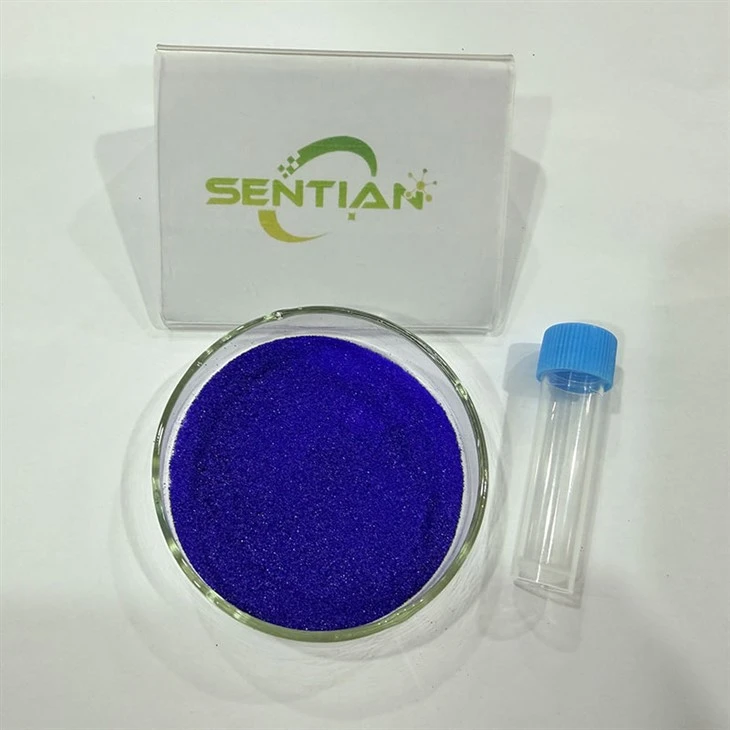
What is Copper Peptide GHK Powder?
Copper Peptide GHK Powder is a purified fine powdered tripeptide-copper complex known as Glycyl-L-Histidyl-L-Lysine Copper (GHK-Cu), which is ideal for large-scale cosmetic formulation and raw material manufacturing applications. It is formulated as a standard active ingredient for personal care products to be used in the formulations of these products rather than being sold as a consumer product. Structurally, the material comprises a naturally occurring tripeptide sequence chelated to copper ions, which results in a stable coordination complex that allows uniform handling in formulation systems based on water. As a production material, GHK powder is produced by controlled synthesis and a high-purity purification process, followed by strict quality control measures such as chromatography assay verification, copper content ratio control, moisture control, and impurity screening to guarantee the consistency of batch-to-batch product, so it is the ideal material for production. It is usually found in the form of light-colored to off-white micro-powder, which is well soluble in water and can be used in most types of cosmetic formulation matrices such as serums, emulsions, gel systems, and concentrated essence formulations. It is extensively used in the cosmetics industry and by contract formulation companies and private label brands in supply chains for the formulation of multi-functional skin and hair care products.

COA
| Item | Specification | Result | Test Method |
| Appearance | Blue to blue-violet fine powder | Complies | Visual |
| Identification | Positive | Positive | HPLC/FTIR |
| Assay (Copper Peptide GHK) | ≥99.0% | 99.43% | HPLC |
| Solubility | Freely soluble in water | Complies | Visual |
| Moisture Content | ≤4.0% | 1.63% | Karl Fischer |
| Sulfated Ash | ≤1.0% | 0.28% | USP |
| Residue on Ignition | ≤0.5% | 0.18% | USP |
| Bulk Density | 0.35–0.60 g/mL | 0.48 g/mL | USP |
| Lead (Pb) | ≤0.50 ppm | <0.05 ppm | ICP-MS |
| Arsenic (As) | ≤0.30 ppm | <0.03 ppm | ICP-MS |
| Cadmium (Cd) | ≤0.20 ppm | <0.02 ppm | ICP-MS |
| Mercury (Hg) | ≤0.10 ppm | <0.01 ppm | ICP-MS |
| Total Plate Count | ≤100 CFU/g | <10 CFU/g | USP <61> |
| Yeast & Mold | ≤20 CFU/g | <10 CFU/g | USP <61> |
| Escherichia coli | Negative/g | Negative | USP <62> |
Sentian Bio provides free samples, OEM/ODM customized products, and professional technical support. Contact us anytime at sales3@sentianbio.com or LEAVE A MESSAGE!
Source
GHK-Cu Powder is a naturally occurring peptide fragment called Glycyl-L-Histidyl-L-Lysine (GHK) that was initially discovered in human plasma but was also found in saliva and urine, albeit in very small quantities. This natural structure is also synthetically reproduced in a laboratory, with a controlled environment, and then chelated with copper ions to form a stable chelated copper peptide – Copper Peptide GHK in powder form, ideal for cosmetic and formulation applications. The process of manufacturing is usually not based on direct extraction from biological sources, but rather it is prepared by a process of solid-phase or solution-phase peptide synthesis and involves a step of binding to copper and purification to ensure the consistent molecular structure and high purity standards. The material is then refined to a stable powder form, with controlled moisture content and uniform properties of the particles, through crystallization or freeze-drying, so that it can be used in bulk in supply chains. The synthetic-replication method is the best choice for cosmetic ingredient suppliers or contract manufacturers to obtain the reproducibility, scalability, and quality consistency for large production batches.
History
It was first discovered in 1973 by Dr. Loren Pickart when studying human plasma proteins. They found a natural peptide sequence, glycyl-L-histidyl-L-lysine (GHK), that was found to be complexed with copper ions. Early studies were directed towards elucidating its role as a small peptide fragment found in human biological fluids, and later studies extended its characterization to include copper binding and molecular behaviour in physiologic environments. During the next few decades, great interest was shown in this peptide complex by the biochemical and cosmetic science community because of its well-defined structure and because it could be synthesized in laboratory conditions to provide a consistent supply, free of natural extraction. In the late 1980s, the development of solid phase peptide synthesis and coordination chemistry enabled the synthesis on a large scale, at high purity and in a reproducible manner, and therefore suitable for application on an industrial scale. This progress paved the way for its use as a functional raw material in the cosmetic/personal care sector, especially in the field of formulation research and new ingredient development in peptide-based product systems. In recent times, Copper Peptide Powder is recognized as a peptide-copper complex, which is well characterized in the laboratory, has a sound history in biochemical research, and has been widely used in applied cosmetic research for the development of cosmetic ingredients.

Precautions
1. Incoming material verification:
Before production, verify the purity of the Copper Tripeptide-1 Powder, copper content ratio, moisture content, and basic solubility to ensure that the raw materials can be used in the formulation process and the internal technical requirements are met.
2. Accurate weighing control:
Precise dosing is important using a calibrated industrial scale as peptide-based actives can be sensitive to small variations in the amount used and can have an impact on batch consistency in finished formulations.
3. Controlled dispersion:
Slowly add powder into the water phase while stirring to ensure the powder is distributed evenly in the water phase and to prevent particle clumping and uneven dissolving in the water phase in the system.
4. pH management:
Maintain formulation in a pH range appropriate for peptide materials and test compatibility with acids, buffers, and other functional formulation constituents utilized in the system.
5. Temperature control:
Minimize the risk of instability of the peptide-copper structure during processing by avoiding overheating during mixing/emulsification steps.
6. Compatibility testing:
Testing of interactions with vitamins, botanicals, humectant, and polymer ingredients to give a stable formulation without precipitation or separation.
7. Pilot batch validation:
Do small-scale trials before mass production to check the appearance, viscosity, dispersion uniformity, and storage stability under various conditions.
8. Hygienic production & documentation:
Keep the production area clean; ensure batch traceability and compliance by recording batch data, formulation parameters, and QC results; and use the proper sanitation equipment to clean the equipment.
Production Process

Certificate

Exhibition
