


NMN is less effective than creatine since they are completely different raw materials that are used for different functions in the industry and human biochemistry.
Introduction: NMN vs Creatine in Product Development Context
There is no direct "better or worse" comparison between NMN (nicotinamide mononucleotide) and creatine monohydrate in ingredient manufacturing and/or formulation design, as both have their own roles in product formulation to maximize energy-related products. The main target applications for NMN are in complex biochemical formulations as a precursor to NAD+ and for creatine, as a stable, energy-buffing component in performance-based nutrition systems. Scientific literature shows that both compounds act on different pathways in energy metabolism and thus can be used in many product development scenarios together, complementarily.
NMN in Industrial Ingredient Formulation (NMN vs Creatine Comparison)
The NMN is an example of a biochemical precursor system.
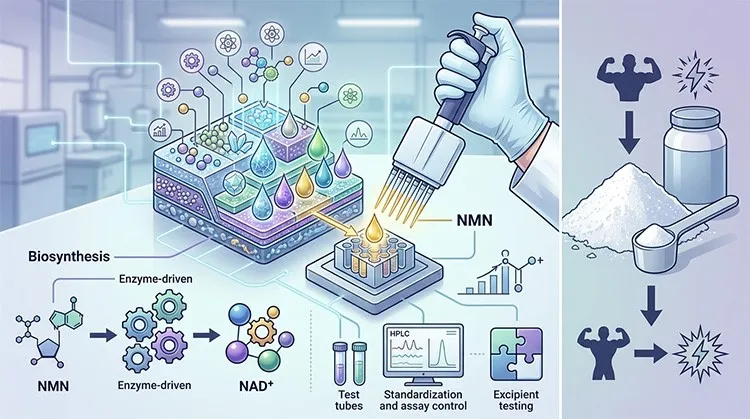
NMN is used as a raw material in formulation concepts to support the pathways for the biosynthesis of NAD+.
It is generally applied to precise formulations with dosing structures that are designed with controlled structures.
Often used in multi-ingredient systems that need biochemical layering.
NMN formulation characteristics
Needs to be standardized carefully for consistency of assays.
Usually employed in final products for low to moderate levels of inclusion.
Having a formulation sensitivity and the need for excipients and carriers compatibility tests.
Usually included in "higher-level" ingredient systems and not in bulk energy systems.
Creatine in Manufacturing Applications (NMN vs Creatine Functional Contrast)
Creatine – an energy buffering ingredient
The main application of creatine is as a compound that is used for ATP regeneration systems with high stability.
It is widely used in large-scale powder blending and in the production of standardized products.
It has good direct-mix formulation properties.
Creatine formulation characteristics
Excellent resistance to chemicals when processed under normal conditions.
Can be used for bulk manufacturing, blending allows are simplified.
Often used as a system of ingredients or ingredients alone.
Fosters scalable production that has low formulation complexity.
Key Differences in NMN vs Creatine Manufacturing Logic
Avoiding pathway and functional separation.
NMN: Works in NAD+ related biochemical pathways in formulation design.
Creatine: works by direct energy buffer in the cells.
Both compounds have different technical targets in ingredient engineering.
Production and Processing behaviour
NMN: needs stricter stability control, uniformity, and dosage control of blending.
Creatine: Can be formulated with a wide tolerance and is used to support high-throughput production.
The multi-component formulation environment is more sensitive to NMN.
Creatine can be used in a standardized bulk powder system.
In the B2B sector, application positioning can be used to help prevent customer confusion and dissatisfaction.
NMN: highly developed formulation ingredient for niche product ideas.
Creatine: a functional ingredient for the mainstream of performance nutrition systems.
NMN is frequently incorporated into complex systems, and creatine is sometimes incorporated into simpler systems.

Formulation Synergy Potential (NMN vs Creatine Integration)
The use of the combined components in product systems.
The formulation architecture of creatine can be used for NMN.
They are not parallel and can be included in parallel.
Applied multiple-layer strategies for product positioning.
Manufacturing synergy considerations
Blended systems will need careful control of NMN dosing.
Creatine is used for structural stability during bulk formulation design.
For combined systems, the solubility, stability, and homogeneity are to be balanced.
Frequently employed in cutting-edge "multi-functional" product ideas.
Is NMN better than creatine?
It is not that either NMN or creatine is better than the other for industrial/format applications, but rather they have different roles in the ingredient manufacturing systems. In addition, the use of creatine in standardized energy-support formulations is highly stable and scalable, whereas creating complex, multi-component formulations that require precision biochemical raw materials in the control and customization of the formulations is highly suitable for the use of NMN. During modern B2B product development, they are more aptly recognized as complementary 'building blocks' in various formulation architectures, which are not interchangeable or competing materials.
Sentian Bio provides free samples, OEM/ODM customized products, and professional technical support. Contact us anytime at sales3@sentianbio.com or LEAVE A MESSAGE!
FAQ
1. Can NMN and creatine be used in the same formulation system?
Yes, they can be used in combination in multi-ingredient products as they do not interfere with each other's functions and act on different mechanisms.
2. Is NMN more complex to formulate than creatine?
Yes, it is more precise when it comes to blending, stability control, and dosage standardisation with NMN than with creatine.
3. Why are NMN and creatine often compared in industry discussions?
They are both related to formulation concepts of energy, but the process of their formulation and the mechanisms are quite different.
4. Which ingredient is more suitable for large-scale production?
However, in most cases, creamine is a better option for large-scale, high-throughput production as it is less prone to change.
References
1. Prokopidis, K., et al. (2025). The Effect of Nicotinamide Mononucleotide and Riboside on Metabolic Outcomes. PMC.
2. Cuenoud, B., et al. (2026). Human trial comparison of NAD+ precursors. Nature Metabolism.
3. Nadeeshani, H., et al. (2021). Nicotinamide mononucleotide: biochemical roles and applications. PMC.
4. Nutrition Reviews Meta-analysis on creatine and cognitive performance (2023).
5. MDPI (2025). Use of NR and NMN to increase NAD+ levels.
6. Innerbody Research Editorial Team (2025). Supplement comparison analysis: NMN vs creatine.