


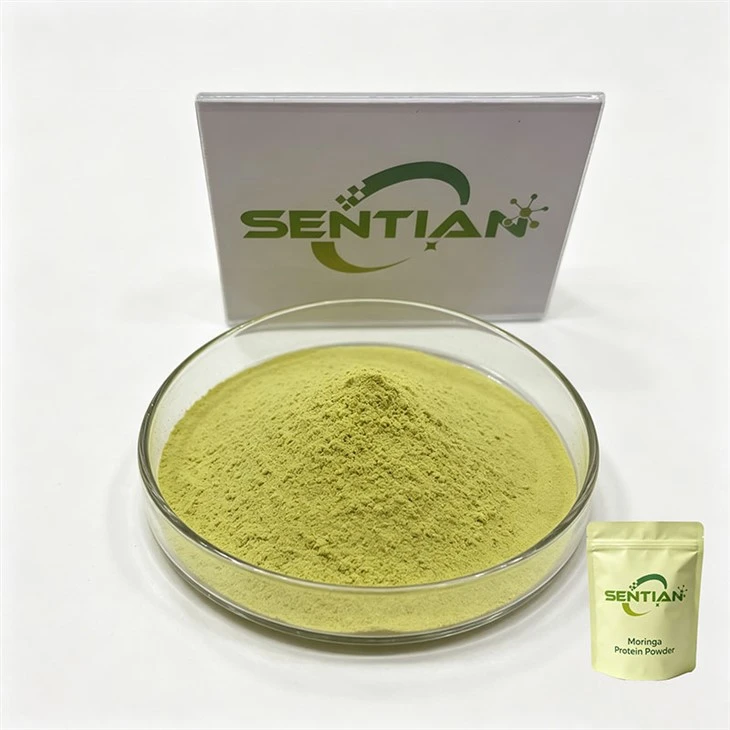
Xi'an Sentian Biotechnology Co., Ltd. is one of the leading manufacturers and suppliers of moringa protein powder in China. We are committed to providing high quality customized service and OEM&ODM private label service for global clients. Please feel free to buy bulk moringa protein powder in stock here from our factory. Also, free sample is available.
What is Moringa Protein Powder?
Moringa Protein Powder is an innovative plant-derived ingredient that is a clean-label botanical protein and functional nutrient source for commercial formulations from the nutrient-rich leaves of the Moringa oleifera tree. As a bulk ingredient, it is an ideal sustainable choice for industrial buyers as an alternative protein source in the functional food, beverage, nutraceutical, and dietary supplement industries, as it is allergen-free and sourced from plants. With growing consumer demand for healthier, plant-forward, and nutrient-dense food products, commercial food manufacturers are adding it to protein blends, meal replacement drinks, bars, and nutritional superfood powders to boost their nutritional benefits. The ingredient is highly appreciated in food production due to its predictable solubility, natural mix of amino acids, and its levels of essential minerals, dietary fibre, and plant compounds, which make it suitable for various applications, including sports nutrition and wellness products. It is processed and sourced with rigorous quality control and offers a safe and non-GMO raw material for industrial partners, helping to simplify the clean-label supply chain while meeting today's regulatory and market expectations for sustainable, plant-based innovations.

COA
| Item | Specification | Result | Test Method |
| Appearance | Fine, free-flowing powder | Complies | Visual Inspection |
| Color | Light green to green | Complies | Visual Inspection |
| Odor | Characteristic of moringa | Complies | Organoleptic |
| Protein (Dry Basis) | ≥ 50.0% | 52.80% | AOAC |
| Crude Fiber | ≤ 12.0% | 8.60% | AOAC |
| Total Carbohydrates | ≤ 35.0% | 27.40% | AOAC |
| Total Fat | ≤ 8.0% | 5.20% | AOAC |
| pH (1% Suspension) | 5.0–7.0 | 6.1 | USP |
| Water Activity (aw) | ≤ 0.60 | 0.32 | ISO 18787 |
| Bulk Density | 0.35–0.65 g/mL | 0.48 g/mL | USP |
| Particle Size | ≥ 95% pass 80 mesh | 98.20% | USP |
| Lead (Pb) | ≤ 2.0 ppm | 0.18 ppm | ICP-MS |
| Arsenic (As) | ≤ 1.0 ppm | 0.09 ppm | ICP-MS |
| Cadmium (Cd) | ≤ 0.5 ppm | 0.06 ppm | ICP-MS |
| Mercury (Hg) | ≤ 0.1 ppm | <0.01 ppm | ICP-MS |
| Salmonella | Absent / 25 g | Absent | ISO 6579 |
| Escherichia coli | Absent / 10 g | Absent | ISO 16649 |
| Yeast & Mold | ≤ 1,000 CFU/g | 120 CFU/g | USP <61> |
Sentian Bio provides free samples, OEM/ODM customized products, and professional technical support. Contact us anytime at sales3@sentianbio.com or LEAVE A MESSAGE!
Market Trends
The world of botanical ingredients and plant-based proteins like Moringa Protein is a very strong one today, with both the commercialisation of sustainable, plant-based supply chains and clean-label product architecture gaining momentum. The food and beverage manufacturing and the dietary supplement manufacturing sectors are strongly affected by macro-level trends towards environmental responsibility, agricultural circularity and transparent sourcing processes. B2B buyers and product developers are increasingly looking for raw materials that can be traced back and have minimal ecological footprint to fit the changing company sustainability agenda. At the same time, consumers are becoming more aware of the importance of healthy eating by consuming food from a natural plant source and, as a result, there is more commercial interest in natural, nutrient-rich derivatives of plants, which can provide them with the nutrients they need for everyday nutrition without the use of artificial additives. There is also a growing range of product development from formulators in all global markets, who are developing plant-based product lines and meeting the needs of flexitarians and label-conscious consumers who are looking for functional foods and/or beverages with recognizable plant-based botanical ingredients. The overall commercial environment promotes raw material manufacturers and ingredient suppliers to invest in the development of new and better processing technology that will deliver predictable powder functionality, allergen-free formulation, and an economically viable supply chain for large-scale commercial enterprise use.
Features
The protein powder of Moringa has been found to possess very specific physicochemical properties suitable for industrial formulation, such as the fine structure of its green powder with a typical bulk density of 0.40-0.55 g/mL, as well as a moisture content of less than 7.0 percent for long-term shelf stability. Its balanced emulsion properties and moderate water-holding ability provide formulators with an advantage by ensuring smooth dispersion in dry powder formulation blends, in nutritional beverages, and in extruded matrix formats, without forming unwanted phases or unwanted viscosity formation. Its nutrient content is complete with all essential amino acids and a stable macronutrient composition with significant amounts of dietary fibre and plant protein, while its excellent thermal tolerance during normal commercial pasteurization and mixing processes is a chemical characteristic. The particle size distribution it has, usually in excess of 90 percent passing through an 80-mesh screen, assures optimal mouthfeel and homogeneity in blending performance in a high-speed industrial manufacturing line. In addition, the natural green color of the Core Moringa Plant Protein provides a lasting vibrant green colour for clean label visual differentiation, and its low allergenicity and pH compatibility give R&D teams the ultimate in versatility in plant-based customised functional food and supplement formulations.

Benefits
1. Nutrient Density Enhancement:
Protein in Moringa Leaves rich and diverse source of natural macro- and micronutrients (plant protein, dietary fibre, vitamins, and minerals) to help industrial food, beverage, and supplement formulators improve the nutritional package of everyday products.
2. Clean-Label Supply Chain Integration:
Meets the increasing corporate and regulatory requirements for plant-based, non-GMO ingredient sourcing, allowing brands to directly address the label-conscious consumers who are looking for natural, non-refined options derived from plants.
3. Allergen-Free Formulation Versatility:
Offers a safe and hypoallergenic raw material alternative that is free from common allergens (soy, dairy, and gluten) and makes the end product more accessible for consumers with different dietary needs.
4. Functional Matrix Synergy:
Improves textural, structural, and visual characteristics of the final product, achieved naturally by the chlorophyll pigmentation, and with the guaranteed moisture retention, it allows for stable product development in dry mixes, nutritional bars, and baked goods.
5. Sustainable Sourcing Alignment:
Connects business product offerings to corporate environmental responsibility metrics by using a quickly renewable, botanical raw material, grown with resource-efficient agricultural methods.
6. Dietary Integration Flexibility:
Integrates easily with a variety of product categories, such as powdered drink mixes to savory product types, without affecting any standard product process parameters or existing product manufacturing procedures.
FAQ
What is the typical protein content of bulk moringa protein powder?
Typically, the protein content in the standard commercial moringa protein powder is found to be in the range of 25-35% crude protein, and this is further supplemented by naturally occurring dietary fibre, minerals, and amino acids.
Is moringa protein powder compatible with vegan and allergen-free product lines?
Yes, 100% plant-derived, non-GMO, and free from major allergens like soy, dairy, gluten, and nuts, which is perfect for clean-label dietary formulations.
How does moringa protein powder behave in industrial manufacturing and blending?
It has a narrow particle size range and excellent thermal stability and water activity, which creates good flowability and dispersion in dry products, nut bars, and beverage formulations.
What is the recommended minimum order quantity (MOQ) for bulk procurement?
Packaging is usually provided in standard 25kg fibre drums or tailor-made bulk bags in both Pilot and Commercial quantities – MOQ.
What certifications accompany this ingredient for international export?
Our moringa protein powder is produced in certified facilities that adhere to international quality standards and has complete documentation of its quality, including Certificates of Analysis (COA), ISO and non-GMO verification on request.
Production Process

Certificate

Exhibition
